
QuickBooks Advisory Services: Optimizing Your Books
Optimize your QuickBooks accounting with our advisory services to streamline finances, reduce errors, and boost business efficiency today.
Growing a business requires more than ambition-it demands a clear strategy backed by financial insight and operational discipline.
At My CPA Advisory and Accounting Partners, we’ve guided countless companies through the scaling phase, and we know that management advisory for growth works best when it addresses three critical areas: your strategic direction, your market position, and your operational efficiency.
This guide walks you through each of these pillars so you can build a sustainable expansion plan.
Most companies fail at growth not because they lack ambition, but because they confuse activity with strategy. We’ve watched businesses waste months chasing opportunities that don’t align with their financial capacity or market position. The difference between companies that scale sustainably and those that stall comes down to one thing: they define what success looks like before they pursue it.
Your business objectives must be specific, measurable, and directly connected to your financial reality. Vague goals like “increase revenue” or “expand the customer base” won’t guide your decisions when resources are tight. Instead, define targets with actual numbers. If you’re a service firm, your goal might be to hit 80% resource utilization across all staff levels-a benchmark the SPI Professional Services Benchmark Report identifies as the standard for consulting firms. If you’re in retail, your target could be to improve inventory turnover by 25% within 18 months or reduce cost of goods sold by 3 percentage points. These concrete targets force you to identify exactly what needs to change operationally and financially.
Your financial goals must directly support your growth strategy, not exist separately from it. Many businesses create a growth plan and then discover halfway through that they don’t have the capital to execute it. This happens because they skip the hard conversation about what growth actually costs.
Rapid expansion demands increased spending on staffing, inventory, technology infrastructure, and possibly new facilities. You need a cash flow forecast that shows month-by-month how much capital you’ll need and when you’ll need it. Without this visibility, you’ll either run out of cash or spend unnecessarily on debt. Businesses that add $2 million in revenue often discover they can’t afford the team needed to deliver it-a costly lesson that proper financial planning prevents.
Your roadmap for sustainable expansion should identify the sequence of initiatives, not just a list of goals. Prioritization matters enormously because resources are finite. If you launch a new product line, expand into a new market, and upgrade your financial systems all at once, you’ll likely fail at all three.
Rank initiatives by their financial impact and operational dependency. Some projects must happen before others can succeed. For example, if your invoicing system can’t handle your current volume accurately, fix that before you add new service offerings, because billing accuracy directly affects cash flow and growth sustainability. Set quarterly milestones to track progress. The discipline of reviewing actual performance against targets every 90 days forces honest conversations about what’s working and what isn’t. If you planned to hire four salespeople in Q1 but only hired two, that variance changes your revenue expectations and your cash position for the rest of the year.
Your strategic plan should include specific financial metrics tied to each phase of growth. These aren’t just profit targets-they’re the operational measures that predict whether you’ll hit those profit targets. Track metrics like gross margin by product line, customer acquisition cost relative to lifetime value, days sales outstanding for receivables, and operating expense as a percentage of revenue.
These numbers reveal whether your growth is actually profitable or if you’re simply getting bigger while becoming less efficient. Regular reviews also catch market shifts early. A competitor’s price cut or a new regulatory requirement might force you to adjust your roadmap midyear, and you need the framework to make that decision quickly. When you combine clear objectives with financial discipline and measurable milestones, your growth strategy stops being a hope and starts being a plan you can execute-one that positions you to identify the market opportunities that matter most.
Most businesses search for growth opportunities in the wrong places. They chase the market trend everyone else pursues, benchmark themselves against competitors in different positions, and ignore the operational gaps that will derail expansion before it starts. The companies that successfully scale do something different: they analyze their market position with brutal honesty, not wishful thinking.
Start by examining what’s actually happening in your market right now, not what you hope will happen. If you operate in professional services, the SPI Professional Services Benchmark Report shows that firms scaling sustainably maintain specific gross margin targets by service line and track customer acquisition cost relative to lifetime value. This means you need to know exactly which services remain profitable at scale and which ones drain resources.
Pull your financial data for the past 18 months and segment revenue by product, service, customer type, or geography. Calculate the gross margin for each segment. You’ll likely find that 20% of your offerings generate 80% of your profit. That’s your growth foundation. The segments losing money or barely breaking even aren’t growth opportunities-they’re distractions that consume management attention and capital.
Next, evaluate what your competitors do differently, but focus on what they execute operationally, not just what they sell. Visit their websites, read their client reviews, call their sales team, and ask their clients what they do well. The gap you’re looking for isn’t in their marketing message-it’s in their execution. Can they deliver faster? Do they have better technology? Do they serve a niche your competitors ignore?
One business discovered their competitors were all fighting over the same customer segment, but none of them had adapted their service delivery to handle remote clients. That became their competitive advantage through operational execution. The operational difference often matters more than the product difference.
Your internal assessment matters more than external market analysis. Most companies spend weeks studying competitors and days understanding themselves. That’s backward. Map your company’s actual strengths honestly. What do your best salespeople do that others don’t? What processes run smoothly while others constantly break? Where do you consistently beat your competitors? Where do you consistently lose deals?
Ask your sales team directly: what objections do we hear most often, and what would it take to eliminate them? Then assess your weaknesses with the same rigor. If your invoicing system can’t handle transaction volume, that’s a weakness that will destroy your growth margins. If your team lacks expertise in a service area customers want, that’s a gap you need to fill before scaling.
The companies that position themselves for competitive advantage don’t try to compete on everything-they double down on what they do better than anyone else and systematically eliminate the operational obstacles that prevent them from delivering it. Position your business by connecting what you do well to what the market actually values.
If you have expertise serving business owners in a specific industry, that’s more powerful than trying to serve all business owners. If you have a process that delivers results 30% faster than competitors, make that your positioning pillar. If you have deeper relationships with a particular customer type, build your growth plan around expanding within that segment (rather than chasing new segments where you lack credibility).
The market opportunity that matters most is the one where your strengths meet genuine customer demand and where you can build defensible operational advantages that competitors can’t easily copy. Once you’ve identified this positioning, the next step involves translating it into the operational and financial systems that actually support scaling.
Scaling a business exposes every operational weakness you’ve been ignoring. The invoicing system that worked fine when you had 10 clients fails when you have 100. The spreadsheet-based inventory tracking that took an hour per week now consumes a full day. The accounting process that your bookkeeper managed alone requires two people, and mistakes increase anyway. We’ve seen this pattern repeatedly: companies invest heavily in sales and marketing to drive growth, then watch their margins collapse because their operational systems can’t keep pace. The real constraint on growth isn’t usually market opportunity-it’s operational capacity. You need to fix the systems before they become the bottleneck that stops your expansion.
Most businesses don’t know what their inefficiencies cost because they’ve never measured them. Start by mapping how long your core processes actually take. If you’re in professional services, track how much time your team spends on non-billable work: data entry, status updates, email coordination, invoice corrections, timesheet reconciliation. Average billable utilization fell to 66.4% in 2025, the lowest in SPI Research history, while firms targeting higher utilization lose that margin to manual administrative work. If one consultant spends five hours per week on administrative tasks that could be automated, that’s roughly 260 billable hours per year you’re leaving on the table. For a consultant billing at $150 per hour, that’s $39,000 in lost revenue annually from a single person. Multiply that across your team and the financial damage becomes obvious.
Identify the processes that consume the most time but create no direct client value, then eliminate them. Your goal isn’t to work harder-it’s to remove the friction that prevents your team from doing billable work. If your invoicing system requires manual data entry from timesheets, automate that connection. If your expense reporting requires email approval chains, implement a system that routes approvals automatically. If your client onboarding requires repetitive data collection, create a digital intake form that populates your CRM directly.
Your financial systems must accomplish three things as you scale: capture accurate data in real time, prevent cash flow surprises, and provide visibility into profitability by client, project, or service line. Most growing businesses operate with a 30 to 60-day lag between when transactions occur and when they understand their financial position. That delay is dangerous. If you’re losing money on a particular client or service, you might not discover it until you’ve already lost thousands.
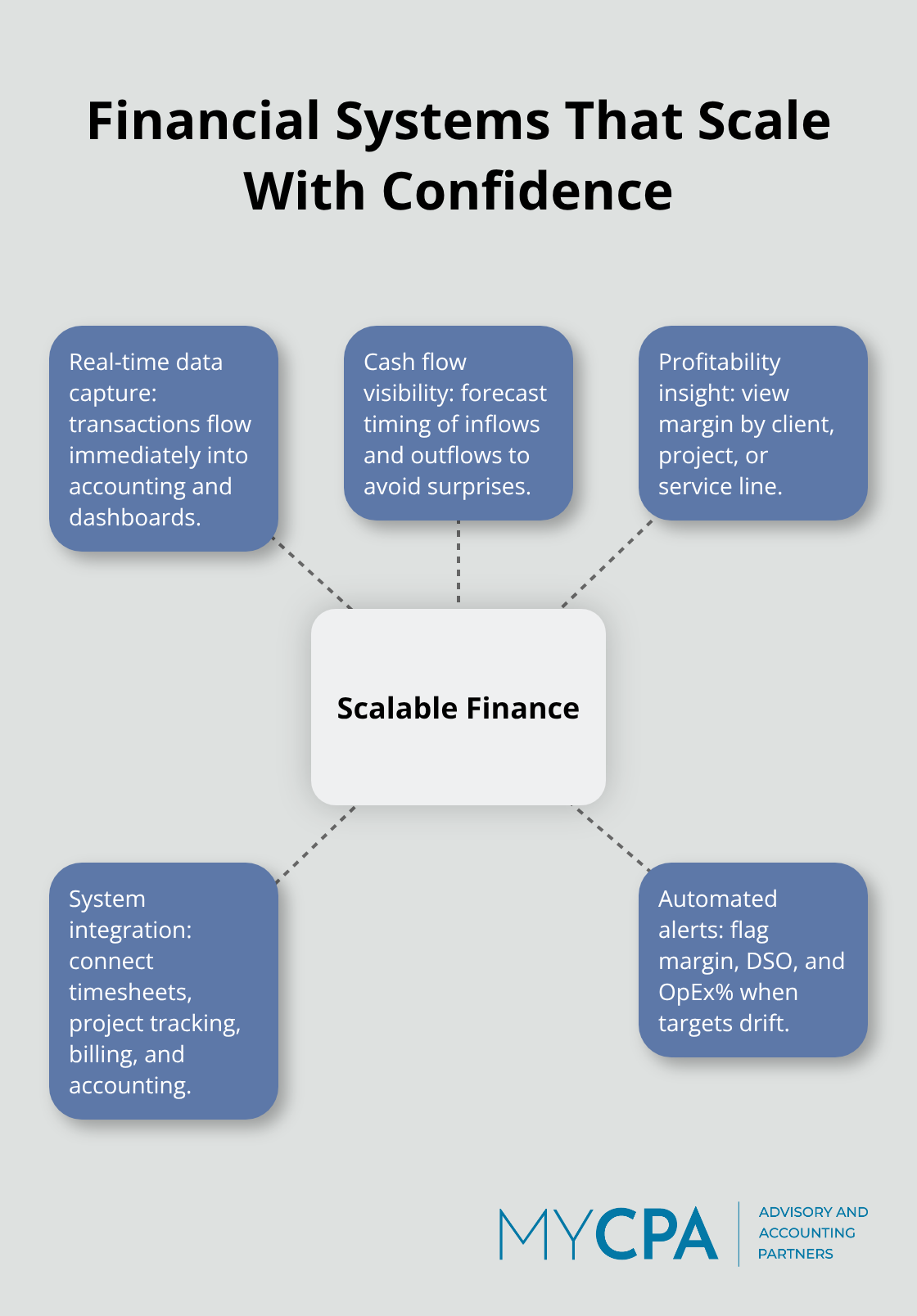
Implement a system that integrates your timesheets, project tracking, and accounting in real time. When a consultant logs hours to a project, that data flows automatically to your accounting system and your project profitability dashboard. When an invoice gets paid, that updates your cash position immediately. This integration eliminates manual data entry, reduces errors, and provides the visibility you need to make growth decisions confidently.
Your financial system should also enforce discipline around pricing and cost management. If you’re delivering a service below cost because your pricing model hasn’t been updated, your system should highlight that. If a project consumes more resources than budgeted, you should know it within days, not months. Set up automated alerts for key metrics: gross margin by service line, days sales outstanding for receivables, operating expense as a percentage of revenue. When these metrics drift outside your target range, something has changed and needs attention.
Technology should automate the work that doesn’t require human judgment and free your team to focus on client work and strategic decisions. The worst technology implementation is one that adds complexity without reducing manual effort. Before you invest in new software, ask a hard question: does this system eliminate manual work, or does it just create a different kind of manual work?
A time-tracking system that requires your team to categorize every 15-minute increment isn’t helping you scale-it’s creating busywork that frustrates your best people. A good system captures time automatically or requires minimal input and integrates with your billing and accounting systems without human intervention. If you’re a service firm, your technology stack should include project management that tracks resource allocation, time and billing that integrates with accounting, and financial reporting that shows real-time profitability. If you’re in retail or distribution, your technology should track inventory, connect to your point of sale system, and alert you when stock levels reach reorder points.
The specific tools matter less than the integration. A $50-per-month tool that integrates seamlessly with your existing systems is more valuable than a $500-per-month tool that requires manual data transfer. Prioritize integration over feature count. As you scale, your operational efficiency depends on systems talking to each other without human translation.
Scaling a business successfully requires three things working together: a clear strategic direction, honest market positioning, and operational systems that actually support growth. The companies that scale sustainably don’t do anything magical-they define specific financial targets instead of vague ambitions, analyze what actually makes them profitable rather than chasing every market trend, and fix their operational bottlenecks before those bottlenecks become the reason growth stops. Management advisory for growth works because it forces you to address all three areas simultaneously instead of hoping one strong area compensates for weaknesses elsewhere.
Your next step isn’t to implement everything at once. Start with the area causing you the most friction right now-if your financial visibility is poor, fix that first because you can’t make good growth decisions without accurate data; if your processes consume resources that should be billable, automate those processes next; if your market positioning is unclear, clarify that before you invest heavily in sales and marketing. The discipline of quarterly milestones matters more than perfect planning, and you’ll adjust your roadmap when reality differs from your plan.
At My CPA Advisory and Accounting Partners, we work with business owners who are serious about scaling. We help you build the financial systems, accounting practices, and strategic plans that support confident growth through our business advisory services. Growth becomes achievable when strategy, market position, and operations align.








Privacy Policy | Terms & Conditions | Powered by Cajabra