
Mastering Sales Funnel Optimization for Higher Conversions
Boost your sales funnel optimization with proven strategies to increase conversions and revenue growth effectively.
Scaling a startup requires more than ambition-it demands a clear strategy grounded in financial reality. Most founders focus on growth without understanding their current position, market dynamics, or financial capacity to support expansion.
We at My CPA Advisory and Accounting Partners have seen countless startups stumble because they skipped the planning phase. This guide walks you through growth planning for startups, covering everything from assessing your business model to managing cash flow as you scale.
Your financial health determines how far you can actually grow. Most startups operate on assumptions rather than data, which creates serious problems when scaling. Pull your actual numbers: revenue, expenses, burn rate, cash runway, and gross margin. If you’re running on spreadsheets without proper accounting, get your books organized first. Accurate financial statements show whether your business model works at all, let alone whether it can support growth.
Look at your unit economics specifically-how much does each customer cost you to acquire, and how much profit does each customer generate over their lifetime? If your customer acquisition cost exceeds your customer lifetime value, scaling will drain cash faster. Many founders discover their margins are far thinner than they believed once they map costs properly.
Calculate your monthly burn rate by subtracting total revenue from total expenses. If you’re burning $50,000 monthly with $200,000 in the bank, you have four months of runway-that’s your hard deadline for reaching profitability or securing funding.
Your competitive position matters as much as your financials. Research your direct competitors thoroughly: their pricing, customer acquisition methods, retention rates, and market share. Customer reviews on platforms like G2 or Capterra reveal gaps in competitor offerings that you can exploit.
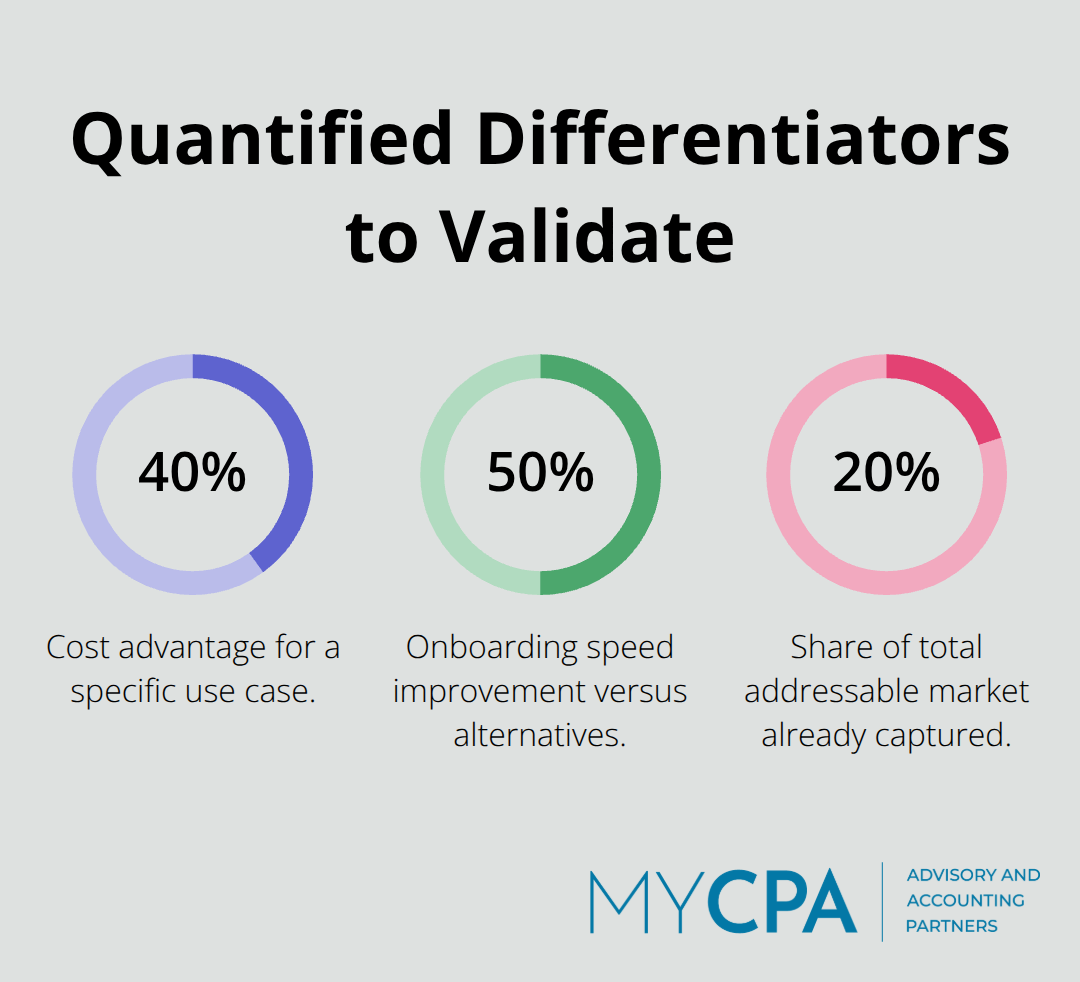
Your unique value proposition must answer one question clearly-why should customers choose you over established alternatives? Generic answers like better service or innovation mean nothing. Be specific: Are you 40% cheaper for a specific use case? Do you serve a customer segment competitors ignore? Is your onboarding 50% faster? Vague positioning wastes marketing budget and confuses customers.
Once you’ve identified what makes you genuinely different, test whether the market actually wants it. Talk to 20-30 potential customers outside your current base and ask directly if they’d switch to your solution. Their honest feedback beats internal opinions every time. Market demand isn’t assumed-it’s validated through conversations and early sales data.
If you can’t generate interest from cold outreach, scaling will be expensive and slow. Understand your addressable market size too. How many potential customers exist for your solution? If your total addressable market is only $10 million annually and you’re already capturing 20% of it, growth will plateau quickly regardless of execution.
With your financial position clear, competitive advantages defined, and market demand validated, you’re ready to build the infrastructure that actually supports growth. The systems and team you establish now determine whether you can handle 10x customer volume without collapsing.
Scaling fails when founders treat growth as a revenue problem instead of an operational one. You need systems that handle 10x volume without requiring 10x headcount. Start by documenting exactly how your business operates right now-every customer interaction, every transaction, every decision point. Most startups run on tribal knowledge, meaning everything lives in someone’s head. Write down your onboarding process, billing workflow, customer support procedures, and product delivery steps. This isn’t busywork; it’s the foundation for delegation.
Once processes exist on paper, you can identify bottlenecks, automate repetitive tasks, and train new hires without constant founder involvement. Companies with documented processes experience improved margins compared to those without them. Your accounting and financial processes need this treatment especially. If your bookkeeper manually enters every transaction, you’re wasting money and creating accuracy problems.
Implement automation through accounting software that connects your payment processors, invoicing system, and bank accounts directly. This eliminates manual data entry and reduces errors significantly. Accounting software like QuickBooks or Xero costs $30–150 monthly but saves 10–15 hours weekly in manual bookkeeping. Establish these systems before you hire aggressively, because bad processes multiply as you scale.
Hiring the wrong people is expensive, but hiring the right people into chaos is worse. You need strategic additions who can wear multiple hats early, not generalists who expect infrastructure to already exist. Your first hires should be people who can build processes, not just execute them. Look for candidates with startup experience who’ve scaled before-they understand that documentation and systems matter more than perfect job descriptions.
Offer equity to early team members to align incentives and stretch limited cash. Develop leadership capacity intentionally by giving high performers increasing responsibility before you desperately need them to step up. If your lead developer is your only technical person, you’re one resignation away from crisis. Invest in your team’s growth through training and mentorship so they can lead others.
Technology and tools multiply what your team accomplishes without proportional cost increases. Project management tools like Asana or Monday.com cost $10–25 per person monthly and prevent communication breakdowns that tank efficiency. Customer relationship management systems like HubSpot track customer interactions and automate follow-ups so nothing falls through cracks. The key is choosing tools that integrate with each other-don’t build a stack of disconnected systems that create more work.
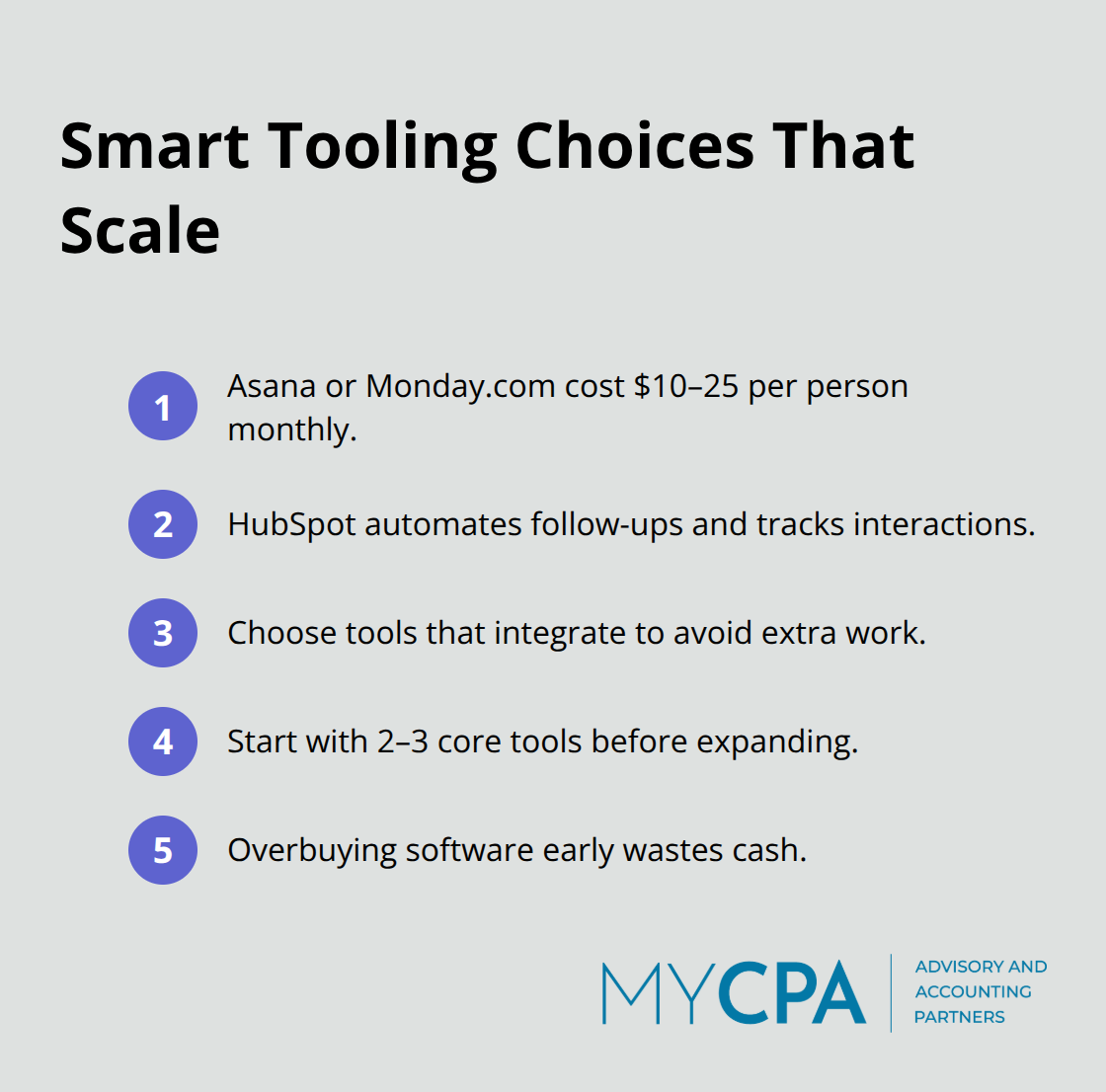
Start with 2–3 core tools that handle your biggest pain points, then expand as you scale. Overbuying software early wastes cash you need for actual growth. Your infrastructure investments should directly support your unit economics and margin expansion. Every dollar spent on systems should reduce your cost per customer or increase customer lifetime value measurably. With your operations documented, your team hired, and your tools in place, you’re ready to address the financial side of scaling-determining how much capital you actually need and managing it wisely.
Determining your funding requirements starts with brutal honesty about your burn rate and runway. Most founders either overestimate how much capital they need or underestimate it drastically, both of which damage growth. Calculate your monthly cash burn by taking your total monthly expenses and subtracting revenue. If you spend $75,000 monthly and generate $25,000 in revenue, your burn is $50,000. Next, project how many months until you reach cash flow breakeven or profitability. If breakeven happens in 18 months and you need $900,000 to survive until then, that’s your minimum capital requirement. Add a 20-30% buffer for unexpected expenses because startups always encounter surprises. This means your actual funding target is roughly $1.08 million to $1.17 million, not the $900,000 you calculated. Many founders skip this buffer and run out of cash six months before profitability, forcing desperate decisions like layoffs or unfavorable funding rounds.
Your funding options depend on your stage and growth trajectory. Bootstrapping works if your business generates positive cash flow within months, but most startups burning cash cannot bootstrap. Friends and family funding typically ranges from $25,000 to $500,000 and works when you have personal connections willing to take risk. Seed funding from venture capital firms averages $500,000 to $2 million according to recent PitchBook data, though this varies significantly by industry and location. Revenue-based financing has grown substantially as an alternative, allowing you to borrow against future revenue without diluting equity, with monthly repayments typically ranging from 3-8% of your monthly revenue until you repay the principal plus a fixed return.
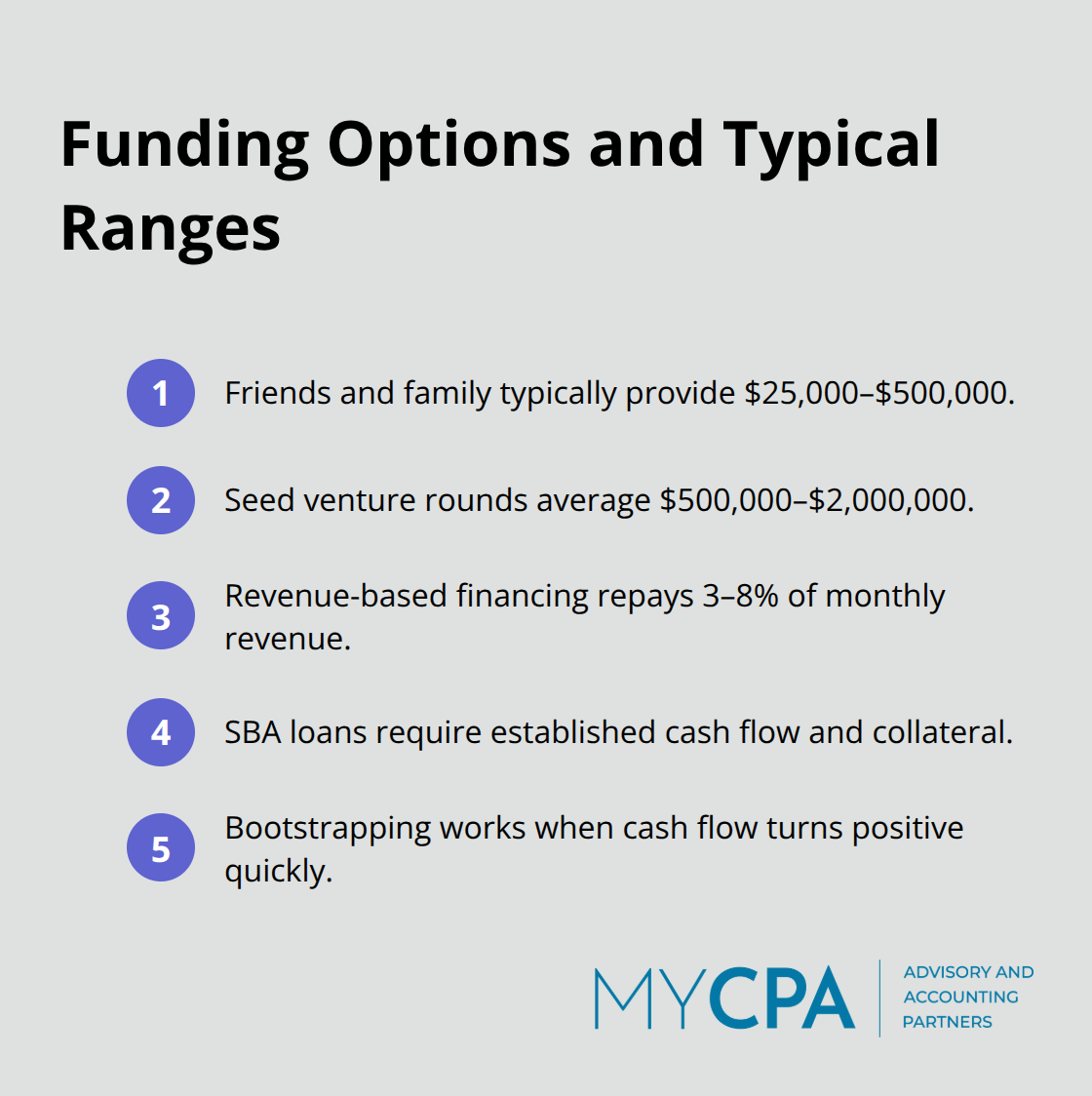
Small Business Administration loans require established cash flow and collateral, making them difficult for early-stage startups. The worst mistake is raising money you don’t need or pursuing funding sources misaligned with your business model. A SaaS startup burning $30,000 monthly and growing 15% month-over-month needs different funding than an e-commerce business with unpredictable cash conversion cycles.
Financial projections guide funding decisions and reveal whether your growth plan actually works financially. Build a 36-month projection showing monthly revenue, expenses, and cash balance. Your revenue projections must connect to specific customer acquisition numbers, not vague growth percentages. If you acquire customers at $1,200 cost, retain 85% monthly, and generate $150 monthly revenue per customer, project exactly how many customers you’ll have each month and calculate resulting revenue. This forces you to validate your unit economics actually support scaling. Most projections fail because they assume revenue growth without accounting for rising customer acquisition costs or competitive pressure. Your expense projections should include salaries, software, marketing, infrastructure, and overhead. Account for salary increases as you hire more experienced people and for cost inflation on tools and services. Many founders forget that customer support costs rise with customer volume, or that payment processing fees increase with transaction volume. These details separate realistic projections from fantasy spreadsheets.
Cash flow forecasts matter more than revenue projections because cash is what keeps your business alive. You can be profitable on paper while running out of cash if customer payments arrive slowly. Map out when you actually receive money from customers versus when you pay expenses. If you invoice customers monthly but they pay in 45 days, your cash arrives late. If you pay payroll bi-weekly but revenue comes monthly, you’ll face cash gaps. Many startups that appear financially healthy actually face cash crunches because of payment timing mismatches. Use your cash flow forecast to identify which months require additional capital or where you might have excess cash to invest in growth. This level of detail prevents the common founder mistake of running out of cash unexpectedly.
Once you secure funding, burn rate management determines whether you make it to profitability or growth inflection. Calculate your monthly burn rate weekly, not monthly, so you catch problems early. If your projected monthly burn is $50,000 but you’re actually burning $65,000 by week three, you have time to adjust before the full month closes. Track your cash runway obsessively, updating it every week as you spend money and generate revenue. If you have $500,000 in the bank and burn $60,000 monthly, you have roughly 8.3 months of runway. This calculation should feel uncomfortable because it should create urgency around reaching profitability or securing additional funding.
The key metrics that matter for funded startups are customer acquisition cost, customer lifetime value, monthly recurring revenue growth rate, and cash burn. Your customer acquisition cost divided by customer lifetime value should exceed 3:1 for sustainable growth. If acquiring a customer costs $2,000 but they generate $5,000 lifetime value, that’s reasonable. If acquisition costs $3,000 but lifetime value is only $4,000, your margins are too thin for scaling. Monthly recurring revenue growth rate should exceed your monthly burn rate as a percentage of total capital. If you’re burning 5% of your capital monthly but growing revenue 8% monthly, you’re moving toward sustainability. If revenue grows 2% monthly while you burn 5% monthly, you’re on a collision course with cash depletion. The difference between founders who scale successfully and those who crash is their discipline around these numbers. Vague awareness of burn rate and runway is not enough when capital is finite and markets are competitive.
Growth planning for startups demands that you execute three core strategies consistently. First, ground your growth in financial reality by understanding your burn rate, runway, and unit economics before scaling aggressively. Second, build operational systems and hire strategically so your team handles growth without constant founder involvement. Third, secure appropriate funding aligned with your business model and monitor key metrics weekly to stay on track toward profitability.
The obstacles that derail most startups are predictable and avoidable. Founders scale revenue without scaling operations, creating chaos that destroys margins and customer satisfaction. They raise capital without calculating true requirements, then run out of money before reaching profitability. They hire generalists into undefined roles instead of strategic talent who can build processes, and they ignore cash flow timing while focusing only on revenue projections.
The financial complexity of scaling demands expertise beyond founder knowledge. We at My CPA Advisory and Accounting Partners help business owners build the accounting systems and financial discipline required for sustainable growth. Our accounting services, QuickBooks setup, and business advisory work strengthen your financial foundation so it supports your growth ambitions rather than constrains them. Contact My CPA Advisory and Accounting Partners to discuss how we can strengthen your financial management as you scale.








Privacy Policy | Terms & Conditions | Powered by Cajabra