
Tax Reduction Strategies for Smart Tax Planning
Discover tax reduction strategies that lower your bill legally. Learn deductions, credits, and planning tactics from our CPA experts.
Most business owners leave thousands of dollars on the table each year by missing deductions they’re entitled to claim. At My CPA Advisory and Accounting Partners, we’ve seen firsthand how strategic tax reduction strategies can transform your bottom line.
The good news is that you don’t need complex schemes or risky moves to cut your tax bill significantly. This guide walks you through proven approaches that work.
Most business owners miss thousands in legitimate deductions because they don’t track expenses properly or assume certain costs aren’t deductible. Home office expenses, vehicle mileage, professional development, and ordinary business expenses get overlooked regularly. The IRS allows deductions for any ordinary and necessary business expense, but you need documentation to back it up. Clients often underestimate what they can claim.
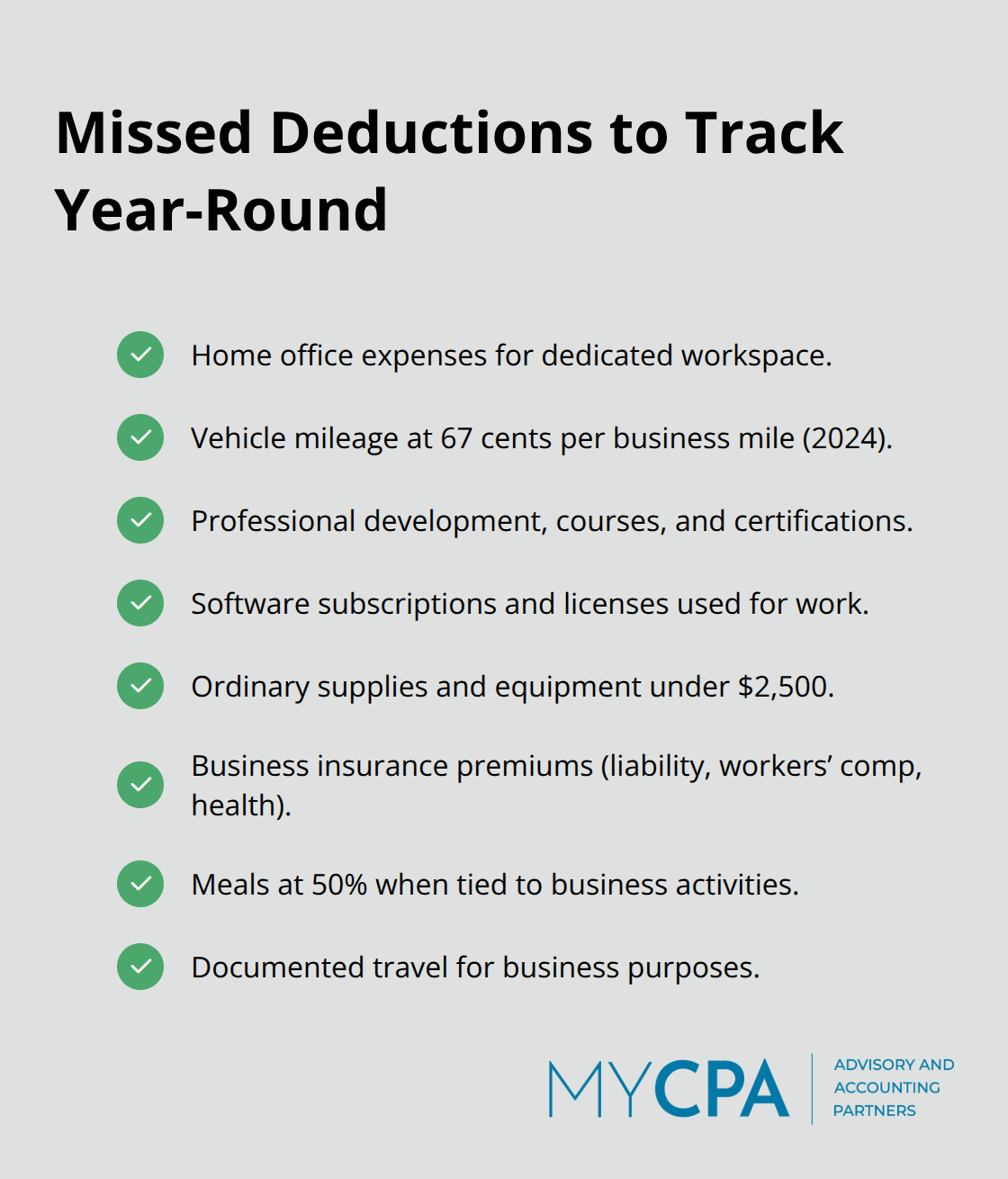
For instance, if you work from home, you can deduct either 5 dollars per square foot of dedicated office space or use the simplified method. Vehicle mileage for business purposes is deductible at 67 cents per mile in 2024, according to IRS rates. Many owners fail to track this consistently, missing out on hundreds or thousands annually. Professional development costs including courses, conferences, and certifications directly related to your business are fully deductible. Subscriptions to industry publications, software licenses, and continuing education requirements also qualify. The problem isn’t that these deductions don’t exist-it’s that business owners don’t maintain organized records throughout the year.
Most owners overlook ordinary business expenses that the IRS clearly allows. Office supplies, equipment under $2,500, software subscriptions, and professional fees all qualify. Insurance premiums for business liability, workers’ compensation, and health coverage count as deductible expenses. Meals and entertainment tied to business activities (subject to 50% deduction limits) represent another commonly missed category. Travel expenses for business purposes-including airfare, hotels, and ground transportation-are fully deductible when you document the business purpose. The key is separating what’s truly business-related from personal spending. Many owners hesitate to claim legitimate expenses because they worry about audit risk, but the IRS expects you to claim what you’re entitled to claim.
If you work from home, measure your dedicated office space and calculate the deduction using either method available. The regular method allows 5 dollars per square foot, while the simplified method permits 300 dollars per month for a dedicated office. For vehicles, the IRS sets the mileage rate annually-67 cents per mile in 2024. You must track the date, destination, business purpose, and miles driven for each trip. Apps automate this process, eliminating the need for manual logs. Personal commuting doesn’t count, but trips between job sites, client meetings, and business errands all qualify. The difference between organized mileage records and rough estimates often determines whether you claim the full deduction or lose it entirely.
Professional development expenses need receipts and proof they relate directly to your current business. Courses, conferences, certifications, and industry publications all qualify when they maintain or improve skills you use in your work. Continuing education requirements for licenses and credentials are fully deductible. Software subscriptions that support your professional work count as well. The IRS doesn’t allow deductions for education that qualifies you for a new profession, but it does allow deductions for improving your existing skills. Store all receipts digitally through a service or photograph them and organize by category. The difference between organized records and scattered receipts often means the difference between claiming a deduction and losing it in an audit.
Start a system immediately to capture every business expense. Use accounting software like QuickBooks to categorize expenses as they occur rather than scrambling during tax season. Separate personal and business accounts completely. Don’t assume an expense is personal just because it has dual use-the IRS allows deductions for legitimate business portions of mixed-use items. Apps like MileIQ automate vehicle tracking, while Expensify handles receipt management. The organized approach you establish today directly impacts your tax savings next year. With proper documentation in place, you’re ready to explore how strategic timing of income and expenses can further reduce your tax liability.
Strategic timing of income and expenses can reduce your tax bill more than most business owners realize. Many owners treat tax planning as something that happens in January or March, missing the real opportunity. Strategic timing works best when you plan it throughout the year, especially in the final quarter.
If you’re in a high-income year, bunching deductions means accelerating expenses into that year rather than spreading them across two years. For example, if your income spikes in 2026 compared to 2027, paying professional fees, equipment purchases, or software subscriptions in December 2026 instead of January 2027 moves those deductions to the higher-income year where they provide more tax relief. The math is straightforward: a $10,000 deduction saves you $2,100 in federal taxes at the 21% corporate rate, but if you’re in a higher personal income bracket, it saves even more.
The practical challenge is knowing your income trajectory early enough to act. Most owners wait until October or November to assess their year, leaving limited time for meaningful adjustments. Run projected numbers by August so you have four months to implement timing strategies. If you use accounting software, you already have real-time income and expense data, so pull a profit-and-loss statement quarterly rather than waiting for year-end.
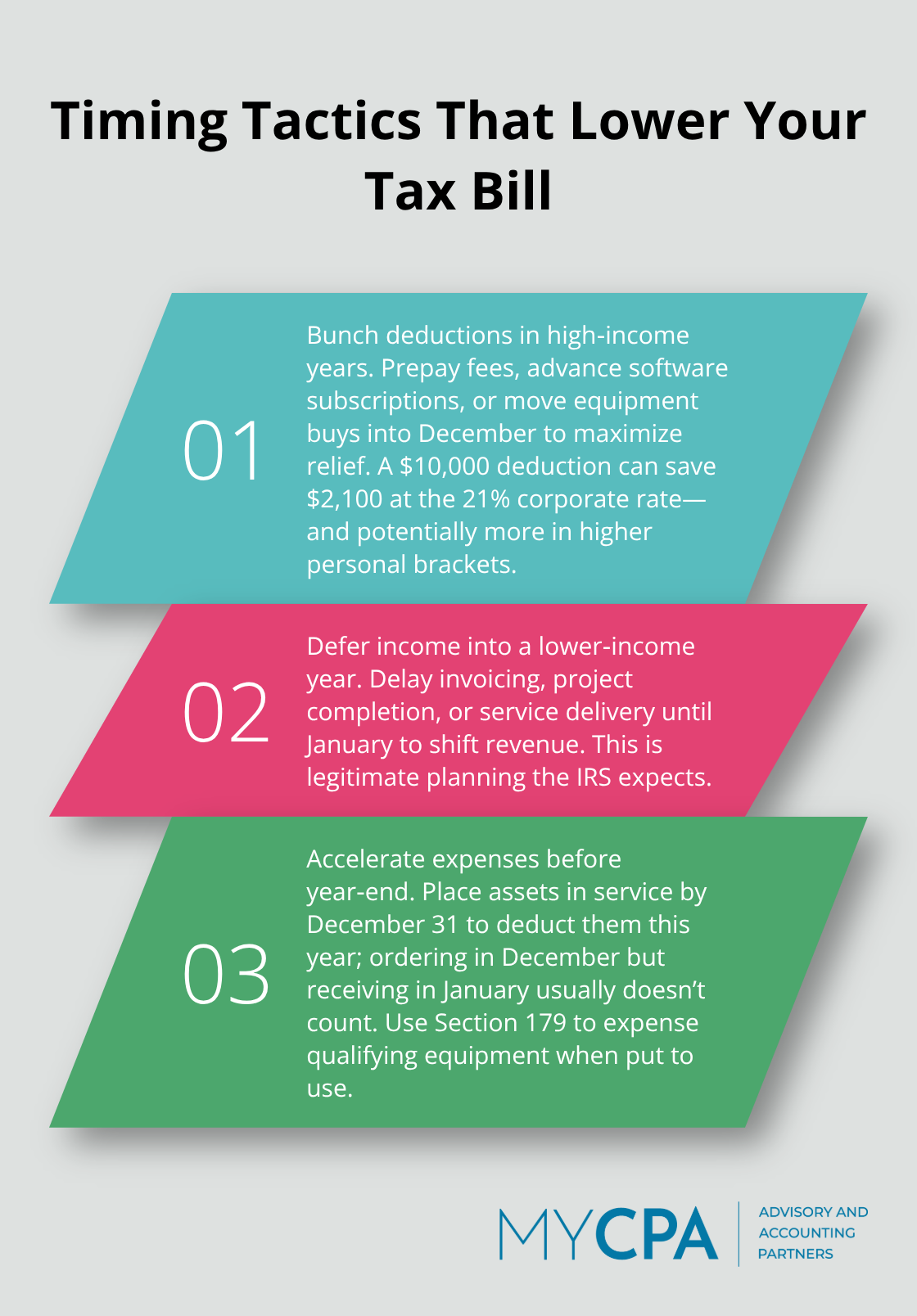
Conversely, if you know 2027 will be a lower-income year, deferring income becomes valuable. If you’re self-employed or a business owner expecting slower months ahead, postpone client invoicing, project completion, or service delivery until January to shift that revenue to a lower-income year. This isn’t tax evasion-it’s legitimate tax planning the IRS expects savvy owners to use.
Accelerating expenses before December 31st is the most common timing move, but it only works if you actually incur the expense in that tax year. The IRS looks at when you place the order and when it’s placed in service, not when you receive it. Ordering equipment in December but receiving it in January doesn’t count.
For equipment purchases, the IRS allows immediate deductions up to $2.5 million through Section 179 expensing, meaning a new computer, furniture, or machinery becomes fully deductible in the year you buy and use it. This makes December an ideal time to evaluate whether capital purchases you’d planned for next year could move up.
Health savings accounts offer another timing advantage: you can contribute up to $4,150 for individual coverage in 2024, and contributions made by April 15th of the following year still count for the prior tax year. If you’re self-employed, a Solo 401(k) allows contributions up to $69,000 in 2024, with employer contributions deductible as long as you establish the plan by December 31st and make contributions by the tax filing deadline.
The key difference between owners who reduce their taxes significantly and those who don’t often comes down to whether they act proactively about timing or reactively. Your tax bill next April is largely determined by decisions you make between now and December 31st. With your timing strategy in place, tax-advantaged accounts and retirement plans offer additional opportunities to shelter income and accelerate deductions even further.
A Solo 401(k) stands as the single most powerful tax tool most business owners ignore entirely. If you’re self-employed or own a small business, you can contribute up to $69,000 in 2024, with the employer portion fully deductible on your business tax return. The contribution deadline extends to your tax filing date, typically April 15th of the following year, so you have until mid-April 2025 to fund a 2024 Solo 401(k). Most owners mistakenly believe December 31st marks the deadline and miss this extended window entirely.
A SEP-IRA offers similar benefits with a $69,000 contribution limit in 2024, but the contribution must arrive by your tax filing deadline including extensions. The real difference between the two comes down to loan availability: Solo 401(k)s allow loans against your balance, while SEP-IRAs don’t. If you might need access to retirement funds for business purposes, the Solo 401(k) structure proves superior.
Health Savings Accounts paired with a high-deductible health plan create what we call triple tax benefits: contributions reduce your taxable income, growth happens tax-free, and qualified withdrawals for medical expenses avoid taxation entirely. You can contribute $4,150 for individual coverage or $8,300 for family coverage in 2024, with contributions accepted through April 15th of the following year. This means you can still fund a 2024 HSA through mid-April 2025.
The catch most owners miss is that HSA funds never expire, making them superior to Flexible Spending Accounts that operate on use-it-or-lose-it rules. After age 65, you can withdraw HSA funds for any reason without penalty, though non-medical withdrawals become taxable income. An HSA balance built over decades creates a tax-free medical fund that compounds without annual resets.
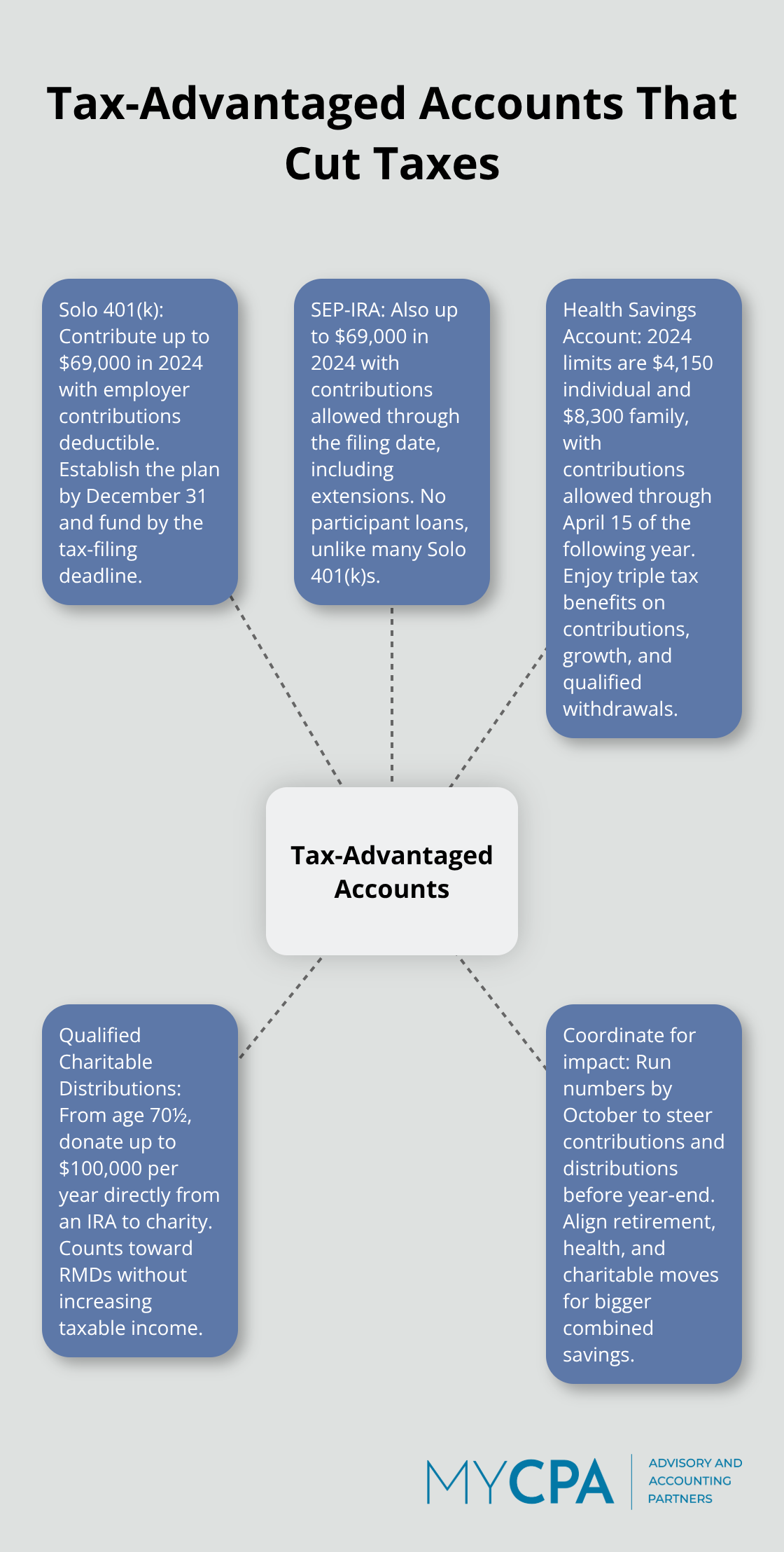
Qualified Charitable Distributions offer a lesser-known strategy for owners age 70 and a half or older with substantial IRAs. You can transfer up to $100,000 annually directly from your IRA to qualified charities, and those distributions count toward your required minimum distributions without increasing your taxable income. This works because the distribution bypasses your income calculation entirely.
If you’re charitably inclined and over 70, this approach saves far more than taking the standard deduction and donating to charity separately. A $50,000 charitable distribution at the 24% federal tax bracket saves $12,000 in federal taxes compared to taking a standard deduction and donating the same amount. Most owners age 70 and a half or older take required minimum distributions they don’t need, pushing themselves into higher tax brackets unnecessarily. Qualified Charitable Distributions eliminate this problem entirely.
Run calculations by October each year so you have time to direct distributions before December 31st. Coordination between your Solo 401(k) contributions, HSA funding, and Qualified Charitable Distributions creates a comprehensive tax reduction strategy that works across your entire financial picture rather than addressing individual accounts in isolation. This integrated approach (combining retirement savings, health account optimization, and charitable giving) produces far greater tax savings than handling each account separately.
The tax reduction strategies outlined in this guide represent real opportunities to lower your tax bill this year. Missing deductions costs thousands annually, strategic timing of income and expenses compounds those savings, and tax-advantaged accounts create additional shelter that most owners never fully utilize. The difference between owners who reduce their taxes significantly and those who don’t typically comes down to action, not luck.
Implementing these strategies requires more than reading about them. You need organized systems to track deductions, projected income numbers by August to plan timing moves, and clear deadlines for retirement and health account contributions. Most owners attempt this alone and miss critical opportunities because they lack visibility into their full financial picture until tax season arrives.
We at My CPA Advisory and Accounting Partners work with business owners throughout the year to identify deductions you’re missing, coordinate timing strategies that actually work, and maximize retirement and health account contributions before deadlines pass. Contact us for a tax planning consultation before the end of this quarter, and we’ll review your numbers, identify specific opportunities for your business, and create a concrete action plan with deadlines and dollar amounts.








Privacy Policy | Terms & Conditions | Powered by Cajabra