
Accounting Accuracy Improvements: Techniques That Endure
Boost accounting accuracy improvements with proven techniques that reduce errors, save time, and strengthen financial controls for your business.
Accounting errors cost businesses time and money. At My CPA Advisory and Accounting Partners, we’ve seen firsthand how accounting accuracy improvements transform financial operations and prevent costly mistakes.
The good news is that accuracy isn’t complicated. It comes down to proven practices, the right technology, and knowing which mistakes to watch for.
Separating financial duties across team members prevents one person from controlling an entire transaction from start to finish. One employee records a transaction, another approves it, and a third reconciles it. Companies with internal controls detect fraud in 9 to 12 months, compared to 18 to 24 months for those without them. In practice, your accounts payable clerk should not also reconcile the bank statement or hold check signing authority. Assign these roles based on your team size-even rotating responsibilities among a small group works better than leaving everything to one person. The friction this creates isn’t a problem. It’s the entire point.
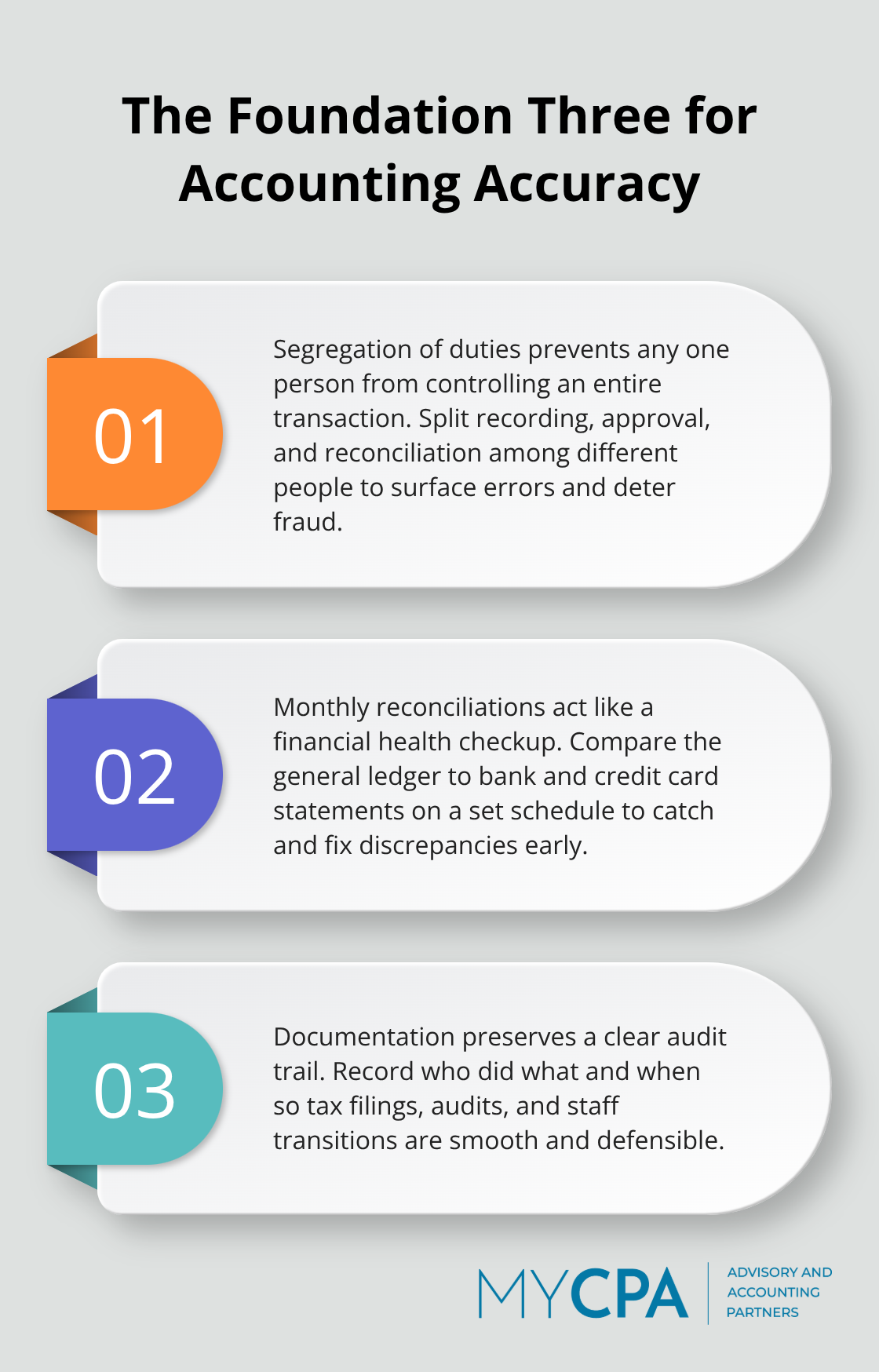
When multiple people touch the same process, errors surface quickly and intentional manipulation becomes nearly impossible.
Monthly bank reconciliations aren’t optional busywork. They function as your monthly checkup for accounting health. The Federal Reserve reports that unreconciled accounts cause the most balance sheet errors in small to mid-sized businesses. Set a specific date each month when someone (not the person who records transactions) compares your general ledger to bank statements and credit card statements. This person should flag every discrepancy, no matter how small. A missing $50 transaction today becomes a $600 problem when you’re trying to close your year-end books and can’t locate it. Documentation of what you reconciled, who performed it, and what adjustments you made creates an audit trail that protects you during tax season or audits. Try completing this reconciliation within 5 business days of month-end when transactions remain fresh and easy to trace.
Write down who performed what action and when they performed it. This applies to journal entries, adjustments, corrections, and approvals. Most accounting software automatically timestamps entries and tracks user names, so use that feature. If you’re using spreadsheets alongside your accounting system, you’ve already lost control of your audit trail. The IRS expects to see clear documentation supporting every transaction and adjustment on your tax return. When you can pull a complete history showing who approved a $15,000 expense, when it was recorded, and what supporting documentation exists, you’re protected. This documentation also matters when employees leave. New team members can understand the reasoning behind past entries instead of wondering why accounts look unusual.
Businesses that ignore segregation of duties, skip reconciliations, or maintain poor documentation face real consequences. Missing audit trails make tax season stressful and audits more expensive. Undetected errors compound month after month, making year-end close a nightmare. Weak controls also signal to employees that accuracy doesn’t matter, which leads to careless mistakes and intentional fraud. The three practices above cost almost nothing to implement but prevent thousands in losses and headaches.
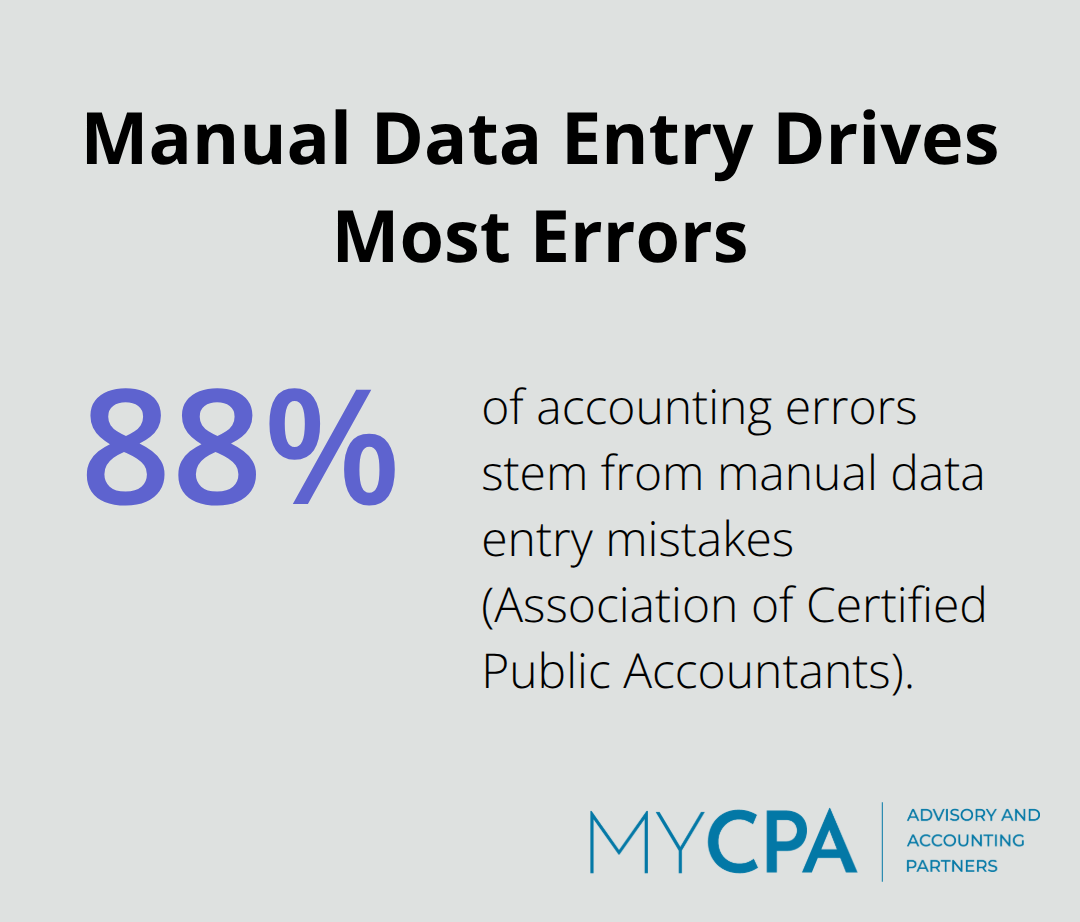
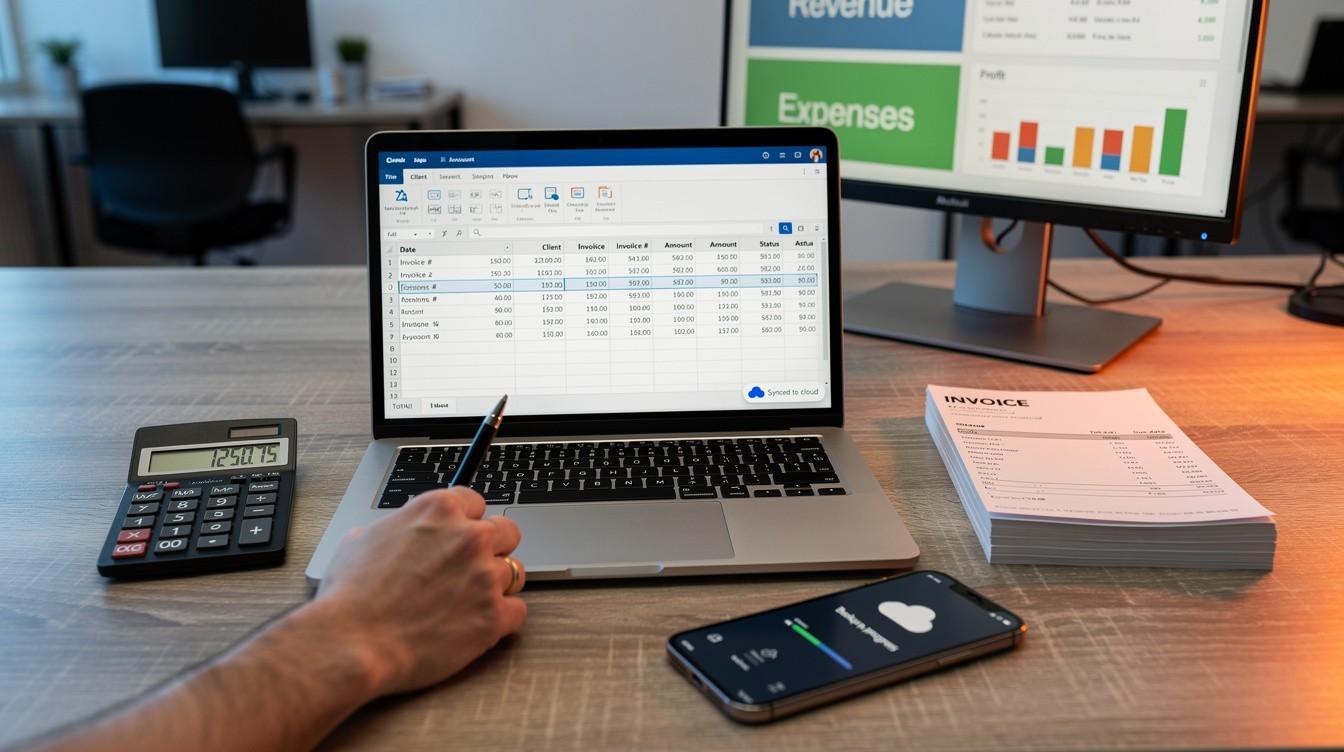
Automated systems eliminate the manual data entry that causes most accounting errors. The Association of Certified Public Accountants reports that 88 percent of accounting errors stem from manual data entry mistakes rather than conceptual misunderstandings. When you move from spreadsheets and manual entry to accounting software that connects directly to your bank and credit card accounts, transactions import automatically with minimal human intervention.
QuickBooks Online, Xero, and FreshBooks all offer bank connectivity that matches downloaded transactions to your records in real time. This means your accounts receivable clerk spends zero hours typing invoice amounts into the system and instead focuses on following up with customers who haven’t paid.
Real-time dashboards built into modern accounting software show you account balances, cash flow status, and profit-and-loss snapshots instantly instead of waiting for month-end reports. You spot cash flow problems in week two of the month instead of discovering them during year-end close. Integration between your accounting software and your banking platforms also flags duplicate transactions and unusual activity immediately. If someone accidentally records the same invoice twice, the system catches it before it distorts your financial statements.
The cost of implementing these systems ranges from 30 dollars monthly for basic cloud accounting software to several hundred dollars for enterprise solutions, but the time savings and error reduction pay for themselves within weeks. The key is choosing systems that work together rather than forcing your team to manually transfer data between disconnected platforms. When your bank feeds directly into your accounting software and your accounting software connects to your tax preparation tools, you eliminate the handoff points where errors typically occur.
This is where long-term accuracy actually lives-not in hoping your team remembers to reconcile or documents properly, but in building systems where accuracy happens automatically. Technology handles the repetitive work that humans perform inconsistently. Your team shifts from data entry to analysis and decision-making. The right accounting infrastructure (one that connects your bank, accounting software, and tax tools) transforms how you operate. With manual errors removed from the equation, your attention turns to the mistakes that technology cannot catch on its own-the ones that require human judgment and understanding of your business.
Technology catches obvious mistakes, but three specific errors slip through automated systems because they require understanding your business, not just processing transactions. Misclassification happens when transactions land in the wrong account. A software purchase gets coded to office supplies instead of software licenses. A customer refund gets recorded as an expense rather than a reduction in revenue.
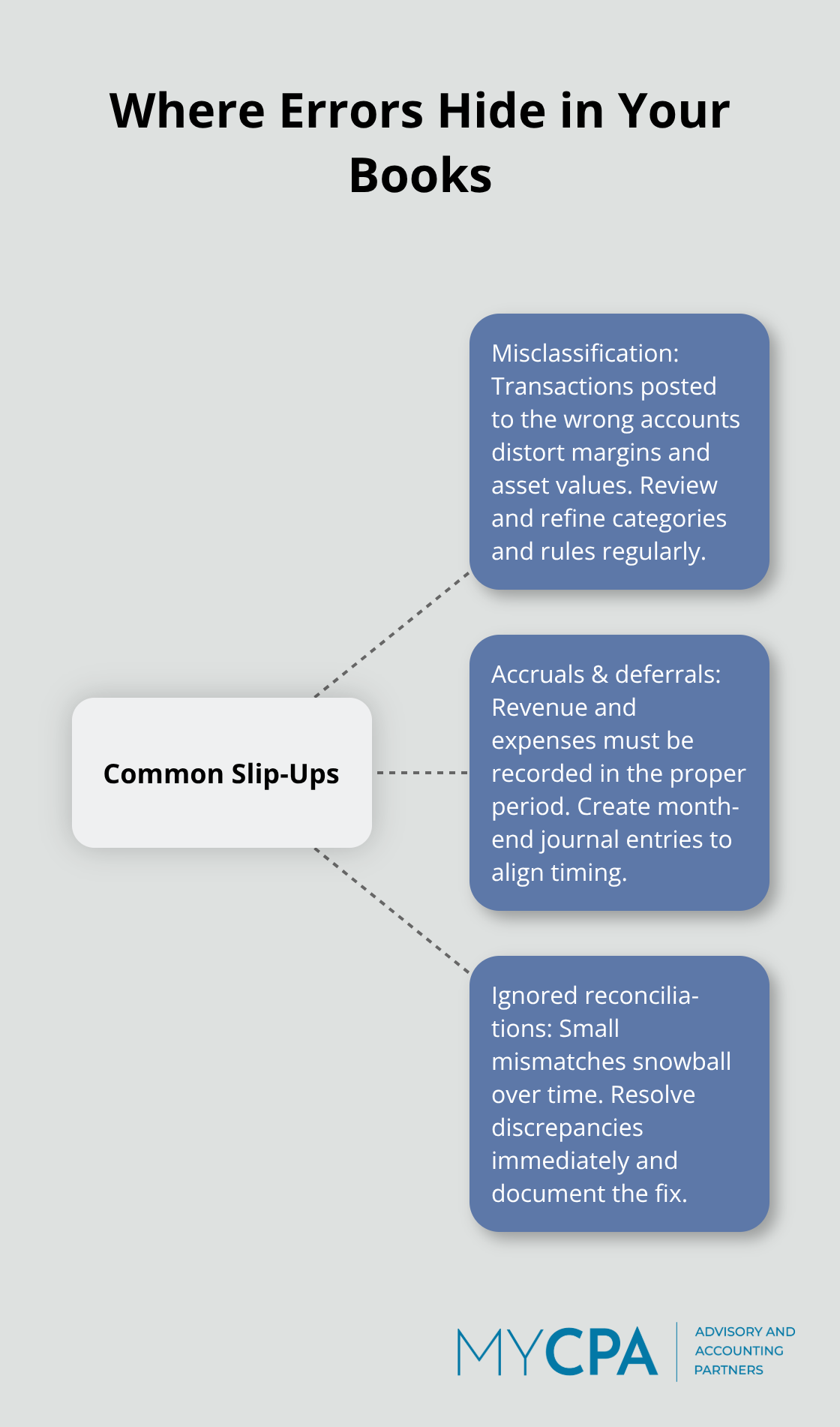
Your bank feed imports the transaction correctly, but the classification is wrong, so your financial statements distort profit margins and asset values.
Assign one person responsibility for reviewing transaction classifications weekly, not monthly. Spot-check 10 to 15 transactions each week across different categories. When you find a pattern of misclassifications in a specific area, retrain whoever handles that category or adjust your chart of accounts to make the correct classification more obvious. Most accounting software lets you create rules that auto-classify recurring transactions, so a monthly software subscription always lands in software licenses without manual intervention.
Accruals and deferrals represent the second trap. These are revenue or expenses that belong in a period even though cash hasn’t moved yet. A client pays you $12,000 in December for services you’ll deliver in January through March. That $12,000 is deferred revenue in December and recognized as you deliver services over three months. Many small business owners skip this entirely and record the full $12,000 as December revenue.
Your December financials look artificially strong while January and February look weak. Under the accrual method, you report income in the tax year you earn it, regardless of when payment is received, and you deduct expenses in the tax year they’re incurred. The IRS expects accrual-basis accounting on tax returns for businesses with over $29 million in annual revenue, and many smaller businesses elect it voluntarily. Create a checklist at month-end that asks: Did we receive cash for work not yet done? Did we incur expenses this month for services received in a prior month? Did we deliver services this month that we were paid for previously? Write down each item and the amount, then create journal entries to record them. Your accounting software can then generate accurate financial statements.
The third mistake is ignoring reconciliation discrepancies because they seem minor. A $200 difference between your records and the bank statement gets ignored because closing is due tomorrow. That $200 becomes a $2,400 mystery by year-end when four more months of ignored discrepancies stack up. Set a rule that zero discrepancies remain unresolved.
If you can’t identify the source within 30 minutes, create an entry to balance the accounts, document what you did, and flag it for investigation. Never leave discrepancies to resolve later because later never comes until audit season when pressure is highest and time is shortest.
Accounting accuracy improvements don’t require overhauling your entire operation. The three core practices-segregation of duties, monthly reconciliations, and detailed documentation-form a foundation that costs almost nothing to implement. Add technology that connects your bank to your accounting software, and you eliminate the manual errors that plague most businesses. Then watch for the three mistakes that slip past automation: misclassification, accruals and deferrals, and ignored reconciliation discrepancies.
Consistent accuracy directly impacts your financial health. When your books are reliable, you make better business decisions based on real numbers instead of guesses. Tax season becomes straightforward instead of stressful, and audits move faster and cost less.
Look at your current processes and identify one area where you’re weakest. We at My CPA Advisory and Accounting Partners help business owners build accounting systems that work, whether you need help setting up QuickBooks, establishing proper controls, or reviewing your current processes. Contact us to strengthen your accounting foundation.






Privacy Policy | Terms & Conditions | Powered by Cajabra