
Tax Compliance Readiness Tips Every Small Enterprise Needs
Prepare your small business for tax season with essential compliance readiness tips. Avoid penalties and stay audit-ready with our practical guidance.
Most business owners check their finances once a year, if that. This approach leaves you flying blind for months at a time, missing cash flow problems and profit leaks that compound quickly.
Monthly financial reporting changes everything. We at My CPA Advisory and Accounting Partners have seen firsthand how businesses that review their numbers monthly catch issues early, make smarter decisions, and grow faster than their competitors.
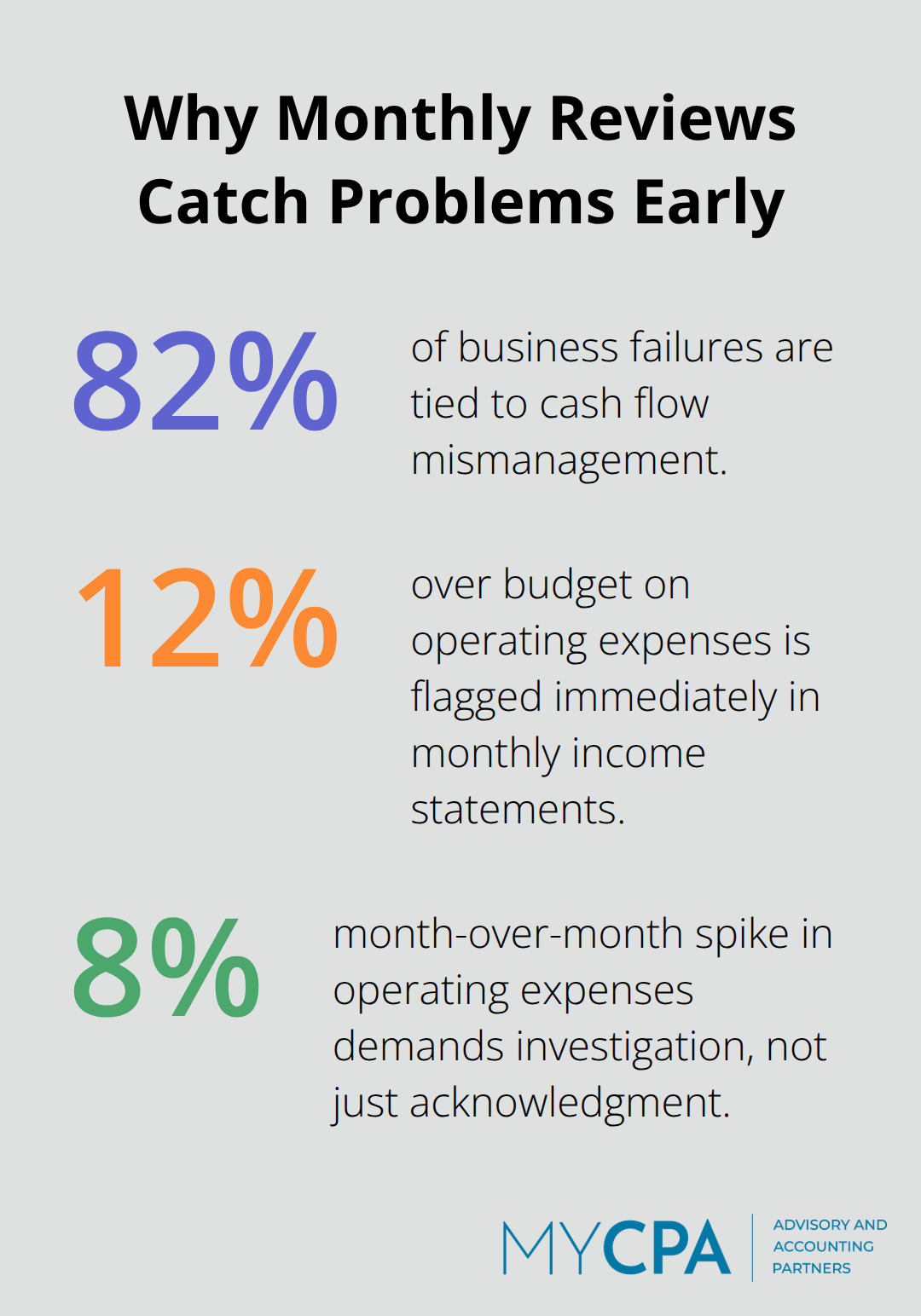
The U.S. Chamber of Commerce reports that 82% of businesses fail due to cash flow mismanagement. That statistic hits hard because it reveals the cost of waiting. When you review finances quarterly or annually, you fall three months or more behind reality. Cash problems develop before you see them, customers who won’t pay stop paying without your knowledge, and cost overruns spiral unchecked. Monthly reporting flips this dynamic entirely. You spot cash flow problems in week one, not month four. A client spending 12% more on operating expenses than budgeted shows up immediately on a monthly income statement, giving you time to investigate whether it’s a one-time blip or a structural issue. You identify a customer whose invoices age beyond 60 days before they become uncollectable bad debt.
You notice that gross profit margins dropped two percentage points month-over-month and trace it back to rising material costs or pricing pressure before it compounds into a quarterly disaster.
Monthly cash flow statements reveal exactly when cash enters and leaves your business, not just how much profit you made. A business can be profitable on paper yet run out of cash because customers pay in 60 days while suppliers demand payment in 30. Monthly reporting exposes this timing mismatch immediately. You see accounts receivable aging-how many invoices sit unpaid in the 0-30, 31-60, 61-90, and 90+ day buckets-and act on it. You track accounts payable the same way, understanding your payment obligations across the month. This visibility lets you negotiate better terms with suppliers, prioritize which invoices to collect first, and plan for seasonal swings before they create a cash crisis. A manufacturing business that sees accounts receivable spike to 75 days outstanding in month two tightens collection efforts in month three instead of discovering a working capital crisis at year-end.
Comparing actual results against budget every month forces accountability and reveals planning accuracy. If you budgeted for 8% revenue growth but achieved 3%, you need to know why in month one, not at the annual review. Was the market softer than expected? Did a major customer delay their purchase? Did your sales team miss targets? Monthly variance analysis answers these questions while there’s still time to adjust pricing, marketing spend, or sales strategy. Tracking key performance indicators monthly-gross margin percentage, customer acquisition cost, inventory turnover, operating expense ratio-gives you trend data that informs decisions on hiring, capital purchases, and pricing adjustments. A service business that monitors labor cost as a percentage of revenue monthly spots when staffing levels no longer match workload and adjusts before profitability erodes across multiple months.
Monthly financial reports transform raw numbers into actionable intelligence. You move from reactive firefighting to proactive management. The data you gather each month becomes the foundation for the next section: understanding which reports matter most and how to structure them for maximum impact on your business decisions.
Your monthly financial reports answer three distinct questions: Are we profitable? Do we have enough cash? Are we using our assets efficiently? The income statement answers profitability. The cash flow statement answers liquidity. The balance sheet answers asset efficiency. Most business owners fixate on one report and ignore the others, which creates blind spots.
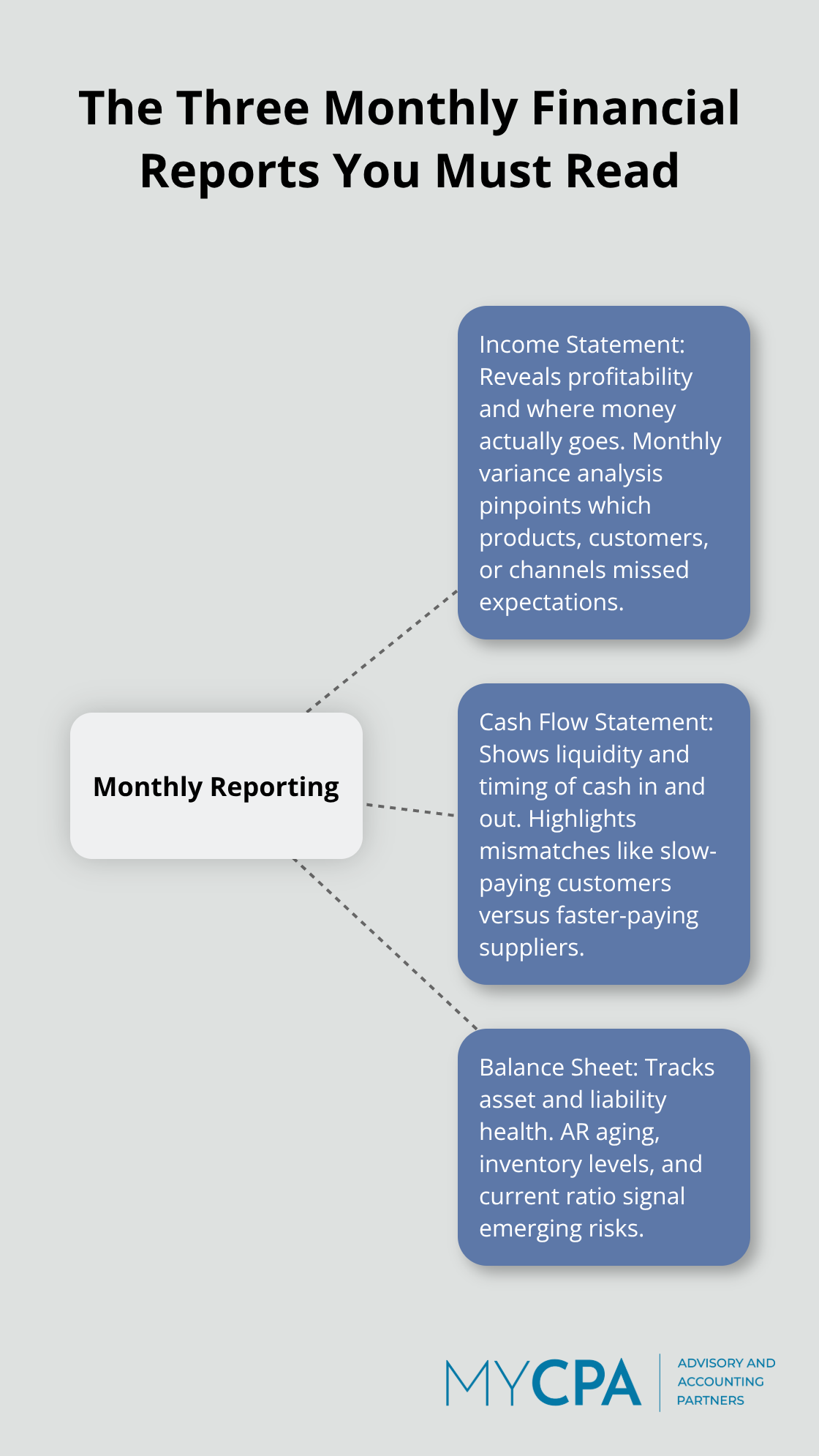
A company can show strong net income on the income statement while cash reserves plummet because customers aren’t paying their invoices. Another business might have healthy cash flow but deteriorating asset quality that signals operational problems ahead. Treat all three as equally important, reviewed together each month to get the complete financial picture.
Your income statement shows revenue minus expenses to calculate profit, but the real power lies in month-to-month variance analysis. If you budgeted $500,000 in revenue and achieved $475,000, that 5% miss matters less than understanding why it happened. Did a seasonal customer delay orders? Did your pricing strategy underperform? Did sales conversion rates drop? Breaking revenue variance into categories-by product line, customer segment, or sales channel-pinpoints exactly where performance missed expectations.
Operating expenses demand equally rigorous scrutiny. Most business owners notice when total expenses spike 10% above budget but fail to investigate which expense categories drove the increase. Track these separately: cost of goods sold, labor costs as a percentage of revenue, rent, utilities, marketing spend, and professional services. A home services contractor who monitors labor cost as a percentage of revenue monthly catches when overtime creeps from 8% to 12% of payroll before it erodes margins across three months.
Gross profit margin and net profit margin tracked monthly reveal efficiency trends that annual reviews miss entirely. A 2% margin decline month-over-month might seem trivial until you realize it compounds into a 20% annual decline if uncorrected.
The balance sheet captures what your business owns, owes, and is worth at a single point in time. Monthly reviews matter because problems develop gradually and become crises if ignored. Accounts receivable aging directly impacts cash availability-invoices outstanding beyond 60 days become progressively harder to collect. Track how many dollars sit in each aging bucket: current, 30 days past due, 60 days past due, and 90+ days past due. If the 90+ day bucket grows month-over-month, you have a collection problem that requires immediate action, whether that means contacting customers, adjusting credit policies, or writing off uncollectable debt.
Inventory levels warrant monthly attention because excess inventory ties up cash that could fund growth, while too little inventory creates stockouts that frustrate customers. Monitor inventory turnover monthly to spot trends before they become working capital crises. Current assets versus current liabilities determines whether you can meet short-term obligations. If current assets fall below 1.5 times current liabilities, liquidity tightens dangerously.
Equipment and property values on the balance sheet should be reviewed monthly to catch depreciation schedules gone wrong or assets that need replacement sooner than expected. Debt levels deserve particular scrutiny because monthly reviews let you track whether you’re paying down obligations on schedule or falling behind.
Cash flow differs fundamentally from profit, and this gap creates the working capital problems that derail businesses. Your cash flow statement categorizes money movement into operating activities, investing activities, and financing activities. Operating cash flow-the cash generated from running your business-is what matters most monthly. A business generating $100,000 in monthly operating cash flow has flexibility to invest, pay down debt, and weather downturns. One generating only $20,000 faces constant pressure.
Track three specific metrics monthly: days sales outstanding (how long customer payments take), days inventory outstanding (how long inventory sits before sale), and days payable outstanding (how long you take to pay suppliers). These three metrics combined determine working capital needs. A manufacturer with 45 days sales outstanding plus 60 days inventory outstanding minus 30 days payable outstanding needs 75 days of operating expenses in cash reserves just to function smoothly.
Monthly cash flow statements reveal whether seasonal patterns are developing as expected or whether payment timing is deteriorating. A business that typically sees strong cash in months 3 and 9 but weak cash in months 2 and 8 can plan accordingly-arranging credit lines before the weak months arrive rather than scrambling when cash runs dry. Understanding these three reports together transforms your monthly financial review from a compliance exercise into a management tool that shapes strategy and prevents crises before they take hold.
Most business owners understand that monthly financial reporting matters, yet they still fail to implement it consistently. The gap between knowing something is important and actually doing it creates predictable failure points that sabotage even well-intentioned efforts.
The first killer is delay. You finish the month on the 30th, but your reports don’t arrive until the 15th of the following month. Half the month has passed and opportunities to correct course have evaporated. Harvard Business Review found that labor-intensive manual processes in finance teams create inherent delays. These delays compound when you wait for receipts to arrive, invoices to be entered, or bank statements to reconcile. A business that generates monthly reports on the 20th instead of the 5th loses actionable intelligence during the most critical decision window. The window for action closes fast once a month ends, and late reports transform potential management tools into historical documents.
The second failure point is worse: you generate reports but never explain what the numbers mean. You see that operating expenses jumped 8% month-over-month, acknowledge the variance exists, then move on without investigating whether it’s a one-time spike or a permanent increase. This happens constantly because business owners confuse report generation with analysis. A report sitting in your inbox unread teaches you nothing. A report you read but don’t investigate teaches you to ignore future reports because you’ve trained yourself that numbers don’t matter. The variance exists, but the investigation never happens. Without investigation, you cannot distinguish between normal fluctuation and structural problems that demand immediate attention.
The third failure is comparing results only to last month or last year instead of comparing against your budget and forward-looking forecast. Last month’s numbers tell you what happened. Your budget tells you what should have happened. The gap between those two numbers is where strategy lives. If you budgeted for 10% revenue growth and achieved 6%, that 4% miss demands investigation in month one, not acknowledgment at year-end. You need to know whether the shortfall reflects market conditions you cannot control, execution problems you can fix, or forecast assumptions that were unrealistic from the start. Without this comparison discipline, you manage in the dark. Business owners who generate beautiful monthly reports but never act on them often compare against moving targets instead of fixed plans. The reports exist as compliance exercises rather than management tools.
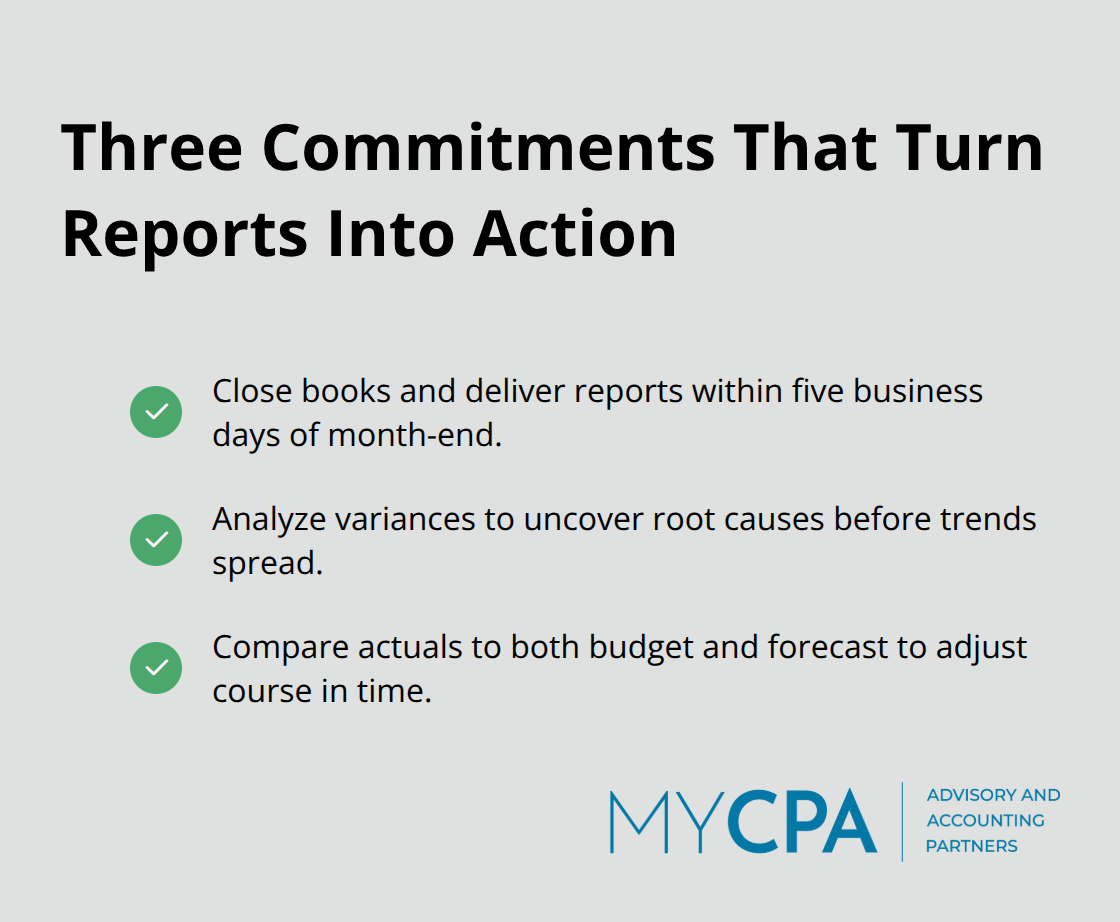
Monthly financial reporting only works when you commit to three things: generate reports within five business days of month-end, analyze variances to understand root causes rather than just acknowledge they exist, and compare actual results against both budget and forecast to inform decisions while there is still time to adjust course. The first commitment eliminates delay. The second commitment transforms data into insight. The third commitment connects insight to strategy. Each commitment alone improves your financial management, but together they create a system that catches problems early and reveals opportunities before competitors spot them.
Monthly financial reporting transforms from a compliance task into your primary management tool when you treat it as essential rather than optional. The income statement, balance sheet, and cash flow statement work together to answer the questions that drive real decisions: Are we profitable? Do we have cash? Are we using assets wisely? Without monthly visibility, you answer these questions months too late, and the window for corrective action has already closed.
Implementing this process requires three non-negotiable commitments. First, close your books and produce reports within five business days of month-end-delays kill actionable intelligence because the opportunity to adjust course disappears fast. Second, investigate every significant variance between actual results and budget to understand root causes rather than simply acknowledge the gap exists. Third, compare results against your budget and forward-looking forecast, not just against last month or last year, so you distinguish between market conditions you cannot control and execution problems you can fix.
We at My CPA Advisory and Accounting Partners help business owners implement monthly financial reporting that transforms numbers into decisions. Our accounting services deliver accurate financial reporting and bookkeeping that forms the foundation for monthly analysis, while our business advisory services help you interpret what your numbers mean and act on them. Contact My CPA Advisory and Accounting Partners to discuss how monthly financial reporting can accelerate your growth.








Privacy Policy | Terms & Conditions | Powered by Cajabra