
Accounting Accuracy Improvements: Techniques That Endure
Boost accounting accuracy improvements with proven techniques that reduce errors, save time, and strengthen financial controls for your business.
Most business owners leave thousands of dollars on the table each year by missing deductions they’re entitled to claim. At My CPA Advisory and Accounting Partners, we’ve seen firsthand how tax deduction optimization can transform your bottom line.
This guide walks you through the deductions you’re likely overlooking, the planning strategies that work, and the mistakes that trigger audits.
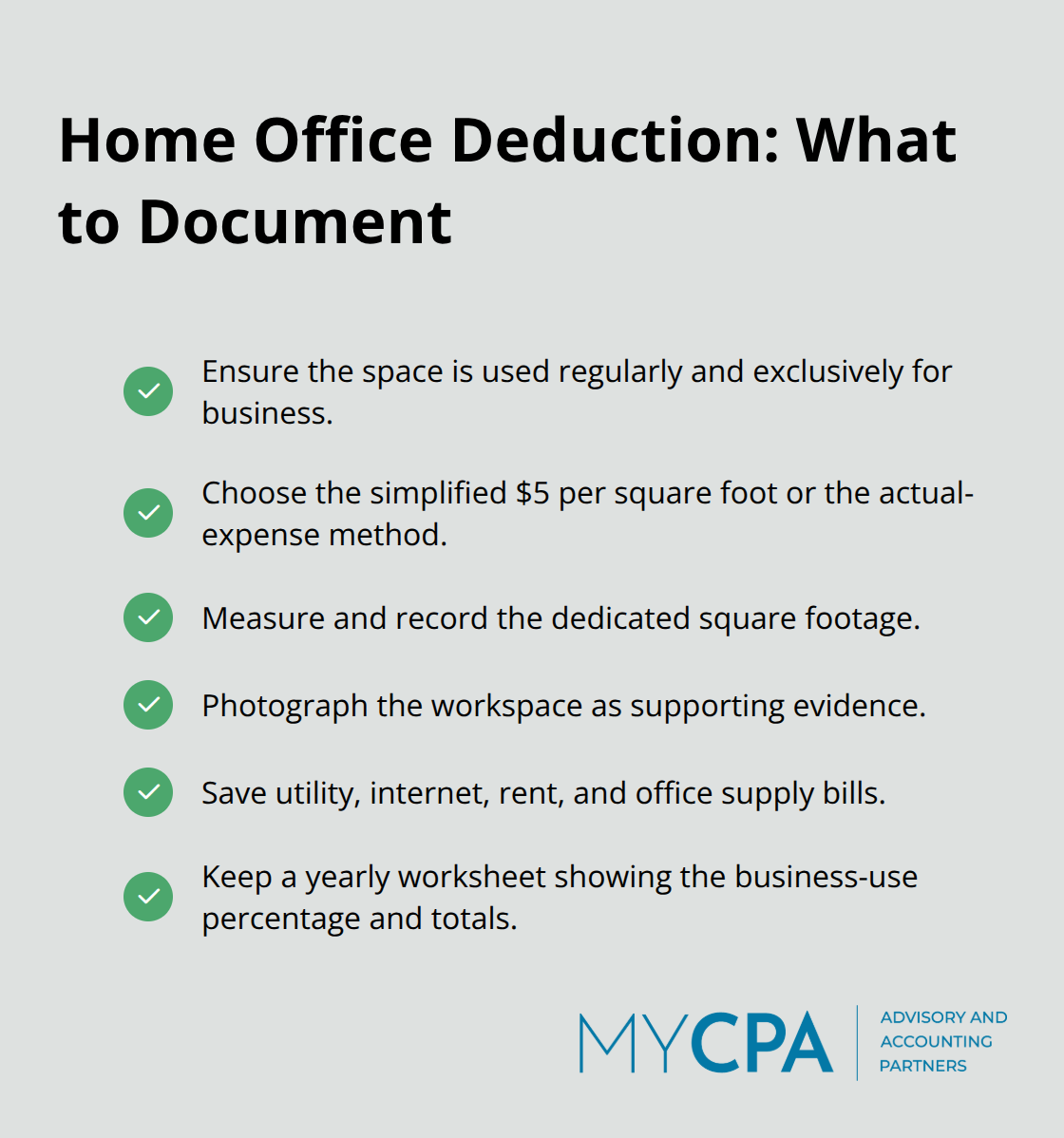
The IRS reports that roughly 27 million self-employed individuals file taxes annually, yet most claim fewer deductions than they qualify for. Home office expenses represent one of the largest missed opportunities. If you work from home, you can deduct either 5 dollars per square foot of dedicated workspace (simplified method) or calculate actual expenses like rent, utilities, internet, and office supplies based on the percentage of your home used for business. Your workspace must be used regularly and exclusively for work. Many owners hesitate because they fear audits, but the IRS allows this deduction routinely when you document it properly. Track your square footage, photograph your setup, and keep utility bills to substantiate your claims.
Vehicle expenses create another significant gap. You can deduct either actual expenses (fuel, maintenance, insurance, depreciation) or the standard mileage rate, which was 67 cents per mile in 2024 for business use. The critical step most owners miss: maintain a mileage log showing dates, destinations, miles driven, and business purpose. Without this documentation, the IRS will disallow the entire deduction if questioned.
Professional development and training costs are fully deductible when they maintain or improve skills required for your current business or profession. Industry conferences, software certifications, online courses, and membership fees all qualify. The IRS distinguishes between education that qualifies you for a new profession (not deductible) versus education that keeps you current in your existing field (deductible). If you’re an accountant taking continuing education credits, that’s deductible. If you’re retraining as an accountant from another career, it’s not.
Most business owners also overlook self-employment tax deductions, which let you deduct one-half of your self-employment tax, and equipment purchases under Section 179 deduction, which allows you to deduct up to $2,560,000 of qualifying property in 2026 rather than depreciating it over years. Health insurance premiums for the self-employed are deductible above-the-line, reducing your adjusted gross income directly. If you employ a spouse or child in your business, their wages are deductible business expenses and they gain earned income for retirement account contributions. Meals and entertainment tied to active business discussions are 50 percent deductible. Subscriptions to industry publications, software tools for business operations, and professional licenses all count. The underlying principle: if an expense is ordinary and necessary for your business, it’s likely deductible.
The real problem isn’t identifying deductions-it’s documenting them. The IRS scrutinizes businesses with high deduction-to-income ratios, so maintain receipts, invoices, credit card statements, and detailed records for every claim. Many owners lose deductions simply because they can’t prove them, not because they’re ineligible. Start tracking expenses by category now, and review your prior three years of returns to identify what you’ve missed. That review often reveals hundreds or thousands in unclaimed deductions that you can recapture through amended returns. Once you’ve identified these missed opportunities, the next step involves strategic planning throughout the year to ensure you capture every eligible deduction moving forward.
Most business owners wait until March to think about taxes, which means they’ve already lost thousands in deduction opportunities. Treating tax planning as a quarterly discipline, not an April emergency, transforms your results. Quarterly reviews let you adjust spending, accelerate deductions, and make strategic decisions while you still have time to act.
Set aside one day each quarter-ideally in the last week of March, June, September, and December-to review your income and expenses against your projected tax liability. Pull your profit-and-loss statement, compare year-to-date income to your annual estimate, and calculate your effective tax rate. If you’re on track to owe significantly more than expected, you have time to deploy deduction strategies before year-end. If your income is lower than projected, you can adjust your estimated tax payments to avoid overpaying.
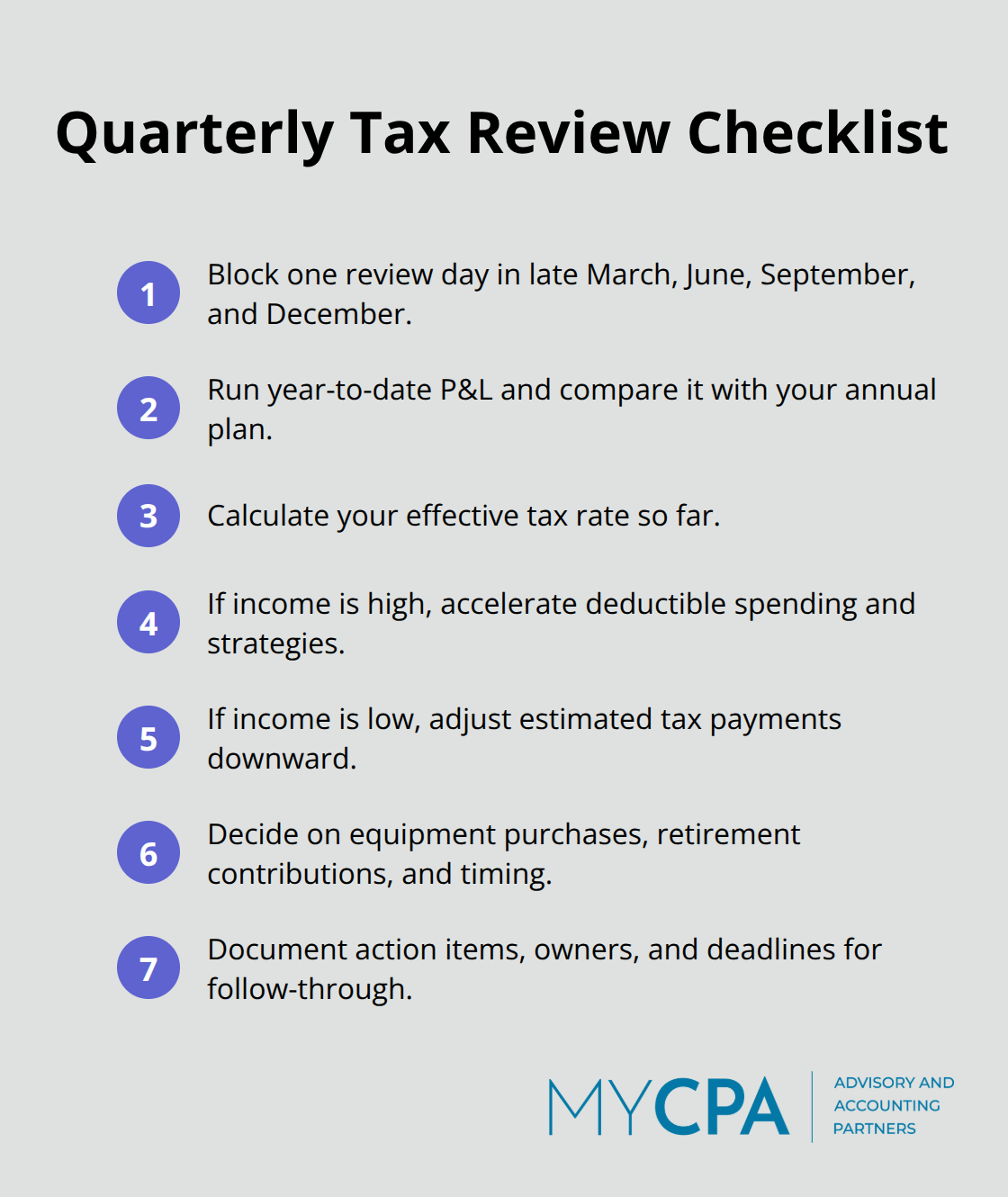
This simple quarterly audit prevents surprises and positions you to make intentional decisions about equipment purchases, retirement contributions, and expense timing rather than scrambling reactively in December.
Equipment purchases qualify for Section 179 deductions and bonus depreciation, allowing you to immediately deduct up to 100% in 2026 of the cost of eligible assets rather than spreading it over years. Your quarterly review should reveal whether excess income exists to fund these purchases strategically. If your numbers show surplus cash flow in November or December, buying equipment captures the deduction in the current year instead of waiting until next year. This timing decision alone can reduce your taxable income substantially and shift your tax bracket downward.
Retirement contributions have hard deadlines that vary by account type, and missing these dates costs you thousands in lost deductions. Traditional IRA contributions must be made by April 15 of the following year, but 401(k) contributions must be made by December 31. For 2026, the 401(k) contribution limit rises to $24,500, and if you’re age 50 or older, catch-up contributions bring the total to $32,500. Contributing the maximum to a traditional 401(k) or solo 401(k) directly reduces your taxable income dollar-for-dollar, making this one of the most powerful deductions available.
Health Savings Account contributions follow the same December 31 deadline and offer triple tax advantages: contributions are deductible, growth is tax-free, and withdrawals for qualified medical expenses are tax-free. If you’re self-employed or own a pass-through business, maximizing retirement contributions before year-end also reduces your self-employment tax liability. Your quarterly review should identify how much additional income you can shelter through retirement and equipment purchases, then execute those decisions before the calendar closes.
The gap between knowing what to do and actually doing it determines whether you capture these deductions or leave them behind. Your quarterly numbers reveal exactly how much tax shelter you need, which equipment purchases make sense, and which retirement account contributions fit your cash flow. Once you’ve identified these opportunities through your quarterly review, the next step involves understanding which deductions trigger audits and how to document them properly to withstand IRS scrutiny.
The line between legitimate business deductions and personal expenses exists, but it’s blurrier than most owners realize, and the IRS draws it differently than you might expect. Owners lose deductions routinely because they misclassify personal spending or fail to document the business purpose behind expenses. A home office deduction fails not because the IRS dislikes home offices, but because you cannot prove the space was used exclusively for business. A vehicle deduction gets challenged not because mileage deductions are uncommon, but because your mileage log shows personal trips mixed with business miles. The IRS rejects deductions not because they’re aggressive; it rejects them because the documentation doesn’t support the claim. If you deduct 100 percent of your vehicle expenses but your actual business mileage represents only 60 percent of total miles driven, the IRS will disallow the entire deduction plus penalties. This isn’t theoretical risk. The Treasury Inspector General for Tax Administration reported that improper deduction claims cost the government billions annually, which means the IRS prioritizes enforcement in this area.
Your quarterly reviews should include a hard look at what you’re claiming versus what you can actually prove. Meals and entertainment illustrate this perfectly. The IRS allows 50 percent deduction for meals tied to active business discussions, but many owners deduct client lunches without documenting who attended, what was discussed, or the business purpose. The receipt alone isn’t enough. You need a contemporaneous log showing the date, attendees, location, amount, and business purpose.
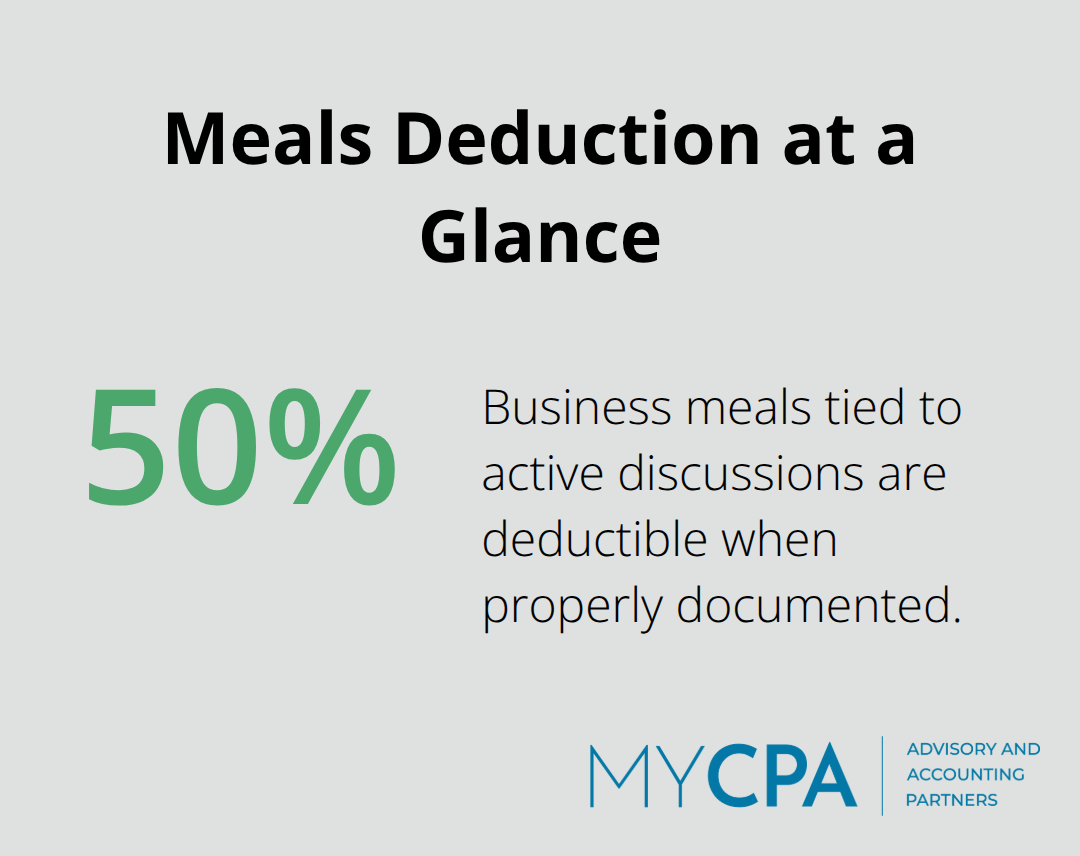
If you cannot produce this documentation when the IRS asks, you lose the deduction entirely, regardless of whether the meal was genuinely business-related.
The same principle applies to vehicle expenses, home office deductions, and equipment purchases. The IRS doesn’t question whether your business actually needed these expenses; it questions whether you can prove it. A $5,000 equipment purchase becomes worthless as a deduction if you lack an invoice showing the business purpose. A home office deduction vanishes if you cannot demonstrate exclusive business use. This documentation gap costs owners thousands annually.
Documentation failures represent the primary reason the IRS disallows legitimate deductions. Many owners maintain receipts but fail to create the contemporaneous records the IRS requires. A credit card statement showing a $200 office supply purchase doesn’t prove the items were business-related. An invoice for software doesn’t prove you actually use it for your business. The IRS wants contemporaneous documentation-records created at or near the time of the transaction-that establishes the business purpose.
Start a system now that captures this information automatically. For vehicle expenses, maintain a mileage log (even a simple spreadsheet works) showing dates, destinations, miles driven, and business purpose. For meals and entertainment, photograph receipts and note attendees and business purpose on the back. For home office expenses, photograph your workspace and maintain utility bills. For equipment purchases, keep invoices and document how the equipment serves your business. This documentation discipline prevents disputes and protects you if the IRS ever questions your return.
Industry-specific deductions represent another blind spot, particularly in professional services, construction, and healthcare. A software developer can deduct specialized equipment and cloud services that a general accountant might overlook. A construction contractor can deduct safety equipment and specialized tools that others don’t recognize as deductible. An HVAC technician can deduct vehicle modifications and diagnostic tools. These aren’t exotic deductions; they’re ordinary and necessary for the specific trade. The problem is that generic tax software and general tax preparers don’t know these deductions exist because they operate outside their industry experience.
If you’re a specialized professional or tradesperson, a generic tax return misses thousands in legitimate deductions simply because your preparer doesn’t know what to look for. This is where working with someone becomes essential, not optional. The cost of missing an industry-specific deduction for even one year often exceeds the cost of working with a specialist who knows your field. Your prior three years of tax returns likely contain missed deductions in this category. If you operate in a specialized field, pull those returns and compare them to what competitors in your industry claim. The gaps you find represent money you’ve already left on the table.
Tax deduction optimization requires action, not just awareness. The deductions you’ve learned about-home office expenses, vehicle costs, professional development, Section 179 deductions, and retirement contributions-represent real money in your business right now. Most owners leave these dollars unclaimed because they lack documentation or miss industry-specific opportunities that apply to their situation.
A qualified tax professional identifies which deductions fit your circumstances, understands the documentation standards the IRS enforces, and spots the blind spots that cost specialized professionals thousands annually. They keep you on the right side of the line between smart tax planning and the mistakes that trigger audits. The cost of professional guidance typically pays for itself many times over through deductions you wouldn’t have claimed otherwise.
We at My CPA Advisory and Accounting Partners help business owners implement tax strategies tailored to their specific situations. Pull your prior three years of tax returns and identify which deductions you’ve missed, then schedule a conversation with our team to explore how we can strengthen your tax strategy and financial management.







Privacy Policy | Terms & Conditions | Powered by Cajabra