
Tax Compliance Readiness Tips Every Small Enterprise Needs
Prepare your small business for tax season with essential compliance readiness tips. Avoid penalties and stay audit-ready with our practical guidance.
Most business owners leave money on the table every tax season. The difference between a mediocre tax return and an optimized one often comes down to knowing which deductions are legitimate and how to document them properly.
We at My CPA Advisory and Accounting Partners help clients maximize allowable deductions while staying completely compliant with IRS requirements. This guide walks you through the deductions you’re likely missing, the documentation standards that matter, and the red flags that trigger audits.
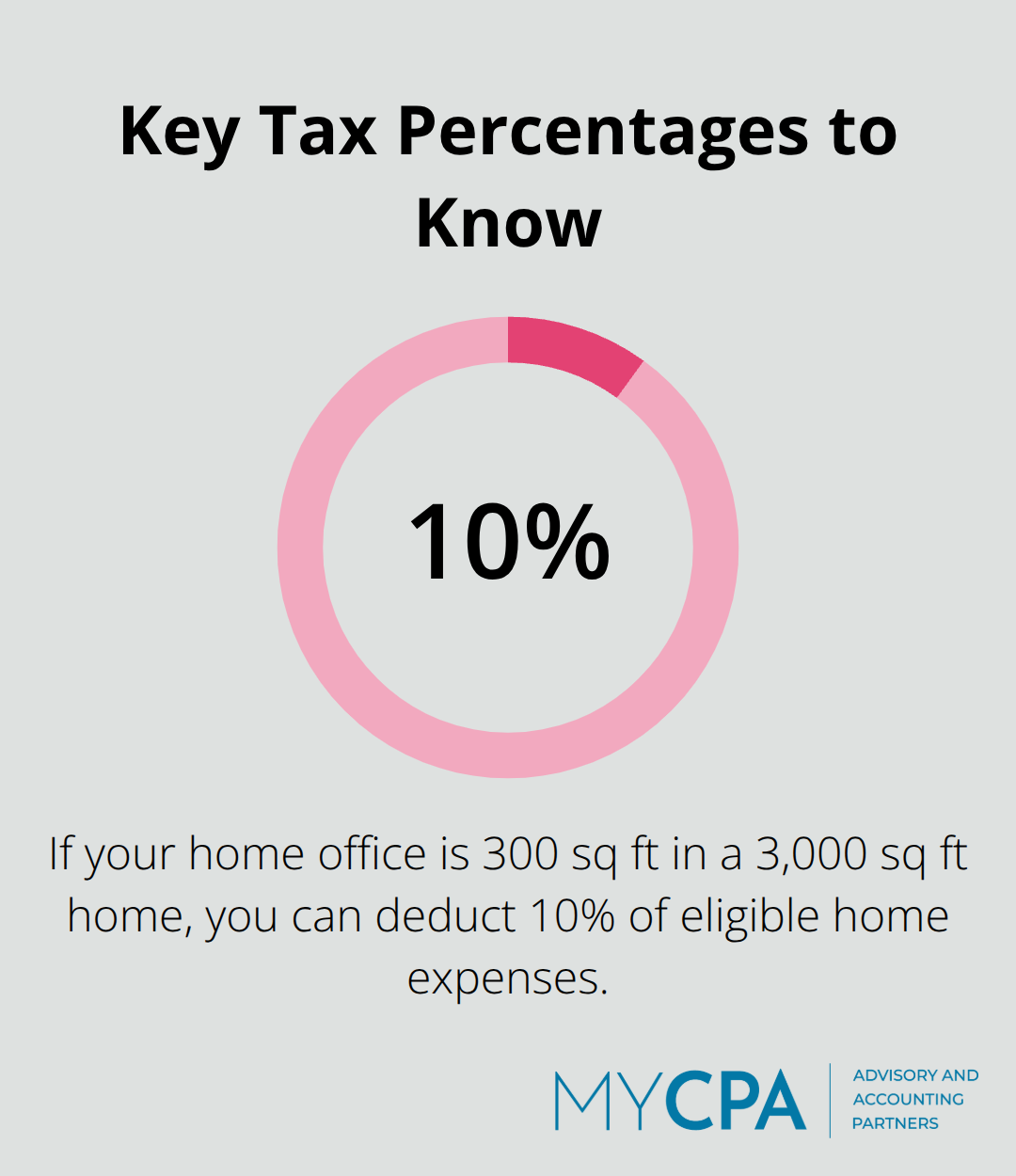
Home office expenses represent one of the easiest deductions to claim yet most commonly missed by self-employed professionals and business owners. The IRS allows you to deduct a portion of utilities, insurance, rent, mortgage interest, property taxes, and depreciation based on the percentage of your home used exclusively for business. If your home office occupies 300 square feet of a 3,000 square foot home, you can deduct 10% of those expenses.
Many business owners avoid this deduction out of fear it triggers audits, but that’s unfounded. What actually triggers scrutiny is claiming a home office without maintaining clear records that show exclusive business use. Set up a dedicated workspace, document its dimensions, photograph it, and keep receipts for any improvements or equipment purchases. The simplified method allows you to deduct $5 per square foot up to 300 square feet, capping out at $1,500 annually, which eliminates the need for detailed expense tracking if simplicity matters more to you than maximizing the deduction.
Vehicle and travel expenses drain business budgets while remaining vastly underreported on tax returns. The standard mileage rate for 2026 is 72.5 cents per mile for business use, which means a business owner who drives 20,000 business miles annually can deduct $14,500. The trap most owners fall into is mixing personal and business mileage without documentation.
The IRS demands contemporaneous records that show the business purpose of each trip, the date, destination, and mileage. A simple mileage log in your phone or a dedicated app eliminates this friction and protects you during an audit. You can also track vehicle expenses through actual expense method if you prefer detailed records over the standard mileage approach.
Professional development and training costs are fully deductible when they maintain or improve skills required for your current business. Industry conferences, certifications, software subscriptions for your trade, and workshops all qualify. However, education that qualifies you for a new profession does not qualify, which means a plumber cannot deduct law school tuition but absolutely can deduct advanced plumbing certification courses.
The distinction matters because the IRS scrutinizes education deductions more heavily than other categories. You must keep receipts for course materials, registration fees, and travel related to training. The IRS will request this documentation if your return undergoes review, so organize these records from the start rather than scrambling to reconstruct them later.
These three deduction categories combined often represent thousands of dollars in overlooked tax savings. Claiming them properly with solid documentation keeps you completely compliant with IRS expectations and positions you well if an audit occurs. The next section covers how to organize your records systematically so you can substantiate every deduction you claim.
Documentation determines whether the IRS accepts or disallows your deductions. Most business owners understand they need receipts, but they fail at execution-receipts sit in shoeboxes, emails get buried, and when the IRS requests substantiation, panic sets in. You need a single, consistent approach to capture and store every expense the moment it occurs. Select one method and commit to it: a cloud-based accounting system like QuickBooks, a dedicated expense app like Expensify, or a physical filing system organized by category and month. The method matters far less than consistency. Upload receipts immediately after purchase rather than waiting until month-end. Most modern phones have built-in document scanners that work better than expected; photograph receipts the same day you incur the expense.
The IRS expects to see contemporaneous records-documentation created around the time the expense occurred, not reconstructed months later. Under IRS Publication 463 and IRC Section 274(d), documentation must prove amount, date, place, and business purpose for each expense. Apps like MileIQ capture GPS data automatically, but even a simple spreadsheet with weekly entries works if you stay disciplined. Missing a few entries doesn’t disqualify the entire deduction, but sporadic logging creates doubt that invites deeper scrutiny. For recurring expenses like utilities or insurance, maintain a spreadsheet that tracks payments alongside supporting documentation filed in your system. Vehicle expense documentation should include fuel receipts, maintenance invoices, and registration records. For professional development expenses, keep course materials, certificates of completion, registration confirmations, and receipts for all related travel.
Digital storage matters more than you realize. Keep scanned copies of everything in a password-protected cloud system like Google Drive, Dropbox, or your accounting software. The IRS cannot demand access to your cloud files, but they can request physical copies or ask you to produce documents during an office audit. Having everything digitized means you can pull together requested materials in hours instead of days. Maintain this system for at least seven years-the statute of limitations for most tax issues runs seven years from the filing date, and the IRS can go back further if it suspects substantial underreporting of income. Organized records reduce audit risk because they signal you operate with integrity and attention to detail. When an auditor requests specific documentation, you provide it within days rather than weeks. That responsiveness and completeness often leads to shorter, less invasive audits.
Use a dedicated business credit card or bank account for all business transactions. This separation eliminates the most common audit red flag-commingled personal and business spending that requires the auditor to determine what portion qualifies. Clean separation proves business purpose without requiring explanation. The IRS audits roughly 0.36 percent of returns overall, but that rate climbs significantly for returns with high deductions relative to income or those showing inconsistent patterns year to year. When you maintain clear boundaries between business and personal finances, you eliminate the friction that auditors scrutinize most closely.
Your documentation system now protects you, but the IRS still watches for specific patterns that signal risk. The next section reveals which deduction behaviors trigger the most aggressive IRS scrutiny and how to avoid them.
The IRS flags returns based on patterns, not random selection. According to IRS data, the overall audit rate sits at 0.36 percent, but this jumps dramatically for high-income earners and returns with deduction anomalies.
Business deductions that deviate significantly from industry norms trigger closer inspection. The IRS maintains benchmark data for most professions, and deductions running above typical occupational norms create audit risk. A consultant claiming $50,000 in home office expenses when peers in the same field claim $3,000 creates an obvious red flag.
Research what business owners in your industry typically deduct. Industry associations, tax publications, and your accountant can provide these benchmarks. When your deductions fall within normal ranges for your profession, you move through the audit process faster if one occurs. This doesn’t mean you should artificially suppress legitimate deductions, but it means understanding where your numbers stand relative to peers protects you from unnecessary scrutiny.
Inconsistent reporting year to year signals either carelessness or intentional manipulation, and the IRS treats both seriously. If you claimed $8,000 in vehicle expenses last year and suddenly $22,000 this year without explanation, an auditor will question the jump. Large fluctuations in income or expenses require context, which is why attaching a brief explanation when filing electronically makes sense when significant changes occur.
Documentation becomes even more critical when your return shows unusual patterns. Missing records compound the problem because the burden shifts to you to prove the deduction is legitimate. The IRS receives third-party income reports like 1099s and W-2s automatically, so income discrepancies get caught immediately. If you reported $50,000 in business income but your 1099-NEC shows $65,000, that mismatch triggers correspondence within weeks.
Reconcile all income sources before filing to eliminate friction entirely. For deductions without third-party verification (like home office or vehicle expenses), supporting documentation becomes your weakest point. An auditor can disallow entire categories of deductions when you cannot produce receipts, mileage logs, or other substantiation.
Organized records from day one prevent this scenario. The cost of maintaining a simple system pales compared to losing thousands in deductions because documentation vanished. When an auditor requests specific materials, you produce them within days rather than weeks. That responsiveness and completeness often leads to shorter, less invasive audits and demonstrates you operate with integrity and attention to detail.
Maximizing allowable deductions comes down to two fundamentals: knowing what qualifies and documenting it properly. Home office expenses, vehicle costs, and professional development represent thousands of dollars most business owners leave unclaimed simply because they lack confidence in the process. The IRS doesn’t penalize legitimate deductions-it penalizes poor documentation and inconsistent reporting.
The patterns the IRS watches for are predictable. Deductions that deviate sharply from industry norms, unexplained year-to-year fluctuations, and missing documentation create red flags. You avoid these entirely by staying within reasonable ranges for your profession, explaining significant changes, and keeping seven years of organized records (income reconciliation matters equally, as mismatches between what you report and what third parties report to the IRS get caught immediately).
We at My CPA Advisory and Accounting Partners help business owners and individuals minimize tax liabilities while maintaining complete confidence in their returns. Whether you need help setting up QuickBooks, organizing your deduction strategy, or preparing for an audit, our team provides personalized guidance tailored to your situation.








Privacy Policy | Terms & Conditions | Powered by Cajabra