
Tax Compliance Readiness Tips Every Small Enterprise Needs
Prepare your small business for tax season with essential compliance readiness tips. Avoid penalties and stay audit-ready with our practical guidance.
Small business owners often underestimate how quickly tax compliance issues can spiral into costly penalties and audits. We at My CPA Advisory and Accounting Partners have seen firsthand how the right tax compliance readiness tips can transform a chaotic filing season into a manageable process.
This guide walks you through the systems, mistakes to avoid, and practical steps that keep your business on solid ground with tax authorities.
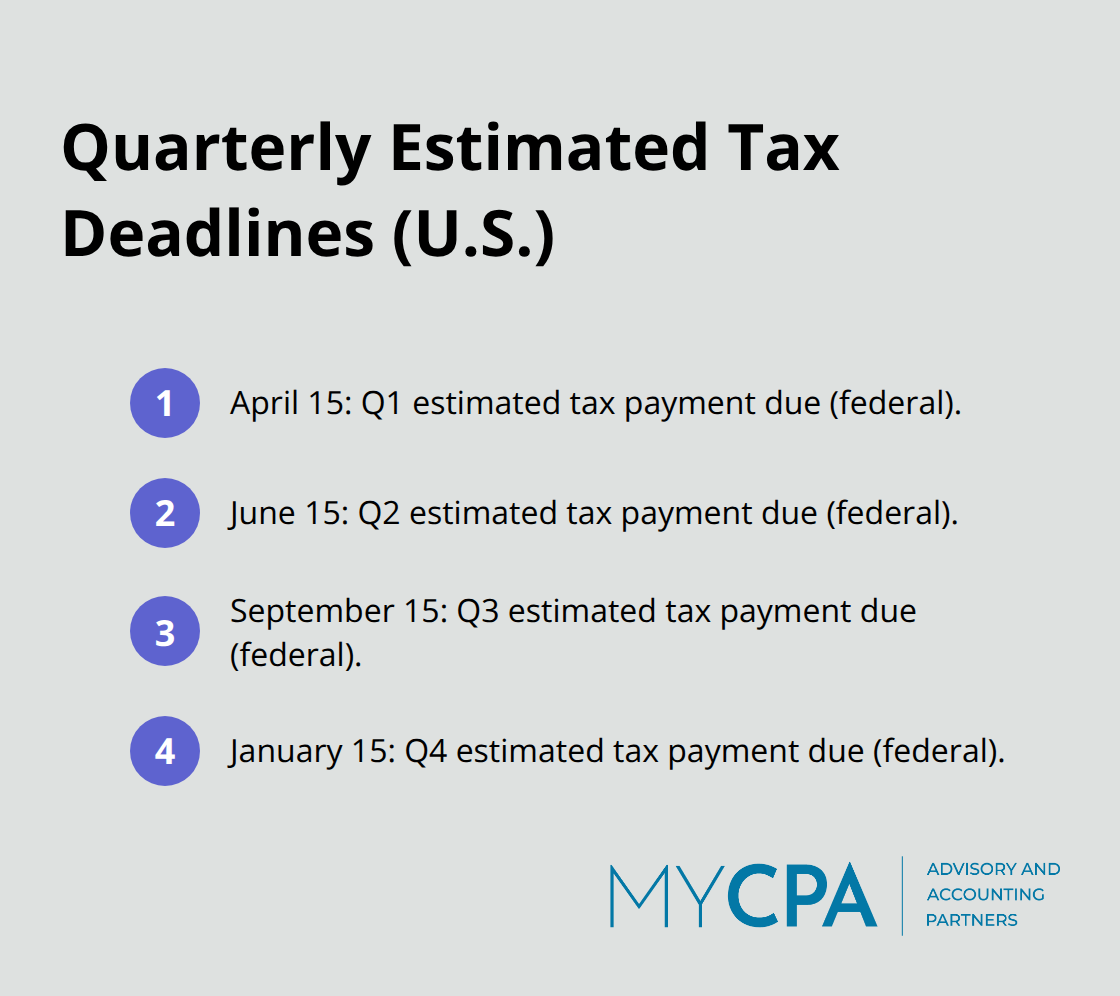
Small business owners face a three-tier tax landscape that most underestimate until tax season arrives. Federal taxes include income tax, self-employment tax if you’re a sole proprietor or partner, and payroll taxes if you have employees. The IRS requires federal estimated quarterly tax payments if you expect to owe $1,000 or more, with deadlines falling on April 15, June 15, September 15, and January 15. State taxes vary dramatically depending on where your business operates-some states have no income tax while others impose rates exceeding 13 percent, according to the Tax Foundation. Local taxes add another layer, with city and county governments collecting everything from gross receipts taxes to occupational licenses. You may owe state taxes even without a physical location in that state; if you have clients or customers elsewhere, you establish nexus and face filing obligations.
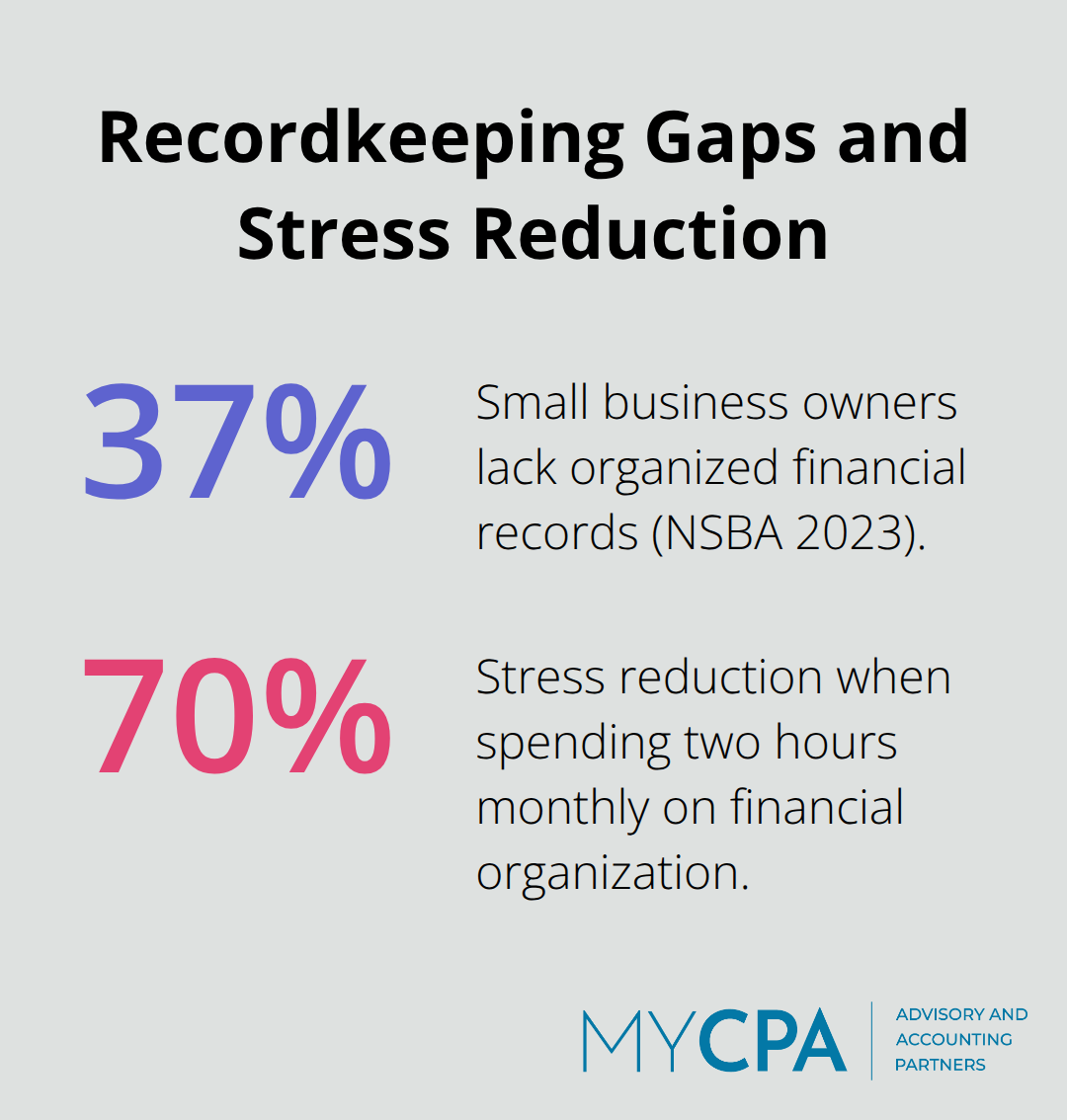
The IRS requires you to keep records for at least three years from the date you filed your original return or 2 years from the date you paid the tax, whichever is later. Your records must show income sources, expenses, deductions, and employment information if applicable. Bank statements alone won’t satisfy the IRS-you need receipts, invoices, mileage logs for vehicle deductions, and proof of business purpose for questionable expenses. A 2023 National Small Business Association survey found that 37 percent of small business owners lack organized financial records, which creates serious exposure during audits. You must separate your business and personal finances completely; commingling funds makes it nearly impossible to defend your deductions and significantly increases audit risk.
Use your business bank account exclusively for business transactions and maintain a simple spreadsheet or accounting software that links expenses to tax categories monthly rather than scrambling to reconstruct everything in December.
Missing a filing deadline triggers penalties that compound quickly. The failure-to-file penalty runs 5 percent per month up to 25 percent of unpaid taxes, while the failure-to-pay penalty adds another 0.5 percent monthly. If you miss a payroll tax deposit deadline, the Failure to Deposit Penalty applies to employers that don’t make employment tax deposits on time, in the right amount, and in the right way. Extensions exist for federal returns-Form 4868 gives you six additional months-but extensions don’t postpone your tax payment deadline, only the filing deadline. State deadlines often differ from federal deadlines, creating confusion; California’s S-corp deadline differs from the federal deadline by weeks. You should mark your calendar with all three deadline types: quarterly estimated tax payments, annual return deadlines, and payroll tax deposit schedules specific to your state and employee count.
Understanding these obligations sets the foundation, but knowing the rules means nothing without systems to track them. The next section shows you how to build the infrastructure that transforms tax compliance from a stressful scramble into a predictable routine.
Knowing your tax obligations means nothing without the operational backbone to track them consistently. Most small business owners fail at tax compliance not because they ignore the rules, but because they lack systems to capture transactions as they happen. The difference between businesses that sail through tax season and those that panic comes down to three interconnected decisions: how you organize financial data, which tools you process it with, and when you review it. Small businesses that spend just two hours monthly on financial organization reduce their tax season stress by roughly 70 percent and catch compliance issues before penalties hit.
Your first move is establishing a single repository for all financial documents. Create a folder structure that mirrors your tax categories: office supplies, vehicle expenses, meals and entertainment, professional services, equipment purchases, and so on. The moment you receive a receipt, photograph it with your phone or scan it directly into your system. Software like Receipt Bank or Expensify reads receipt images and categorizes expenses automatically, saving you from manual data entry that causes bottlenecks in December. For mileage, use an app like MileIQ that logs your drive automatically rather than relying on handwritten notes that the IRS scrutinizes heavily. The goal is capturing transaction details within days of purchase, not reconstructing your year from credit card statements in March. Once you’ve chosen your organization method, commit to it for an entire year without switching platforms mid-stream, which creates duplicate records and gaps in your audit trail.
QuickBooks Online and Xero dominate small business accounting for good reason, but they serve different business structures. QuickBooks Online handles payroll processing natively if you have employees, while Xero requires a third-party payroll integration like Gusto or Rippling. If you operate as a sole proprietor with no employees, Wave offers a free accounting platform that covers basic income and expense tracking, though its reporting features lag behind paid competitors. The critical factor is accounting software that connects directly to your bank and credit cards; software that imports transactions automatically and dramatically reduces manual entry errors. Test your chosen platform with three months of real transactions before committing to annual plans. Many small business owners waste hundreds on software they never use because they selected based on features they don’t actually need rather than their specific workflow.
Schedule a recurring 90-minute block on the first Friday of each month specifically for financial review. During this session, reconcile your bank and credit card statements against your accounting software, verify that transactions post to correct expense categories, and flag any unusual activity. This monthly habit catches fraudulent charges, duplicate entries, and miscategorized expenses while they’re still fresh and easy to correct. A business that reconciles monthly catches a $2,000 data entry error immediately, while one that waits until December scrambles to find it amid thousands of transactions. Document your review by noting the date, who performed it, and any adjustments made. This documentation becomes invaluable if you face an audit, proving that you maintained reasonable controls over your financial records. Your accountant can also review these monthly summaries to spot tax planning opportunities throughout the year rather than discovering them only after your return is filed.
With your systems in place and your monthly reviews running smoothly, you’re ready to tackle the mistakes that trip up most small business owners-and the next section shows you exactly which pitfalls to avoid.
The gap between knowing tax rules and actually following them is where most small business owners stumble. The IRS reports that misclassification of workers costs the government an estimated $5.7 billion annually in lost tax revenue, and the agency has intensified enforcement in this area over the past three years. When you classify an employee as an independent contractor to avoid payroll taxes, you create a ticking bomb that will explode during an audit.
The IRS uses a 20-factor test to determine worker status, and if an audit occurs, the agency assesses back taxes, payroll taxes, penalties reaching 100 percent of unpaid taxes, and interest compounding from the original due date. A small marketing firm that misclassified five part-time employees for two years faced a $47,000 penalty bill plus legal fees when audited in 2024. The distinction matters: employees require payroll tax withholding, W-2 reporting, and unemployment insurance contributions, while contractors receive 1099s and handle their own tax obligations.
If someone works on-site at your location, follows your processes, works exclusively for you, or receives benefits like health insurance, they qualify as an employee regardless of what paperwork you signed. Many owners rationalize this gray area, but the IRS sees either compliance or fraud-nothing in between. The financial consequences of misclassification far outweigh any short-term savings from avoiding payroll taxes.
Overlooking deductible business expenses represents the opposite mistake that costs you money directly. A 2023 study by the National Association for the Self-Employed found that small business owners miss an average of $3,200 in deductible expenses annually simply because they fail to track them. Most owners capture obvious expenses like rent and supplies but ignore meals with clients, home office space, professional development courses, software subscriptions, and vehicle expenses.
The IRS allows home office deductions if you use a dedicated space exclusively for business, calculated either at $5 per square foot or through actual expense allocation-a 200-square-foot home office qualifies for roughly $1,000 in annual deductions using the simplified method. Vehicle expenses work the same way: you can deduct either actual expenses (gas, insurance, maintenance, depreciation) or the standard mileage rate, which was 67 cents per mile in 2024. The trap most owners fall into is failing to document these expenses contemporaneously. A mileage log started in March for the entire year looks suspicious; one maintained continuously throughout the year passes audit scrutiny.
Commingling personal and business finances makes documentation nearly impossible. When your business checking account includes personal grocery purchases, your accountant cannot confidently claim business deductions because the underlying transaction record is contaminated. The IRS sees this pattern constantly in audits of sole proprietors and small partnerships. Your business account should contain only business transactions, period.
Open a separate business credit card if you struggle with this discipline-it creates an automatic categorization barrier. A sole proprietor who mixed $8,000 in personal expenses into business accounts during a three-year audit period lost roughly $2,400 in deductions because the IRS disallowed them outright as unsubstantiated business expenses. These three mistakes compound: misclassification creates documentation gaps, missed deductions reduce your legitimate tax liability, and commingled finances make everything undefendable during an audit. The solution requires consistent execution of the systems covered in the previous section, applied rigorously to your hiring decisions and expense capture processes.
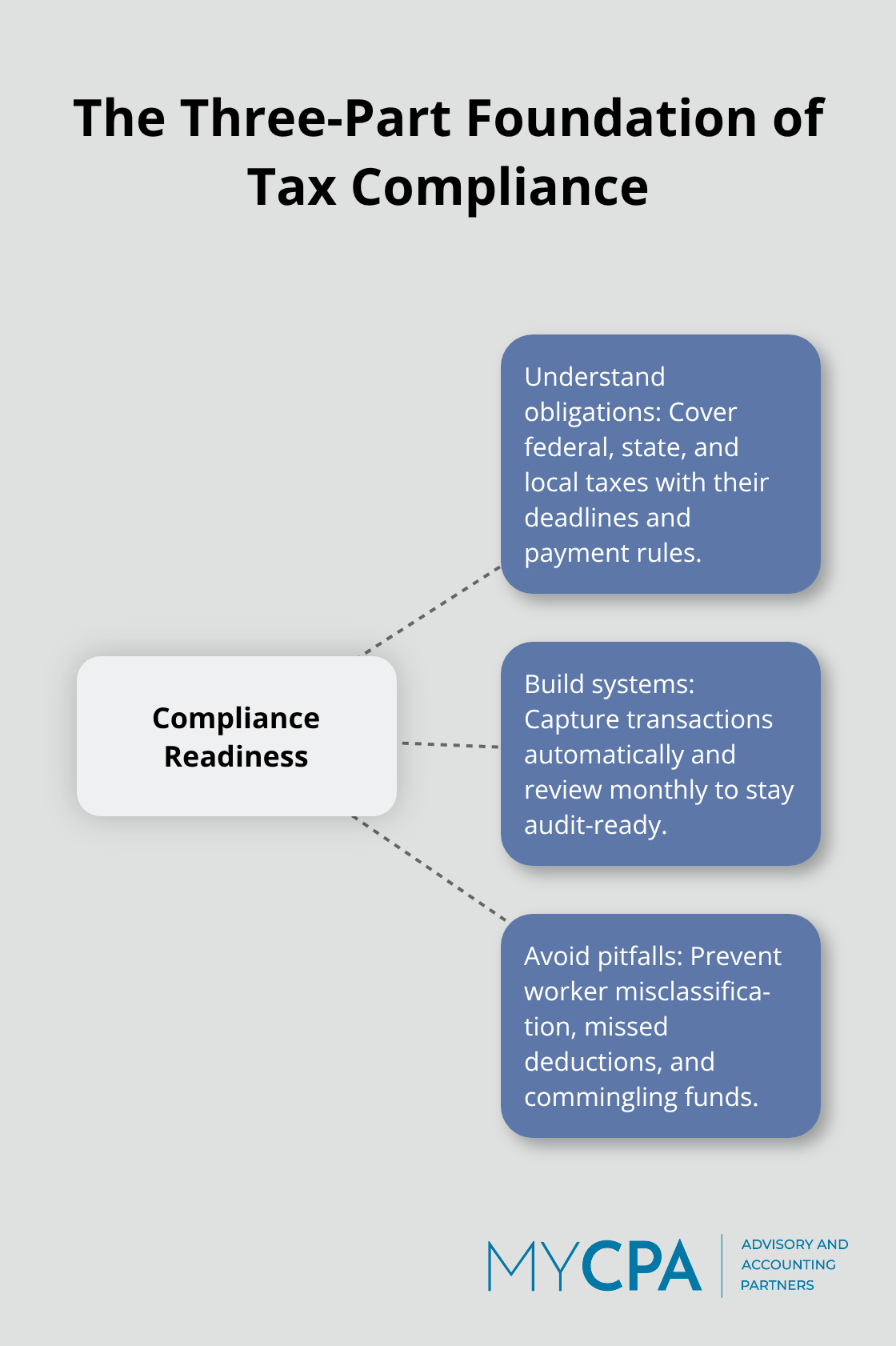
Tax compliance readiness tips work only when you implement them consistently across your organization. The three-part foundation we’ve covered-understanding your obligations, building systems that capture transactions automatically, and avoiding the mistakes that trigger audits-transforms tax season from a source of dread into a manageable process. Proactive compliance planning pays dividends beyond just avoiding penalties.
Businesses that maintain organized records and review finances monthly spot tax planning opportunities their accountants can act on throughout the year rather than after the fact. A sole proprietor who catches a $5,000 deduction gap in July can adjust quarterly estimated payments immediately; one who discovers it in March has already overpaid significantly. The same discipline that keeps you audit-ready also positions you to minimize what you actually owe.
Your tax compliance readiness depends on three things working together: your internal systems running monthly, your team understanding the rules around worker classification and expense documentation, and professional guidance keeping you aligned with changing regulations. We at My CPA Advisory and Accounting Partners work with small business owners to handle the accounting and tax services that transform compliance from a burden into a competitive advantage. Schedule a conversation with a tax professional who understands your specific business structure and can audit your current processes for gaps-My CPA Advisory and Accounting Partners offers personalized financial plans designed specifically for business owners seeking tax efficiency.








Privacy Policy | Terms & Conditions | Powered by Cajabra