
Cash Flow Advisory Guidance for Startups and Growing Firms
Get cash flow advisory guidance for startups and growing firms. Learn proven strategies to manage money, avoid cash crises, and scale sustainably.
You’re running a startup or scaling your business, and you’re probably focused on growth. But here’s what we see constantly: companies collapse not because they lack customers, but because they run out of cash.
At My CPA Advisory and Accounting Partners, we’ve guided hundreds of growing firms through cash flow crises that could have been prevented. This guide gives you the cash flow advisory guidance you need to keep your business breathing.
The brutal truth is that startup failure has almost nothing to do with bad business ideas. According to data from the U.S. Small Business Administration, 82% of business failures stem from cash flow problems, not from lack of demand or poor products. A company can be profitable on paper and still collapse within weeks if cash doesn’t arrive when bills are due. Profit is an accounting concept that shows up on your income statement at the end of the month or quarter. Cash flow is what keeps the lights on today. You can sell a product for $10,000 and show a profit, but if your customer doesn’t pay for 90 days and your rent is due tomorrow, you have a crisis. This distinction separates companies that survive from those that don’t.
Growing firms face a specific cash flow trap that most founders don’t anticipate. When you land a big client and increase production, you need to purchase inventory or hire staff before that client pays you. A manufacturing company might spend $50,000 on materials and labor to fulfill a $75,000 order, but not receive payment for 60 days. That $25,000 gap has to come from somewhere. Seasonal businesses face this annually. A landscaping company in the northern United States generates 70% of its revenue between April and September but has expenses year-round. Many growing firms overestimate how much working capital they actually have available. If you reinvest every dollar back into growth, you have zero buffer when something unexpected happens. A major client delay, equipment breakdown, or sudden supplier price increase can empty your account in days.
Overestimating revenue is the most common mistake we see. Founders project that 90% of potential deals will close and that customers will pay on time. Reality is messier. If you budget based on optimistic projections and only 60% of deals materialize, you’re immediately short on cash. Many firms spend months building inventory based on anticipated orders that never arrive. Others negotiate fixed payment terms with suppliers without understanding their actual cash collection cycle. One growing software company had 30-day payment terms with customers but 60-day terms with vendors, creating a funding gap that required emergency financing.
The solution isn’t complicated, but it requires discipline. You need to forecast cash weekly, not monthly. You need to track what customers actually pay versus what they promise. You need to understand the specific timing of when money leaves your account and when it arrives. These practices form the foundation for the practical strategies that can transform your cash position.
The gap between when you pay suppliers and when customers pay you is where most growing firms hemorrhage cash. Founders often think they’re profitable but can’t meet payroll because money moves through their business too slowly. Fixing this requires three aggressive moves: speed up what customers owe you, slow down what you owe suppliers, and build a buffer that actually exists.
Most growing firms accept customers who pay in 30, 60, or even 90 days. That timeline wasn’t set in stone by law-you accepted it. The National Federation of Independent Business reports that businesses that invoice within one day of delivery collect payments 50% faster than those that wait a week. Invoice on delivery, not at the end of the month. Many software companies now use automated invoicing that sends statements the moment a service is delivered.
A digital marketing agency shifted from monthly invoicing to weekly invoicing and reduced their average collection time from 45 days to 18 days within three months. That’s the difference between survival and crisis. Offer a small discount for payment within 7 days-typically 1 to 2 percent. If a customer pays $10,000 in a week instead of 60 days, you’ve solved a working capital problem that would otherwise require expensive financing.
For customers who consistently pay late, tighten terms before they become customers. If a prospect needs 90-day terms, that’s a signal they have cash flow problems themselves. You don’t want to fund their operations.
Most founders accept whatever payment terms their suppliers offer without question. This is a mistake. A manufacturing firm was paying suppliers in 30 days while collecting from customers in 45 days. They negotiated extended terms with three major suppliers-moving from net 30 to net 45-and freed up $120,000 in working capital overnight without borrowing a penny.
Start by asking. Most suppliers will negotiate if you’re a reliable customer. If you’ve paid on time for six months, you’ve earned the right to ask for 45 or 60-day terms. If you’re new, offer to pay in 30 days but ask for a volume discount instead. As your business grows and you place larger orders, renegotiate again.
Seasonal businesses should structure annual contracts that match their revenue cycle. A landscaping company generating 70 percent of revenue between April and September should negotiate terms with equipment suppliers that don’t require payment until August or September (when cash is flowing). Don’t be shy about this. Your suppliers want your business and would rather adjust terms than lose you to a competitor.
A cash reserve isn’t an optional luxury-it’s the difference between weathering a crisis and closing your doors. Most financial advisors recommend three to six months of operating expenses, but that’s theoretical advice for stable companies. Growing firms need a minimum of one month of operating expenses in reserve before you scale further.
A one-month buffer means if a major customer delays payment by 30 days, you don’t panic. If an unexpected equipment failure costs $15,000, you handle it. Many founders resist building reserves because they want to reinvest everything into growth. This is backwards. A $200,000 annual revenue company with $50,000 in monthly expenses needs $50,000 sitting in a separate account before hiring that third employee or launching that new product line.
Set up a dedicated reserve account at a different bank and move 10 percent of revenue into it until you hit your target. Once you reach one month of operating expenses, you can reduce this to 5 percent per month to maintain it. Track this reserve separately from working capital. This money doesn’t move.
Weekly cash flow tracking reveals exactly how much cash you have on any given day and when shortfalls appear. Most growing firms track cash monthly, which means they discover problems too late. Forecast cash three weeks ahead by tracking every invoice sent, every payment received, and every expense due. A simple spreadsheet showing what money arrives and leaves each week prevents surprises that force emergency decisions.
These three moves-accelerating collections, extending payables, and building reserves-create the foundation for stable cash flow management. But accounting services alone won’t protect you from the mistakes that drain reserves faster than you can build them.
The mistakes that drain cash reserves happen quietly, often months before a crisis surfaces. Founders make the same errors repeatedly, and most of them trace back to disconnects between what founders expect to happen and what actually happens. Revenue projections sit too high. Seasonal patterns get ignored. Growth consumes cash faster than it creates it. And worst of all, money gets spent before it actually arrives in the bank account. These aren’t theoretical problems-they’re the specific behaviors that force growing firms to choose between payroll and suppliers.
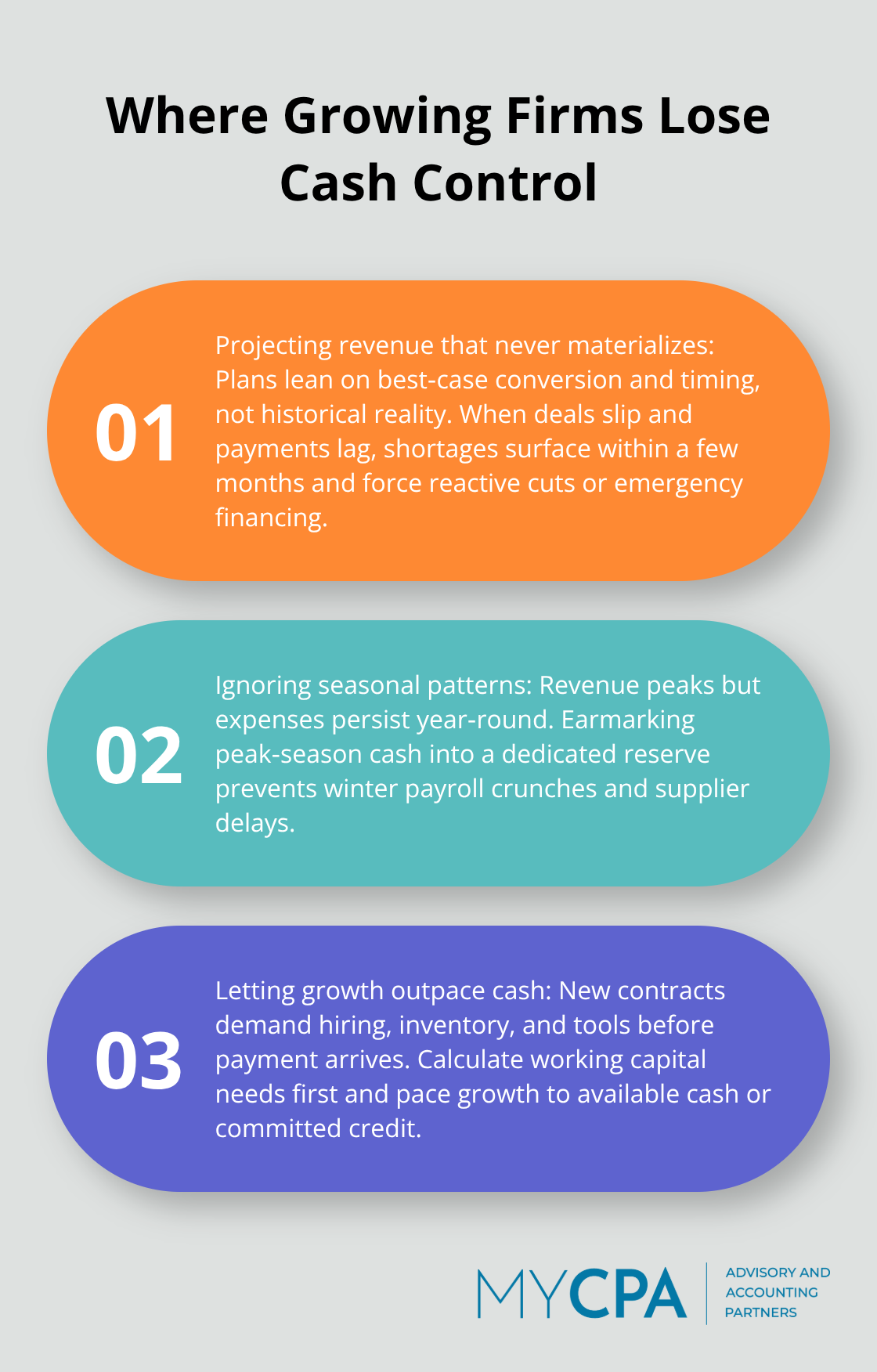
Most founders build financial plans around their best-case scenario, not their realistic scenario. A SaaS company might assume 85 percent of qualified leads will convert to customers when historical data shows 55 percent conversion. A consulting firm might budget for 100 percent utilization of billable hours when 75 percent is the industry standard. The gap between projection and reality creates a cash shortage that appears three to four months into the year when founders realize revenue won’t meet expectations.
One manufacturing firm projected $2.1 million in revenue for the year based on verbal commitments from prospects. Actual revenue came in at $1.3 million because deals slipped and customers delayed purchases. The firm had already hired two additional staff members and committed to a lease expansion based on the inflated projection. This single mistake consumed the entire year’s profit and forced the owner to inject personal funds to cover the gap.
The solution is brutal honesty about conversion rates, deal timing, and customer payment behavior. Look at your actual historical data from the past two years. If 60 percent of prospects become customers, plan for 55 percent. If customers take 45 days to pay on average, assume 50 days in your forecast. Conservative assumptions create breathing room instead of crisis.
Seasonal businesses often fail because founders treat revenue as if it arrives evenly throughout the year. A landscaping company generates 70 percent of annual revenue between April and September but incurs expenses every month. A retail business sees 40 percent of annual sales in November and December but must pay rent and staff year-round. Seasonal businesses that don’t plan for cash flow gaps face working capital shortages at higher rates than their non-seasonal counterparts.
A pool maintenance company brought in $85,000 monthly during summer but only $12,000 during winter. The owner spent most summer revenue on growth initiatives and had nothing left for winter payroll. The company nearly collapsed in February when cash dropped below $8,000.
The fix is straightforward: during your peak revenue months, immediately move a percentage of that revenue into a reserve account designated specifically for lean months. A business that generates 70 percent of revenue in six months should move 15 to 20 percent of peak-month revenue into reserves starting in month one of the peak season. That reserve covers lean-month expenses without requiring emergency borrowing or delayed payments to suppliers.
Fast growth feels like success, but it’s actually a cash drain if you’re not managing working capital carefully. When you land a major new client and increase production, you need to purchase materials or hire staff before that customer pays you. A services company might need to hire two additional employees and provide equipment before a large contract generates revenue. That upfront investment could total $80,000 in salary, benefits, and equipment, but the contract might not deliver payment for 60 days.
Growth-stage companies often make this mistake repeatedly, assuming that because revenue is growing, cash is improving. The opposite is frequently true. A marketing agency landed a $120,000 annual contract and immediately hired a full-time employee at $48,000 annually to service the account. They purchased software licenses and equipment totaling $8,000. The client didn’t pay for 45 days. During those 45 days, the agency had to cover payroll and other operational expenses from existing cash reserves. The growth was real, but the cash impact was negative for two months.
The solution is to slow growth to match your cash position, not your revenue. Before taking on a major new client or project, calculate the working capital required to service it. If you don’t have that cash available or accessible through credit, don’t take the engagement. Profitable growth that requires external financing is growth that owns you, not the other way around.
Cash flow management separates businesses that survive from those that close. The 82 percent of startups that fail due to cash problems didn’t lack customers or good ideas-they ran out of money because they didn’t control when cash arrived and when it left. Start today by calculating your current cash position, listing every dollar owed to you, every payment you owe, and your current bank balance, then project cash flow for the next four weeks.
Take one action this week to strengthen your position. If you’re not invoicing on delivery, start immediately. If you haven’t asked suppliers about extended terms, make those calls today. If you don’t have a one-month cash reserve, begin moving 10 percent of revenue into a dedicated account right now. These moves prevent the cash flow crises we see repeatedly in growing firms.
We at My CPA Advisory and Accounting Partners help startups and growing firms build sustainable cash flow strategies through tailored business advisory and consulting services. Our team works with you to create financial plans that match reality, not optimistic projections, and provides the cash flow advisory guidance that keeps your business stable while you focus on growth. If you’re uncertain about your current cash position or need help building a forecasting system that actually works, reach out to us today.








Privacy Policy | Terms & Conditions | Powered by Cajabra