
Cash Flow Advisory Guidance for Startups and Growing Firms
Get cash flow advisory guidance for startups and growing firms. Learn proven strategies to manage money, avoid cash crises, and scale sustainably.
Starting a business means handling taxes from day one, and most founders aren’t prepared for the complexity. Tax compliance for startups isn’t optional-it’s a legal requirement that affects your bottom line and protects you from penalties.
At My CPA Advisory and Accounting Partners, we’ve seen firsthand how early mistakes cost startups thousands in back taxes and missed deductions. This guide walks you through the registrations, obligations, and credits you need to know about right now.
Your first tax obligation arrives before you make your first sale. An Employer Identification Number, or EIN, is a nine-digit identifier the IRS assigns to your business, and you need it whether you plan to hire employees or not. Most startups apply for an EIN through the IRS website at no cost, and you’ll receive it immediately after submission. Some founders use their Social Security number instead, which creates a costly mistake because it blurs personal and business finances and limits your liability protection. The IRS processes roughly 3 million EIN applications annually, and the vast majority are completed online in minutes.
After you obtain your EIN, you’ll need state and local tax registration, which varies dramatically depending on where you operate. Some states require a general business license before you can legally operate, while others don’t. Delaware, for example, requires a Certificate of Good Standing if you incorporate there, but your actual operating state may have separate requirements. Texas doesn’t mandate a state business license for most sole proprietors and partnerships, but you’ll still need local permits depending on your city. The key is checking your specific state’s Secretary of State website and your local city or county clerk’s office, not assuming one registration covers everything.
Sales tax registration is where startups get trapped. If you sell physical products or taxable services in a state, you must register for sales tax in that state before collecting revenue. Many founders delay this registration thinking they can handle it later, then face back taxes and penalties when audited. The National Federation of Independent Business reports that sales tax compliance errors are among the most common audit triggers for small businesses. Registration timelines vary by state-some require it instantly while others take up to four weeks. Once registered, you’re responsible for collecting and remitting sales tax based on your state’s rates, which range from zero in states like Alaska and Montana to over 7.25 percent in California and Tennessee.
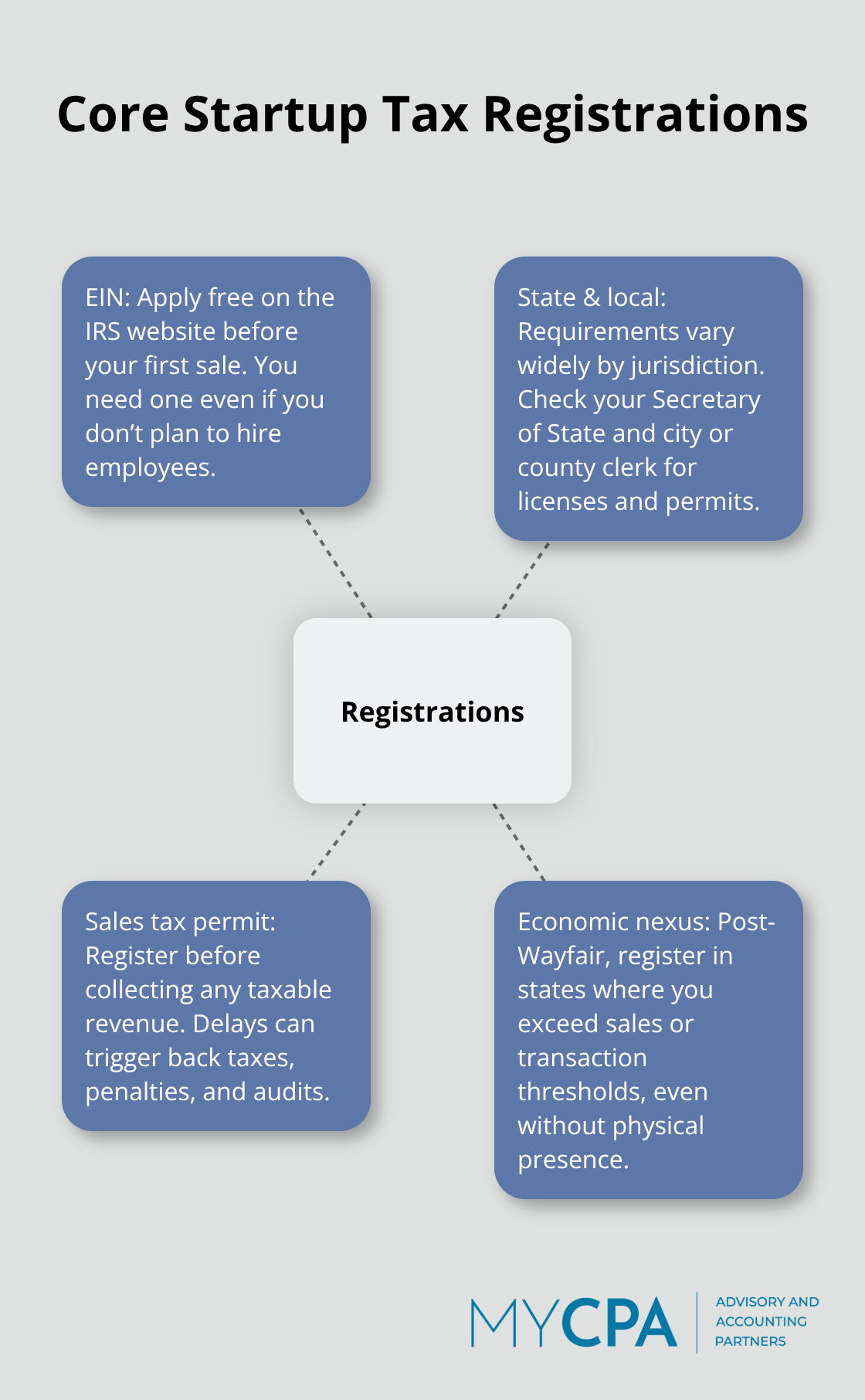
If you sell online, you have nexus obligations in multiple states, meaning you must register in states where you have customers or warehouses. The Supreme Court’s 2018 South Dakota v. Wayfair decision expanded this requirement significantly, and most online sellers now must collect sales tax in any state where they have substantial sales (typically defined as over $100,000 or 200 transactions annually). Failure to register costs you money in two ways: you’ll owe back taxes plus penalties and interest, and you risk losing your business license entirely. These registration steps form your foundation, but they’re only the beginning-your ongoing tax obligations start immediately once you open your doors.
Payroll taxes shock most startup founders on their first payday. Once you hire even one employee, you must withhold federal income tax, Social Security, and Medicare from their paychecks, then remit those amounts to the IRS on a schedule determined by your deposit size. The IRS requires deposits either monthly or semi-weekly, and missing a deadline triggers payroll tax penalties.
Many founders outsource payroll processing to services like Gusto or ADP to avoid these mistakes. This costs roughly $30 to $60 monthly per employee but eliminates the compliance headache entirely. Quarterly payroll tax forms (Form 941) show the IRS exactly what you withheld and paid, and the Social Security Administration cross-checks this against employee W-2s filed at year-end.
Most startup owners underestimate their payroll tax liability because they forget that as the employer, you also pay a matching portion of Social Security and Medicare taxes on top of employee withholdings. If you have one employee earning $50,000 annually, you’ll owe roughly $3,825 in employer payroll taxes alone, separate from what you withhold from their paycheck.
Quarterly estimated tax payments matter equally if you structure your startup as an S-corp, C-corp, or sole proprietorship. Unlike W-2 employees, you don’t have taxes withheld automatically, so the IRS expects you to pay estimated taxes quarterly using Form 1040-ES or Form 1120-W depending on your entity type. These payments are due April 15, June 15, September 15, and January 15, and underpayment penalties compound quickly if you skip quarters.
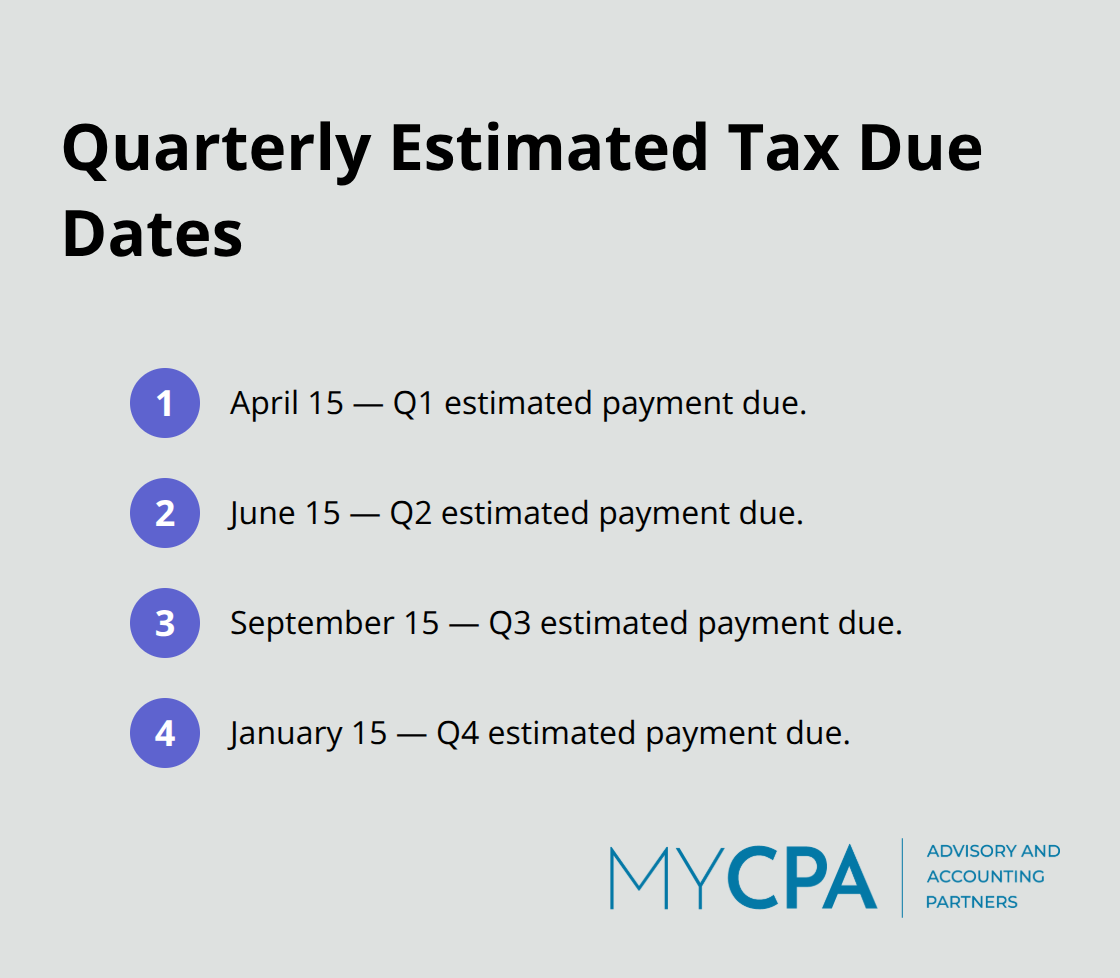
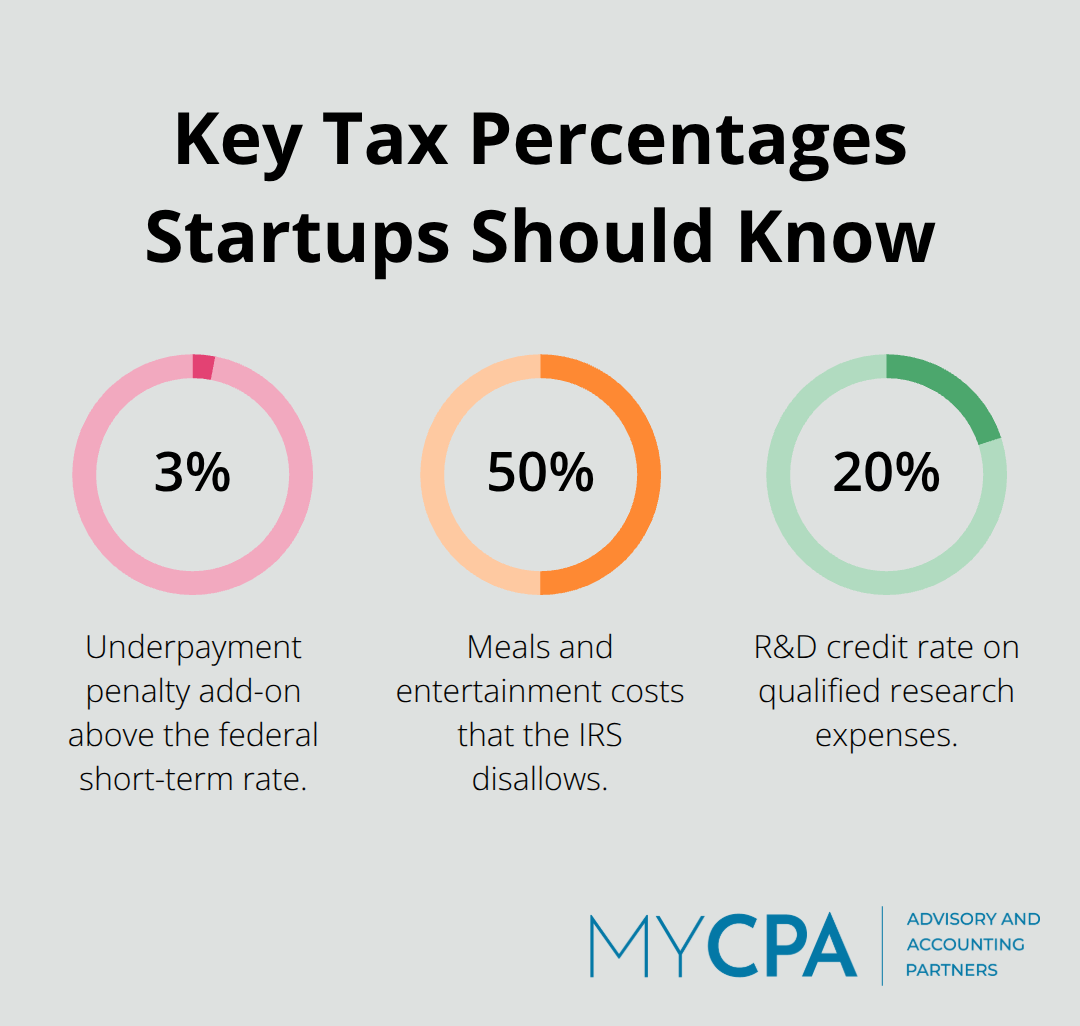
The penalty rate sits at the federal short-term interest rate plus 3 percent, which means missing one quarter can cost you hundreds in penalties alone. Calculating these payments accurately requires knowing your projected annual income, which most founders struggle with during their first year. Underestimating your income leads to penalties, while overestimating wastes cash flow you need for operations.
Your record-keeping system determines whether you survive an audit. The IRS recommends maintaining receipts, invoices, bank statements, and expense documentation for at least three years, though the statute of limitations extends to six years if you underreport income by 25 percent or more. Digital accounting software like QuickBooks or FreshBooks automatically categorizes expenses and generates reports that satisfy IRS requirements, and these platforms cost $15 to $50 monthly depending on features.
Paper records fail audits because they’re incomplete and difficult to verify, while organized digital records demonstrate you take compliance seriously. Starting these systems now prevents the nightmare of reconstructing six months of transactions when an auditor knocks on your door. The IRS increasingly expects digital documentation, and auditors view handwritten ledgers with skepticism.
Deductions only count if you document them properly. The IRS doesn’t accept vague expense categories or missing receipts, and auditors scrutinize startup deductions more heavily than established businesses. Home office deductions (whether you use the simplified $5 per square foot method or actual expense method) require proof that you use a dedicated space exclusively for business. Equipment purchases need receipts showing the date, amount, and business purpose.
Mileage deductions demand a contemporaneous log showing dates, destinations, and business purposes for each trip. The IRS allows 67 cents per mile for 2024 business travel, but you must track this consistently throughout the year. Meal and entertainment expenses face stricter scrutiny than other deductions, and the IRS disallows 50 percent of these costs automatically.
These documentation habits position you to claim legitimate deductions while avoiding audit triggers that cost time and money to defend.
The gap between deductions startups think they can claim and deductions the IRS actually allows determines thousands of dollars in tax savings or penalties. Home office deductions top the IRS audit list for small businesses because founders misunderstand what qualifies. You can only deduct a home office if you use a dedicated space exclusively for business, not a corner of your kitchen table where you occasionally work. The IRS offers two methods: the simplified approach at $5 per square foot (capped at 300 square feet, so maximum $1,500 annually) or the actual expense method where you calculate your home’s total square footage, determine the percentage used for business, then deduct that portion of rent, utilities, insurance, and repairs.
The simplified method works for most startups because it avoids the detailed record-keeping actual expenses demand, but actual expenses win if your home office exceeds 60 square feet. Equipment purchases like computers, furniture, and machinery qualify for depreciation deductions spread over several years, or Section 179 expensing which lets you deduct up to $1,160,000 of qualifying equipment in 2024 immediately rather than spreading costs across years. This matters because taking the Section 179 deduction in year one reduces your taxable income when you likely need the deduction most.
Research and Development tax credits deliver real money back to startups that develop new products or processes, yet most founders never claim them because they assume these credits apply only to tech companies. The IRS defines qualified research broadly to include businesses in manufacturing, software development, engineering, and even certain service industries that improve processes or create new functionality. If your startup spent $50,000 developing a new product feature, testing prototypes, or improving manufacturing efficiency, you qualify for the R&D credit worth 20 percent of qualified research expenses, potentially $10,000 back.
The catch is documentation-you must maintain detailed records showing the research activities, employee time spent on qualifying work, and materials consumed. Small business tax credits extend beyond R&D to include the Work Opportunity Tax Credit (up to $2,400 per employee hired from targeted groups), the Employee Retention Credit (though this expired December 31, 2025), and state-specific incentives that vary dramatically by location.
Startups should track potential qualifying expenses throughout the year rather than scrambling to reconstruct them during tax season, because IRS auditors scrutinize R&D and credit claims heavily when they lack contemporaneous documentation showing what work was performed and when. This approach prevents the nightmare of missing receipts or vague records that auditors reject outright. Digital accounting software automatically flags potential deductible expenses and organizes them by category, making year-end tax preparation far simpler and more accurate.
Tax compliance for startups demands your attention from month one, and the decisions you make early shape your tax bill for years to come. The registrations, payments, and deductions we’ve covered form your foundation, but staying compliant requires consistent attention and accurate record-keeping throughout your business life. Most startup founders underestimate how much time tax administration consumes-between quarterly estimated payments, payroll processing, sales tax remittance, and year-end reporting, you’ll spend dozens of hours annually on these tasks.
This is where working with a tax professional becomes practical rather than optional. A CPA or tax advisor catches mistakes before they become expensive problems, identifies deductions you’d miss on your own, and handles the administrative burden so you focus on growth. We at My CPA Advisory and Accounting Partners work specifically with business owners navigating these early-stage challenges, and our tax services minimize your liabilities while our accounting expertise keeps your records organized throughout the year.
Your next step is straightforward: audit your current tax setup against what we’ve covered here. Do you have your EIN registered, are you collecting sales tax in all required states, and is your record-keeping system digital and organized? If you’re uncertain about any of these, contact My CPA Advisory and Accounting Partners to discuss your specific situation and build a tax plan that actually works for your startup.








Privacy Policy | Terms & Conditions | Powered by Cajabra