
Tax Compliance Readiness Tips Every Small Enterprise Needs
Prepare your small business for tax season with essential compliance readiness tips. Avoid penalties and stay audit-ready with our practical guidance.
Growing a business without a plan is like throwing money at problems and hoping they stick. At My CPA Advisory and Accounting Partners, we’ve seen countless companies hit growth plateaus because they skipped the financial groundwork.
Business growth planning isn’t just about ambition-it’s about knowing your numbers, optimizing your taxes, and building systems that actually scale. This guide walks you through the financial decisions that separate sustainable growth from costly mistakes.
Most business owners have a vague idea of their revenue but can’t tell you which products, services, or customer segments actually generate profit. This gap costs real money. Start by mapping every revenue stream and calculating the profit margin for each one. If you sell both services and products, they likely have different margins, different cash conversion cycles, and different growth potential.
A service business with 60% margins behaves completely differently from a product line running at 25% margins, yet many owners treat them identically in their growth plans. Separate them out, measure them independently, and be honest about which ones are actually worth scaling. Some revenue streams look impressive on the top line but evaporate after accounting for delivery costs, customer acquisition, and fulfillment. Others are unglamorous but highly profitable and predictable. The data matters more than the narrative you’ve built around your business.
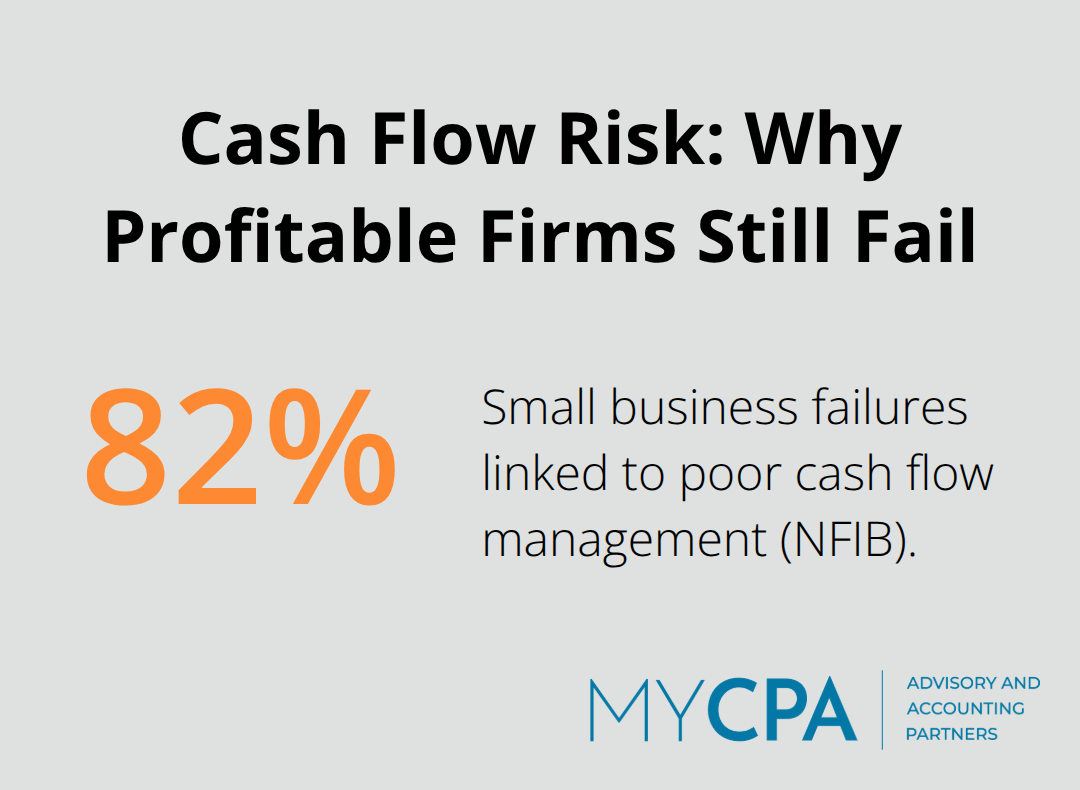
A profitable company can run out of cash and fail. This is not theoretical. The National Federation of Independent Business reports that poor cash flow management contributes to roughly 82% of small business failures. Revenue recognition and actual cash in your bank account are not the same thing.
If you invoice customers on net-30 or net-60 terms, you finance their operations while waiting for payment. If you stock inventory before you sell it, cash leaves your account weeks before revenue arrives. Growth amplifies this problem. Doubling your business means doubling your working capital needs unless you fundamentally change how you operate.
Calculate your cash conversion cycle: the number of days between paying for inventory or labor and receiving cash from customers. A 60-day cycle means you need enough cash reserves to cover two months of operations at your new scale. Most growth plans ignore this entirely and then wonder why they hit a wall. Map out your monthly cash flow for the next 12 months, including seasonal variations, planned expenses, and customer payment timing. If the picture is tight, you need funding or operational changes before you accelerate growth.
Revenue concentration is a hidden weakness that looks like strength. If one customer accounts for 30% of revenue, you don’t have a diversified business-you have a dependency. Similarly, if 80% of profit comes from one product line, growth in that area masks vulnerability everywhere else. Identify which customers, products, or services generate your actual profit, then assess the risk if any of them disappear.
Look at your cost structure too. Fixed costs that made sense at your current scale become crushing obligations if growth stalls. A large office lease or permanent staff salaries that scale with revenue are fine, but staff and overhead that don’t scale with revenue become liabilities fast.
Finally, assess the quality of your financial data. If your bookkeeping is incomplete, your revenue recognition is inconsistent, or your expense tracking is sloppy, every growth decision you make is built on sand. Clean, accurate financial information forms the foundation for everything that comes next-including the realistic growth targets you’ll set in the next section.
Growth targets mean nothing without financial anchors. Most business owners set revenue goals based on wishful thinking rather than operational reality. Work backward from your cash flow analysis and cost structure instead. If your cash conversion cycle is 45 days and you currently operate with 90 days of working capital reserves, doubling revenue requires doubling that reserve to 180 days. That’s real capital you need before you scale, not after.
Set your revenue target first, then calculate the working capital required to support it. If the number exceeds what you can fund, your growth target is fiction. A realistic approach ties revenue growth to specific operational changes: reducing payment terms from net-60 to net-30 frees cash immediately, switching to faster inventory turnover reduces capital needs, or shifting to retainer-based revenue improves predictability.
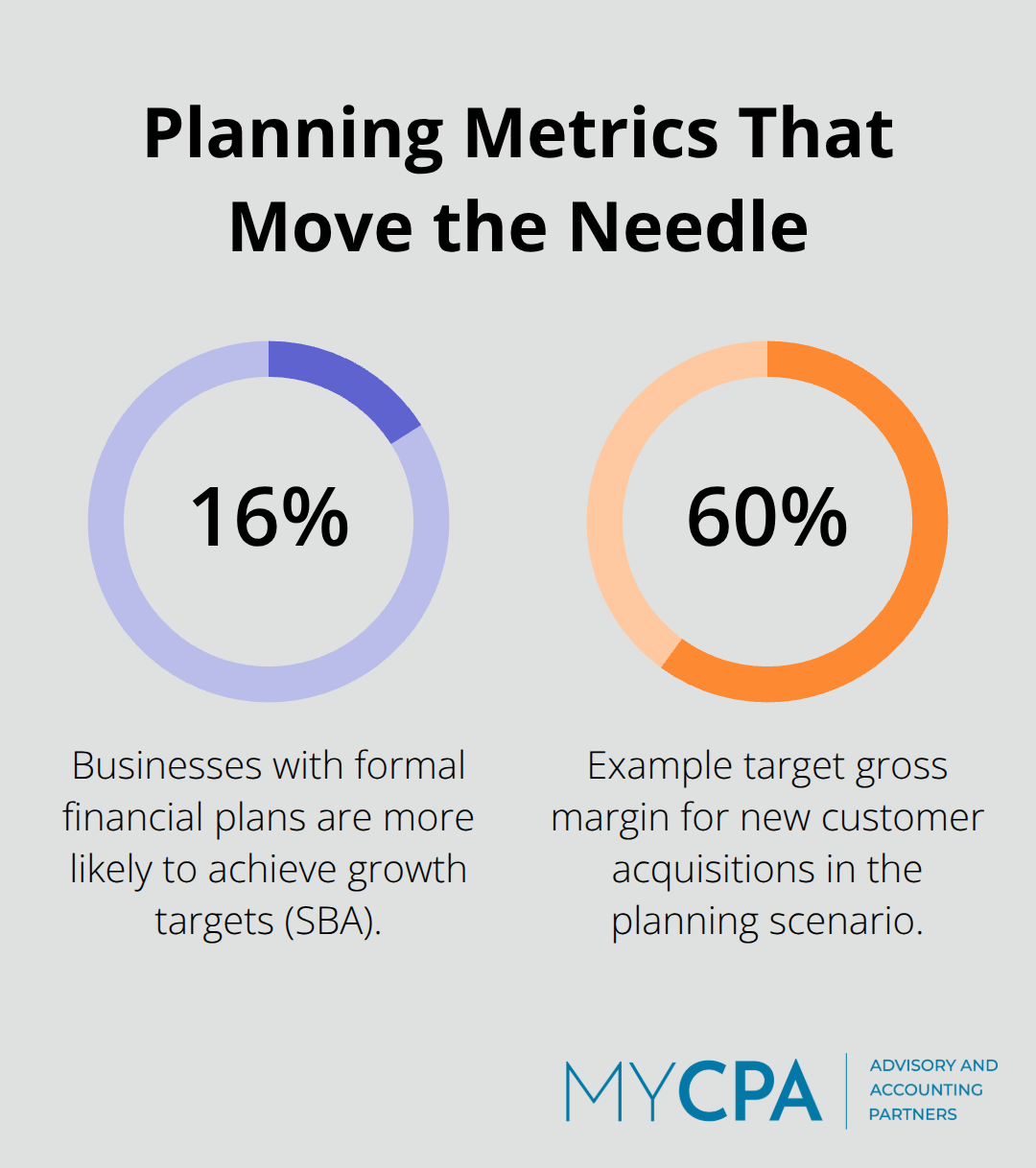
The Small Business Administration reports that businesses with formal financial plans are 16% more likely to achieve growth targets than those without them. Your targets should specify monthly revenue by product line, customer acquisition costs per channel, and the timeline for reaching each milestone. Vague targets like reaching $2 million in annual revenue tell you nothing about the operational work required. Specific targets like acquiring 12 new customers per month at an average contract value of $8,000 with a 60% gross margin give you something to execute against and measure.
Scaling operations requires hiring in advance of revenue growth, not after. This is where most businesses fail. You cannot hire your tenth employee after you need them; you hire them when you have the cash flow and confidence that revenue growth justifies the expense. Map out your hiring plan by role and timeline, then calculate the fully loaded cost of each hire including salary, taxes, benefits, and equipment. Many owners underestimate fully loaded costs by 30% or more. A $60,000 salary costs closer to $80,000 when you include payroll taxes, workers compensation, health insurance, and equipment.
If you plan to hire three people in the next 18 months, that’s roughly $240,000 in committed expense. Your growth plan must generate enough incremental profit to cover these costs plus provide a margin for error.
Determine what capital you need beyond working capital and payroll. Technology infrastructure, equipment, facilities, and systems upgrades often represent 15% to 25% of growth investment. A service business scaling from 10 to 20 employees might need $50,000 to $100,000 in technology and infrastructure improvements. These investments enable your team to operate efficiently at scale and prevent bottlenecks that kill growth momentum.
Funding options include retained earnings, bank lines of credit, SBA loans, or equity investment. Each option carries different costs and implications for your business. Bank lines of credit move fastest if you have strong financial statements and cash flow history. SBA loans take longer but offer better terms for businesses with two years of operating history. Retained earnings avoid dilution but limit how fast you can grow. The timing matters enormously. Start conversations with lenders or investors six months before you need capital, not when cash runs dry. This preparation gives you options and prevents desperation from driving poor decisions. With your growth targets and strategic financial advisory insights locked in, you’re ready to address the tax implications of scaling-a step that separates profitable growth from growth that erodes your bottom line.
Most business owners treat taxes as an annual event handled by their accountant in March. This passive approach costs tens of thousands during growth phases. Tax planning during scaling is not about dodging obligations-it’s about timing income, managing entity structure, and capitalizing on deductions before growth pushes you into higher brackets. The difference between a business that plans taxes and one that reacts to them often runs 15% to 25% of net income.
Your tax liability rises faster than your revenue during growth because you move into higher marginal tax brackets. A service business growing from $500,000 to $1 million in annual revenue doesn’t just double its tax bill-it accelerates into a steeper bracket. Federal income tax rates for pass-through entities reach 37% at the highest levels, and when you add state income tax, self-employment tax, and potential alternative minimum tax, your effective rate climbs substantially.
The IRS allows you to reduce this burden through strategic timing of income and deductions, but only if you plan ahead. Quarterly estimated tax payments must arrive by April 15, June 15, September 15, and January 15 of the following year. Missing these deadlines triggers penalties and interest that compound throughout the year. Calculate your estimated quarterly liability now, not after you’ve already spent the money on growth initiatives. If your first quarter shows unexpectedly strong revenue, adjust your second quarter payment upward rather than falling behind.
Your business structure directly determines your tax exposure. A sole proprietorship or single-member LLC taxed as a sole proprietor pays self-employment tax on all net income at 15.3%, which is brutal during growth. An S-corporation allows you to split income between W-2 wages (subject to payroll tax) and distributions (not subject to self-employment tax), but only if you take a reasonable salary.
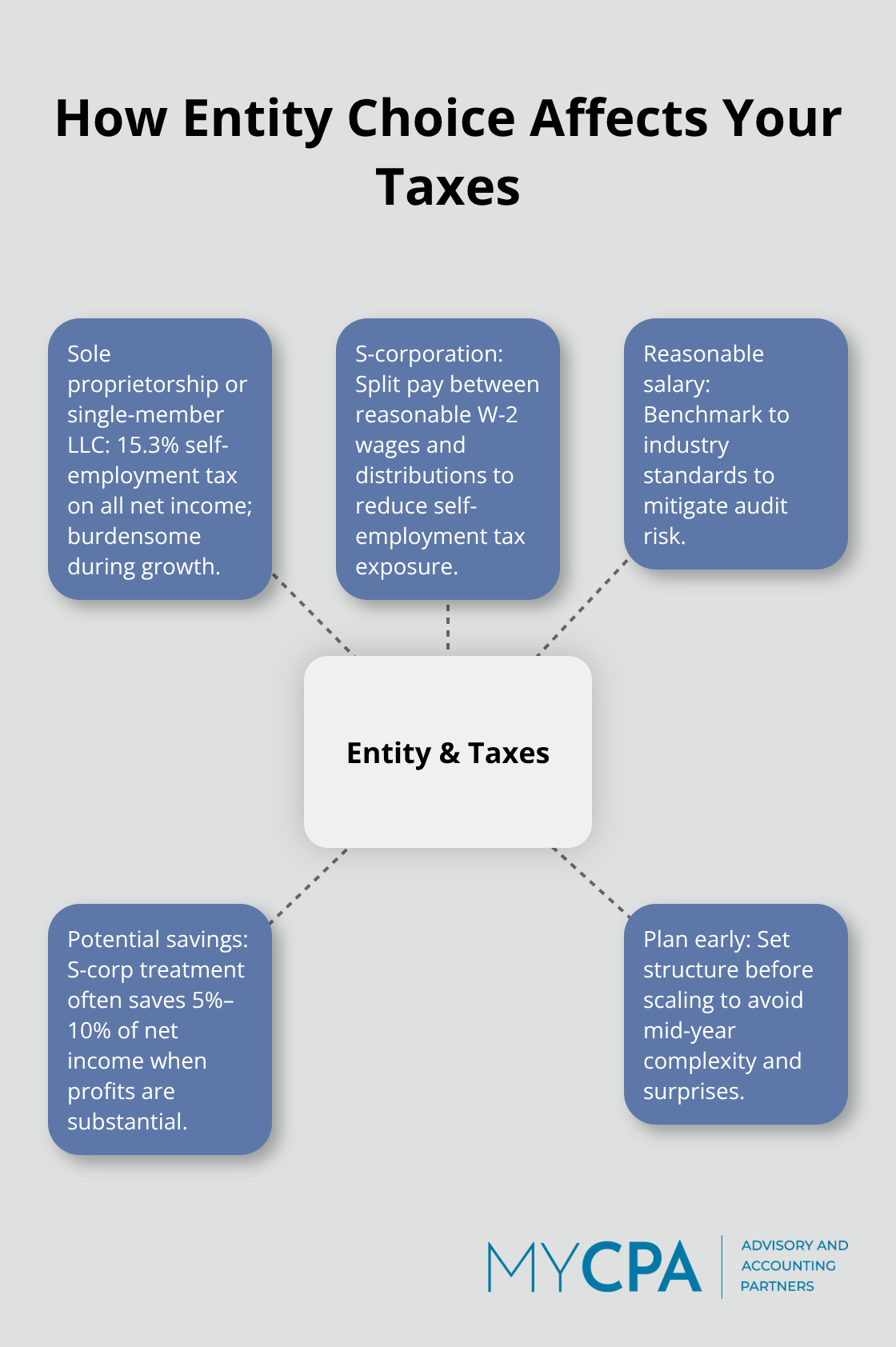
The IRS watches S-corp owners closely, and setting your salary artificially low invites audit risk. A reasonable salary for your role typically falls within industry standards reported by the Bureau of Labor Statistics or comparable salary surveys. The tax savings from S-corp treatment often range from 5% to 10% of net income, but only if your business generates substantial profit after paying yourself a competitive wage. If you’re a consulting firm with $800,000 in revenue and $300,000 in profit after expenses and your reasonable salary is $120,000, you can take $120,000 as W-2 wages and $180,000 as distributions, saving roughly $27,000 annually in self-employment tax. That’s real money that stays in your business for growth investment.
Entity structure decisions made now prevent costly restructuring later. Converting from a sole proprietorship to an S-corporation mid-year creates accounting complexity and potential tax surprises. If you’re planning to scale significantly, consult with a tax professional about entity structure before revenue accelerates.
Depreciation and asset management become increasingly important as you invest in equipment, vehicles, and technology infrastructure. Section 179 expensing allows you to deduct up to $2.5 million of qualifying business property in a single year, with annual adjustments for inflation. Bonus depreciation provides additional write-downs for certain assets. These tools compress tax deductions into the year you make the investment, reducing taxable income when you scale rapidly.
If you’re purchasing $200,000 in new technology infrastructure, Section 179 could allow you to deduct the full amount this year rather than spreading it over five years. The timing of these purchases matters enormously. A $200,000 equipment purchase in December creates a massive deduction for the current tax year, but the same purchase in January hits next year’s tax return. Plan major capital investments around your tax calendar, not just your operational needs.
Retirement contributions offer another legitimate tax reduction lever. A Solo 401(k) allows self-employed business owners to contribute up to $69,000 annually (as of 2024, adjusted annually for inflation) in combined employee and employer deferrals, reducing taxable income dollar-for-dollar. A SEP-IRA offers simpler administration and allows contributions up to 25% of net self-employment income.
For business owners, these aren’t just retirement savings vehicles-they’re tax-deferred growth accelerators that reduce current-year tax liability while building long-term wealth. If your business generates $200,000 in profit and you contribute $50,000 to a Solo 401(k), you reduce your taxable income to $150,000. The tax savings at a 37% marginal rate approach $18,500, which then funds your growth initiatives or further retirement savings.
Quarterly tax planning prevents the shock of a massive tax bill in April. Too many growing businesses reinvest all their profit back into operations, then face a tax liability they can’t immediately pay. Work with your accountant to forecast quarterly tax liability based on year-to-date revenue and expenses. If projections show a significant liability in Q4, adjust your estimated payments or reduce distributions in the final quarter. Alternatively, accelerate deductible expenses into the current year if you have flexibility-a software subscription renewal or professional development expense moved from January to December reduces this year’s taxable income. This isn’t tax evasion; it’s tax management within the rules the IRS provides.
Sustainable growth requires three non-negotiable elements: accurate financial data, realistic targets tied to operational capacity, and proactive tax management. You now understand where your money comes from, what working capital you need to scale, and how tax brackets accelerate faster than revenue. The gap between businesses that execute this framework and those that skip it shows up in profitability, cash flow stability, and the ability to fund growth without desperation.
Most owners underestimate working capital needs, overestimate hiring timelines, and treat taxes as an afterthought. These mistakes compound quickly. A business that grows 50% without planning for cash flow impact hits a wall. A business that scales payroll without calculating fully loaded costs suddenly discovers it cannot afford the team it hired. A business that ignores tax brackets watches profit margins evaporate into unexpected liabilities. Professional financial guidance changes this equation by translating growth ambition into executable financial strategy.
We at My CPA Advisory and Accounting Partners work with business owners to build realistic business growth planning tailored to your specific situation. Our accounting services provide the accurate reporting you need to make real decisions, while our business advisory services help you forecast capital requirements and structure your entity for tax efficiency. Start your conversation with us today by visiting My CPA Advisory and Accounting Partners to connect with a financial advisor who understands both the operational side of growth and the financial mechanics that make it sustainable.








Privacy Policy | Terms & Conditions | Powered by Cajabra