
Tax Compliance Readiness Tips Every Small Enterprise Needs
Prepare your small business for tax season with essential compliance readiness tips. Avoid penalties and stay audit-ready with our practical guidance.
Startup cash flow management is where most founders hit their first real wall. You can have a great product and solid sales, but if cash runs out before revenue arrives, nothing else matters.
We at My CPA Advisory and Accounting Partners have seen countless startups struggle with irregular income, high burn rates, and the timing gaps between what they owe and what they’re owed. The good news is that this problem has real solutions.
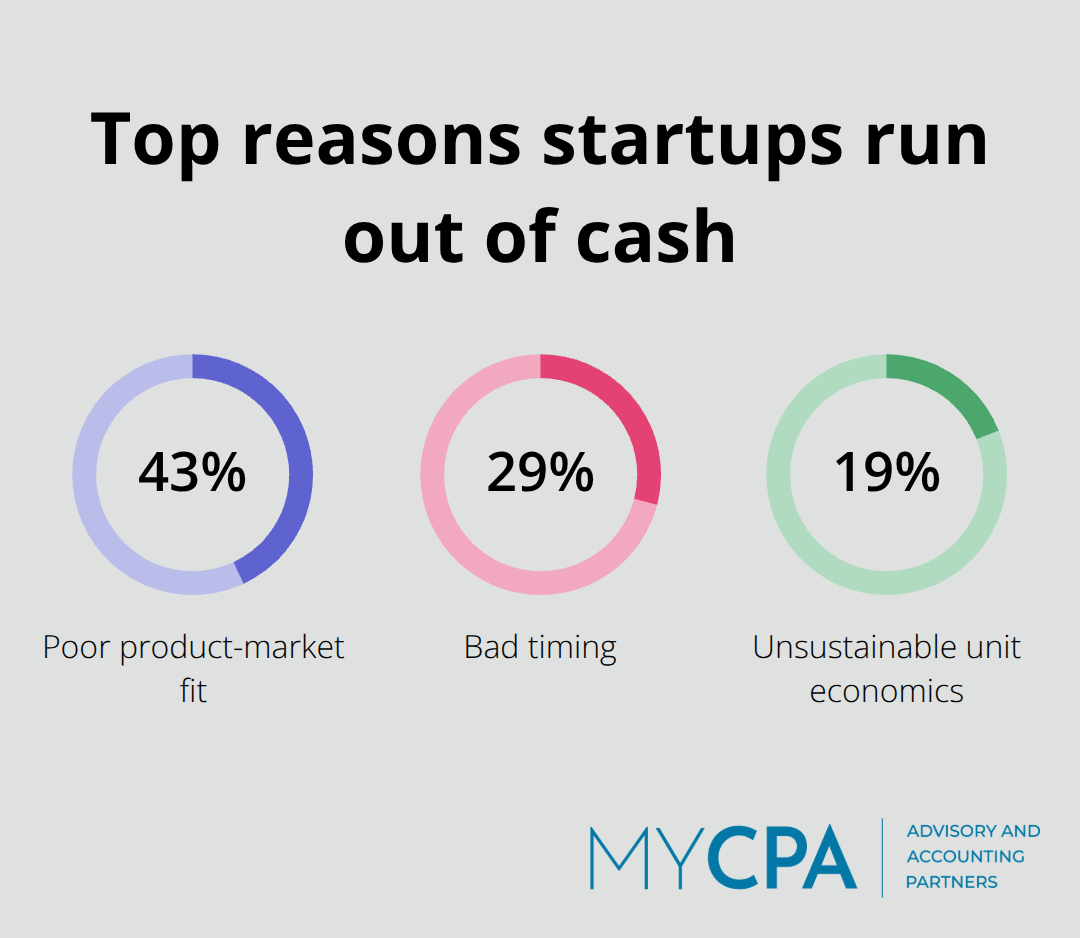
Startups face three distinct cash flow problems that most founders underestimate until they hit a wall. The first is revenue unpredictability. Unlike established businesses with steady contracts, startups often depend on a handful of large deals, seasonal spikes, or customers who delay payment indefinitely. The more telling causes of startup failure-poor product-market fit (43%), bad timing (29%), and unsustainable unit economics (19%)-reveal why capital dries up. When one major customer pushes their payment from net-30 to net-90 terms, your runway shrinks overnight. You cannot forecast accurately if you treat all revenue as equally likely to arrive on schedule.
Instead, segment customers by payment history and likelihood. Enterprise clients typically pay in 60–120 days, while smaller accounts might pay in 30 days or never at all. Build your cash forecast around the worst-case arrival timing for each customer segment, not the invoice date.
Your second problem is operating expenses, and payroll dominates this category. Most startups spend 60–70% of monthly burn on salaries and benefits, which means your hiring decisions directly determine how long you survive. If you hire aggressively before revenue stabilizes, you lock in fixed costs that cannot flex downward when deals slow. This is where most founders make their critical mistake: they hire based on what they need to win, not on what they can afford to lose. Instead, build a hiring roadmap tied directly to milestone-based funding events. Hire sales and support staff only after you have confirmed revenue from at least three customers. Hire engineering only after you have product-market fit signals. This discipline is brutal but necessary. One founder we worked with reduced monthly payroll from 75% of revenue to 45% simply by delaying two hires until after Series A closed, extending runway by eight months without cutting existing staff.
Your third problem is the gap between when you must pay vendors and when customers pay you. This is not a theoretical issue. If you purchase inventory on net-60 terms and your customers pay on net-90 terms, you need enough cash on hand to cover 30 days of inventory costs upfront. Large enterprise deals make this worse. You might invoice a customer for 50,000 dollars in month one, but payment does not arrive until month three. Your team still needs salaries in months one, two, and three. This timing mismatch is why many high-revenue startups still run out of cash.
The solution is to separate your cash flow into three distinct buckets: operating cash for daily expenses, strategic cash for growth investments, and a cash reserve for emergencies. Keep operating cash in a liquid deposit account where you can access it immediately. Place strategic cash in money market funds or short-term instruments that yield 2–3% in current rate environments. This segregation forces discipline.
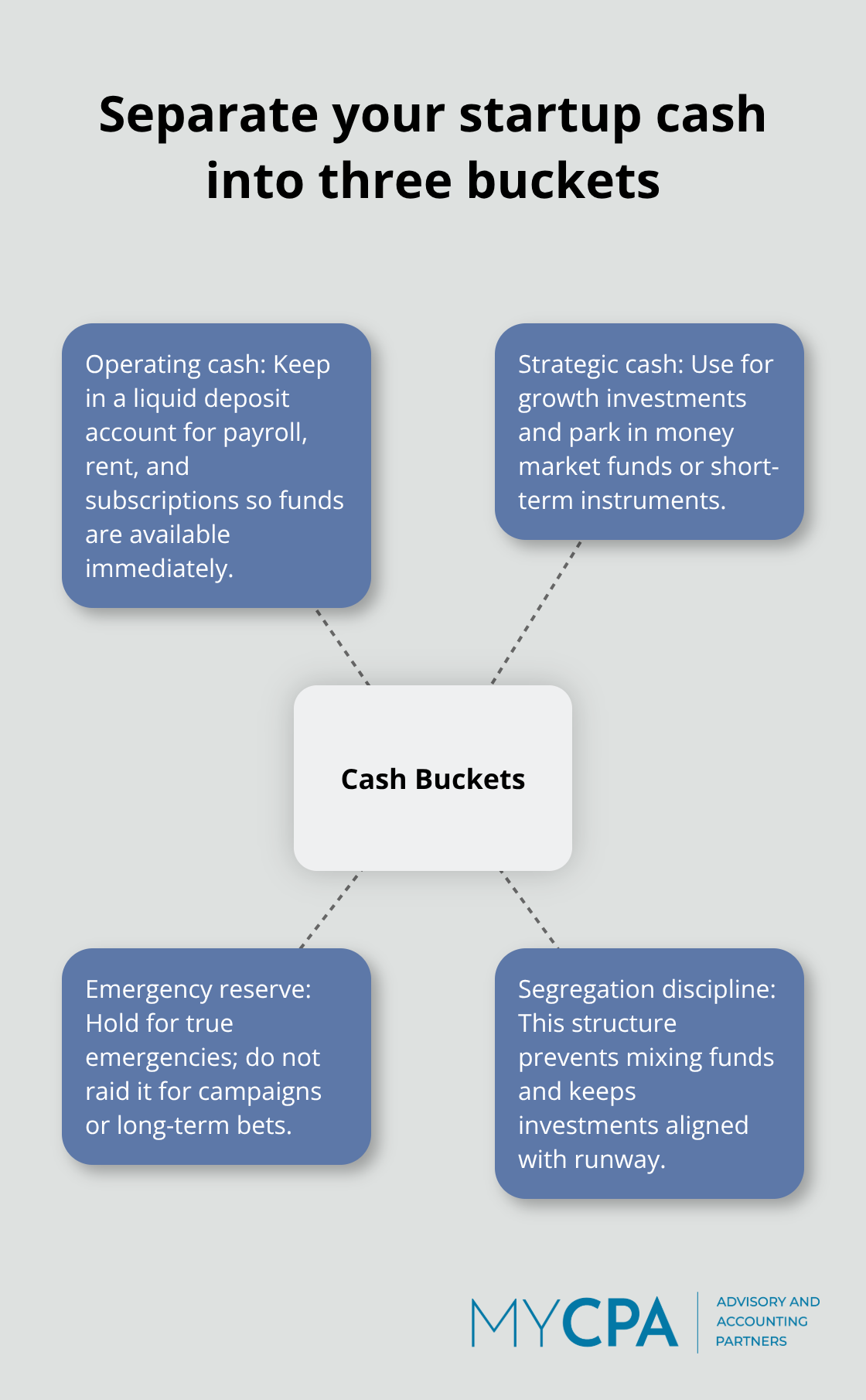
You cannot raid your emergency reserve for a marketing campaign, and you cannot invest growth cash in long-term instruments when your payroll runway is only two months. Most startups ignore this structure entirely and treat all cash as fungible, which leads to decisions that feel rational in the moment but destroy long-term survival odds.
Understanding where your cash actually goes is the foundation for moving forward. The next step is to build systems that track these flows in real time and give you visibility into what’s coming and what’s leaving.
Most startups create a cash forecast once and never touch it again. That approach guarantees failure. Cash forecasting is not an annual planning exercise-it is a monthly discipline that keeps you alive. Start by separating what you know from what you are guessing. Your fixed costs-payroll, rent, software subscriptions-are predictable. List every single recurring expense and the exact date it leaves your account. Payroll on the 15th and 30th, rent on the 1st, insurance on the 20th. This is your baseline, and it should not change month to month unless you make a deliberate hiring or spending decision.
Your variable costs are where most founders fail at forecasting. Instead of assuming every customer pays on their invoice terms, segment customers by actual payment history. If a customer invoiced in January paid in March, assume they will pay in March again, not January. If you have never worked with enterprise clients before and you land a $100,000 deal, do not forecast that cash in month one. Enterprise deals typically collect in 60–120 days according to industry patterns. Build your forecast assuming month three or four arrival. This conservative approach feels pessimistic until the day it saves your company.
Update your forecast every single month after you close your books. Compare what you predicted to what actually happened. If you forecasted $50,000 in revenue and collected $35,000, that variance matters. Track whether the miss came from fewer deals closing, customers paying late, or deal sizes shrinking. Most startups have a forecast accuracy problem because they do not track the drivers behind misses. Nearly 90% of treasury professionals report unsatisfactory cash flow forecasting accuracy, and the root cause is poor cross-department communication.
You need one person-ideally your finance lead or founder-responsible for collecting actual numbers from sales, customer success, and operations every month. Sales tells you which deals closed and their actual payment terms. Customer success tells you which customers are at risk of churning. Operations tells you if you hired ahead of schedule or delayed a planned expense.
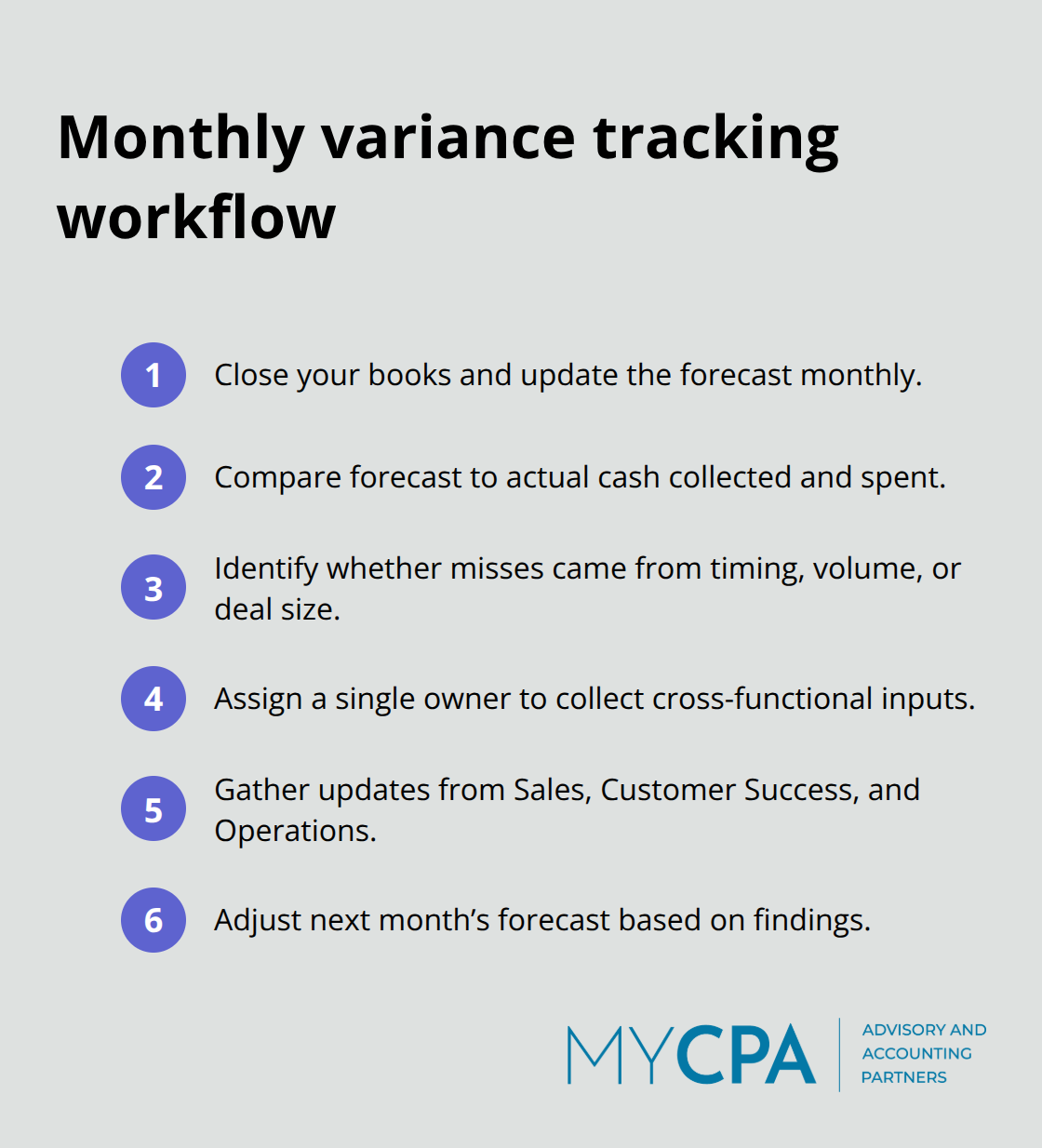
Feed these inputs into your forecast and adjust. A 15% improvement in forecast accuracy delivers a 3% or higher pre-tax improvement in overall business performance, which means better forecasting directly impacts your bottom line.
Set a target variance of around 5% for each expense category and review monthly. If payroll was supposed to be $80,000 and came in at $78,000, you are tracking well. If it came in at $72,000, something changed-someone left, a bonus did not pay out, or headcount shifted. Understand the variance so you can adjust next month’s forecast with confidence. This monthly discipline transforms forecasting from a static document into a living tool that reflects your actual business. Once you have visibility into what cash arrives and when, you can make strategic decisions about how to deploy it.
The best forecasting spreadsheet in the world fails the moment your business grows beyond one founder tracking everything manually. You need systems that pull data directly from your bank account and accounting software so your forecast updates without human intervention. Most startups waste time choosing between enterprise-grade tools designed for Fortune 500 companies and free spreadsheet templates that break after three months of use. The practical middle ground exists, and it matters more than you think.
Real-time accounting integration means your forecast reflects actual bank balances, not guesses. When a customer payment hits your account at 2 PM on Tuesday, your cash position updates immediately. This eliminates the dangerous lag where founders think they have more cash than they actually do. QuickBooks Online, Xero, and FreshBooks all connect directly to your bank, pulling transactions daily. If you are not using this feature, you are flying blind. Set up bank connections first, then layer forecasting tools on top. Abacum, Agicap, and Float all integrate with these accounting platforms and automate cash flow calculations so you stop manually updating rows in a spreadsheet. The global cash flow forecasting software market reached approximately 726 million dollars in 2025 and is projected to grow at 7.4% annually through 2033, according to market research, which signals that automation is becoming non-negotiable for serious founders.
Invoicing delays destroy cash flow more than any other operational mistake. Most startups send invoices days after delivering work, then wait passively for payment. Automated invoicing systems help speed up the payment process and improve efficiency, accuracy and cash management. Send invoices the same day work completes, not the next week. Specify your exact payment methods directly on every invoice so customers know whether to send a check, ACH transfer, or credit card payment. Many founders forget this detail, and customers default to whatever method is convenient for them, which often means checks that take two weeks to clear. Use Stripe Billing or Square Invoices to accept credit card payments directly on invoices, which accelerates collection and reduces friction.
Negotiate payment terms before you start work, not after you invoice. If a customer says they always pay net-60, build that into your cash forecast and do not assume net-30. For large deals over 25,000 dollars, require a 50% deposit upfront. This is standard practice in professional services and consulting, and most customers expect it. The remaining 50% gets invoiced upon completion. This structure cuts your working capital needs in half and forces you to validate deal seriousness before investing heavily.
Implement a formal spend policy and approval workflow alongside your invoicing system. Require dual approval for any expense over 5,000 dollars and maintain separate bank accounts for payables and receivables if your business handles significant transaction volume. This prevents commingling of funds and makes variance tracking exponentially easier when you reconcile monthly. Strong controls protect your cash from unnecessary leaks and create accountability across your team.
Startup cash flow management comes down to three disciplines: knowing exactly what cash you have, understanding when it arrives and leaves, and making deliberate decisions about how to deploy it. The founders who survive are not the ones with the best product or the most funding-they are the ones who treat cash as a strategic asset, not an afterthought. Nearly 38% of startups fail because they run out of cash, which means the difference between success and failure often hinges on execution of the fundamentals outlined in this article.
Start by separating your cash into operating, strategic, and emergency buckets, then build a forecast that reflects actual customer payment behavior rather than optimistic assumptions. Update that forecast every month and investigate variances so you understand what drives your cash position. Implement systems that automate invoicing and bank reconciliation so you have real-time visibility into your runway and can negotiate payment terms before work starts, require deposits on large deals, and maintain strict controls over spending.
The long-term health of your startup depends on treating startup cash flow management as a CEO-level priority, not a finance department task. If you manage startup finances alone or with a small team, consider getting professional support-we at My CPA Advisory and Accounting Partners offer accounting services, QuickBooks expertise, and business advisory that help founders build the financial foundation their startups need. Contact us to learn how we can support your financial management and give you the confidence to scale.








Privacy Policy | Terms & Conditions | Powered by Cajabra