
Strategic Business Advisory: Aligning Strategy and Finance
Align your strategy and finance with strategic business advisory insights to drive sustainable growth and profitability for your organization.
Most business owners leave thousands of dollars on the table each year simply because they don’t know which deductions apply to them. The good news is that you can legally reduce taxes through smart planning and awareness of opportunities you might be missing.
We at My CPA Advisory and Accounting Partners have helped countless business owners identify overlooked deductions and implement strategies that actually work. This guide walks you through the most effective ways to cut your tax bill without crossing any legal lines.
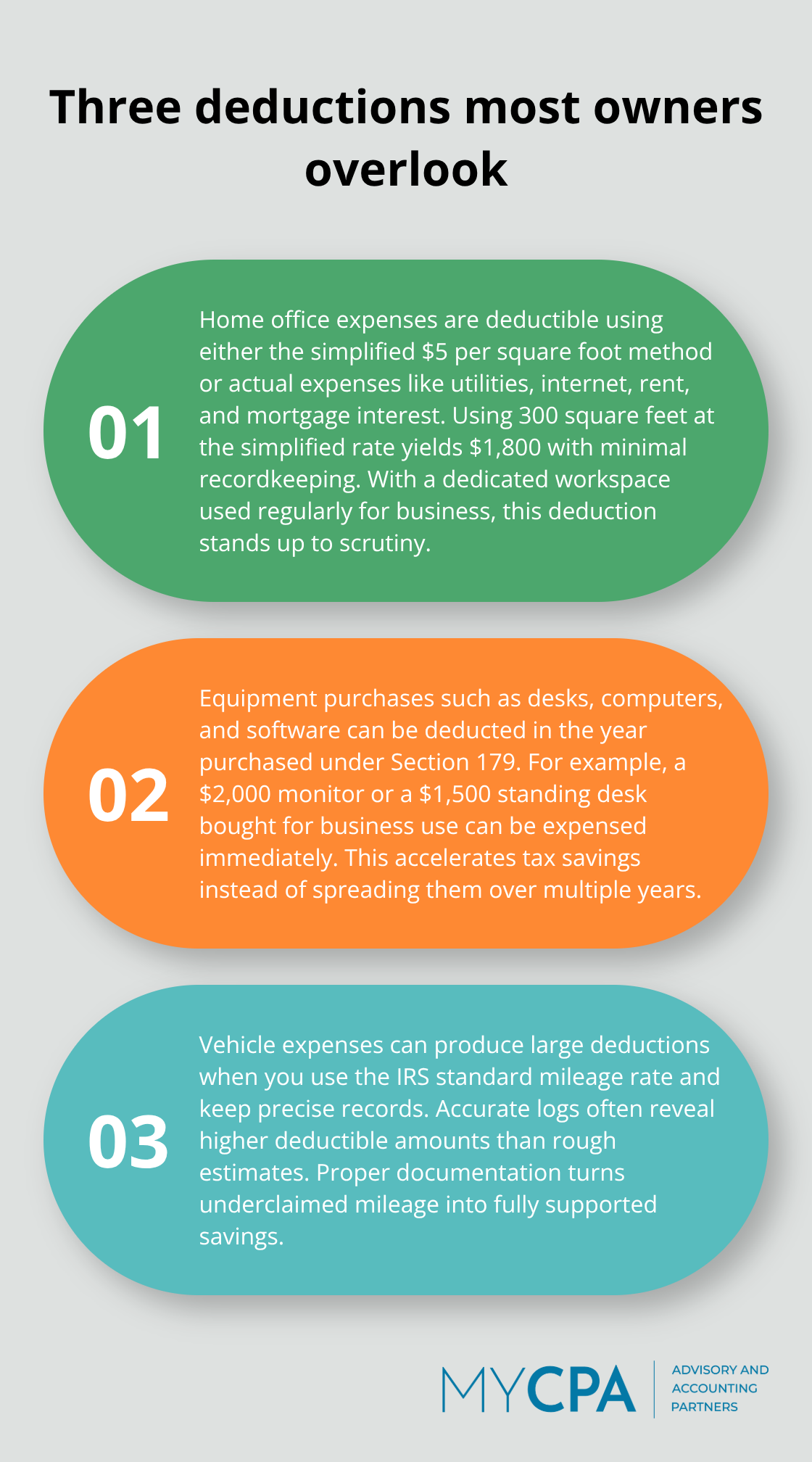
Your home office isn’t just a workspace-it’s a legitimate tax deduction that most business owners either ignore or claim incorrectly. The IRS allows you to deduct either $5 per square foot of dedicated office space or calculate actual expenses like utilities, internet, rent, and mortgage interest. If you use 300 square feet exclusively for work, that amounts to $1,800 annually at the simplified rate, with no receipts required. Many owners fear an audit and skip this entirely, leaving money on the table. The reality is straightforward: if you have a dedicated workspace and use it regularly for business, the deduction holds up under scrutiny.
Equipment purchases amplify this benefit further. A new desk, filing cabinet, computer, or software subscription used for business qualifies as a deduction in the year purchased under Section 179. If you bought a $2,000 monitor or a $1,500 standing desk this year for your home office, deduct it immediately rather than depreciating it over years. This approach puts money back in your pocket now instead of spreading the benefit across multiple tax years.
Vehicle expenses create another major opportunity, but you must track mileage meticulously. The IRS standard mileage rate determines your deduction based on business miles driven. If you drive 12,000 business miles annually, that creates substantial deductions. Most owners either don’t track at all or estimate poorly, claiming $3,000 when actual mileage supports $8,000.
Keep a mileage log in your phone or vehicle showing dates, destinations, and business purpose. This documentation protects you during an audit and ensures you claim what you actually earned.
Professional development and education expenses directly reduce taxable income when they maintain or improve skills required in your current business. An accounting course, industry certification, or software training counts. A $1,200 course to improve your bookkeeping skills is fully deductible if you already operate a business. However, education that qualifies you for a new profession doesn’t qualify. The distinction matters: sharpening existing expertise is deductible; pivoting careers is not. Track all receipts and course descriptions to support these claims during an audit.
These three categories represent just the beginning of what you can legitimately claim. The next section explores how strategic timing of income and expenses can multiply your tax savings even further.
Most business owners react to taxes rather than plan for them, which costs them thousands annually. The difference between reactive and proactive tax management comes down to three concrete moves: controlling when you recognize income and expenses, structuring your business entity correctly, and maximizing retirement contributions.
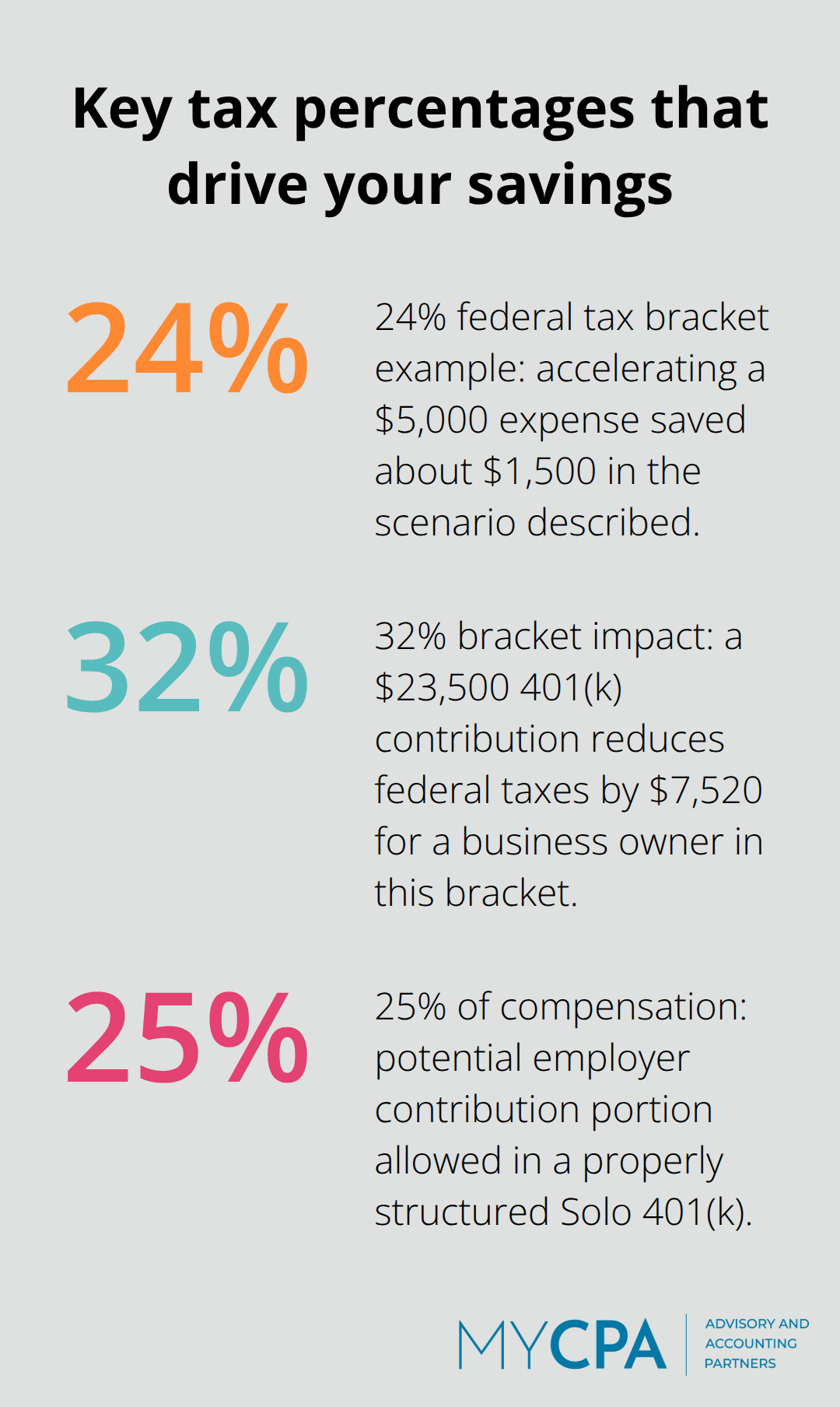
Timing matters enormously because the IRS taxes you based on when you receive income and incur expenses, not when cash actually changes hands. If you operate on a cash basis and expect a large payment in December, you can defer it to January, pushing that income into the next tax year and staying in a lower bracket. Conversely, if you have discretionary expenses you’d pay anyway, accelerate them into the current year when you’re in a higher bracket. A freelancer earning $120,000 might prepay a $5,000 software subscription or equipment purchase in December rather than January, dropping their taxable income to $115,000 and saving roughly $1,500 in federal taxes at the 24% bracket.
Quarterly estimated tax payments and depreciation schedules all hinge on timing decisions you make months in advance.
Your business structure determines how much self-employment tax you actually pay, and this is where most owners leave real money behind. A sole proprietor pays self-employment tax on 92.35% of net business income, which amounts to 15.3% in Social Security and Medicare taxes on top of regular income tax. An S-Corporation election changes this dramatically because you pay yourself a reasonable salary subject to payroll taxes, then take distributions that avoid self-employment tax entirely. If your business generates $100,000 in net profit, an S-Corp structure might allow you to pay yourself a $60,000 salary and take a $40,000 distribution, saving roughly $5,600 in self-employment taxes compared to operating as a sole proprietor. This strategy works best when your business profit exceeds $60,000 annually.
Retirement account contributions amplify these savings further. A 401(k) contribution of $23,500 in 2025, as the IRS allows, directly reduces your taxable income. A business owner in the 32% tax bracket saves $7,520 in federal taxes from that single contribution. If you’re self-employed, a Solo 401(k) contribution limits lets you contribute as both employee and employer, potentially reaching $69,000 annually if structured correctly. Health Savings Accounts offer a third tax advantage: contributions are deductible, growth is tax-free, and withdrawals for qualified medical expenses face no tax. A self-employed person can contribute $4,300 in 2025 to an HSA, reducing taxable income while building tax-free savings for healthcare costs.
These structural decisions set the foundation for tax efficiency, but they only work when applied to the right business type. Different business structures demand different strategies, which the next section explores in detail.
Sole proprietors and freelancers operate with complete flexibility but pay the highest tax rate on every dollar earned. Your business income flows directly to your personal tax return, and you owe the full self-employment tax of 15.3% on 92.35% of net profit. A freelancer earning $80,000 annually pays roughly $11,304 in self-employment tax alone, before any income tax. Once your business consistently generates $60,000 or more in annual profit, an S-Corporation election becomes financially sensible. You would pay yourself a reasonable salary of perhaps $50,000 and take $30,000 as a distribution, reducing self-employment tax by approximately $4,240 compared to staying as a sole proprietor. The paperwork and accounting fees for S-Corp status typically run $1,500 to $3,000 annually, meaning the tax savings cover the costs within the first year if your profit exceeds $80,000.
Freelancers should maximize a Solo 401(k), which allows contributions up to $23,500 as the employee plus an additional 25% of compensation as the employer when structured correctly, since you can contribute as both employee and employer. Track every legitimate deduction aggressively at this stage because your personal tax rate climbs quickly as income rises, making deductions worth 24% to 32% in federal taxes depending on your bracket. This approach puts substantially more money back into your business and personal finances compared to ignoring available deductions.
An S-Corp is a tax election, not a legal entity, and it specifically addresses self-employment tax by splitting income into salary and distributions. An LLC is a legal entity that can elect S-Corp taxation if profitable, or remain taxed as a partnership or sole proprietor if preferred. An LLC with S-Corp election works exceptionally well for service businesses like consulting, accounting, or design where you have meaningful profit after reasonable salary costs. However, an S-Corp creates compliance burdens: you must file Form 2553 with the IRS, run a payroll system even if you are the only employee, file corporate tax returns, and maintain meticulous documentation of reasonable compensation. Ignore the reasonable salary requirement and the IRS will reclassify distributions as wages, eliminating your tax savings and adding penalties.
Small businesses with employees face entirely different calculations. Once you hire staff, payroll taxes, workers compensation insurance, and unemployment insurance dramatically change your tax picture. A business with five employees might generate $200,000 in profit, but payroll liabilities could exceed $80,000 annually. An S-Corp election still saves on your personal self-employment tax, but the real opportunity lies in offering a 401(k) plan. Employees value retirement benefits, which reduces your wage expense while generating tax deductions. You can also implement a simplified employee pension plan or SIMPLE IRA with lower administrative burden. Equipment purchases under Section 179 become even more valuable when you reinvest profits into business growth, and you should accelerate these purchases into years where your profit is highest to maximize the deduction benefit against your income.
The strategies outlined in this guide show that you can legally reduce taxes through deliberate planning and awareness of opportunities specific to your situation. Home office deductions, vehicle expense tracking, professional development costs, strategic income timing, entity structure optimization, and retirement contributions work together to create meaningful tax savings that most business owners never claim. The real difference between owners who save substantially and those who don’t comes down to intentionality-reactive tax management means paying whatever the IRS calculates, while proactive tax management means making decisions throughout the year that position you favorably when tax season arrives.
Working with a tax professional transforms these opportunities from theoretical to actual results. A qualified advisor reviews your specific situation, identifies deductions you’re missing, and structures your business for maximum efficiency while handling the compliance burden of S-Corp elections and maintaining meticulous documentation that protects you during an audit. The cost of professional guidance typically pays for itself many times over through tax savings and penalty avoidance.
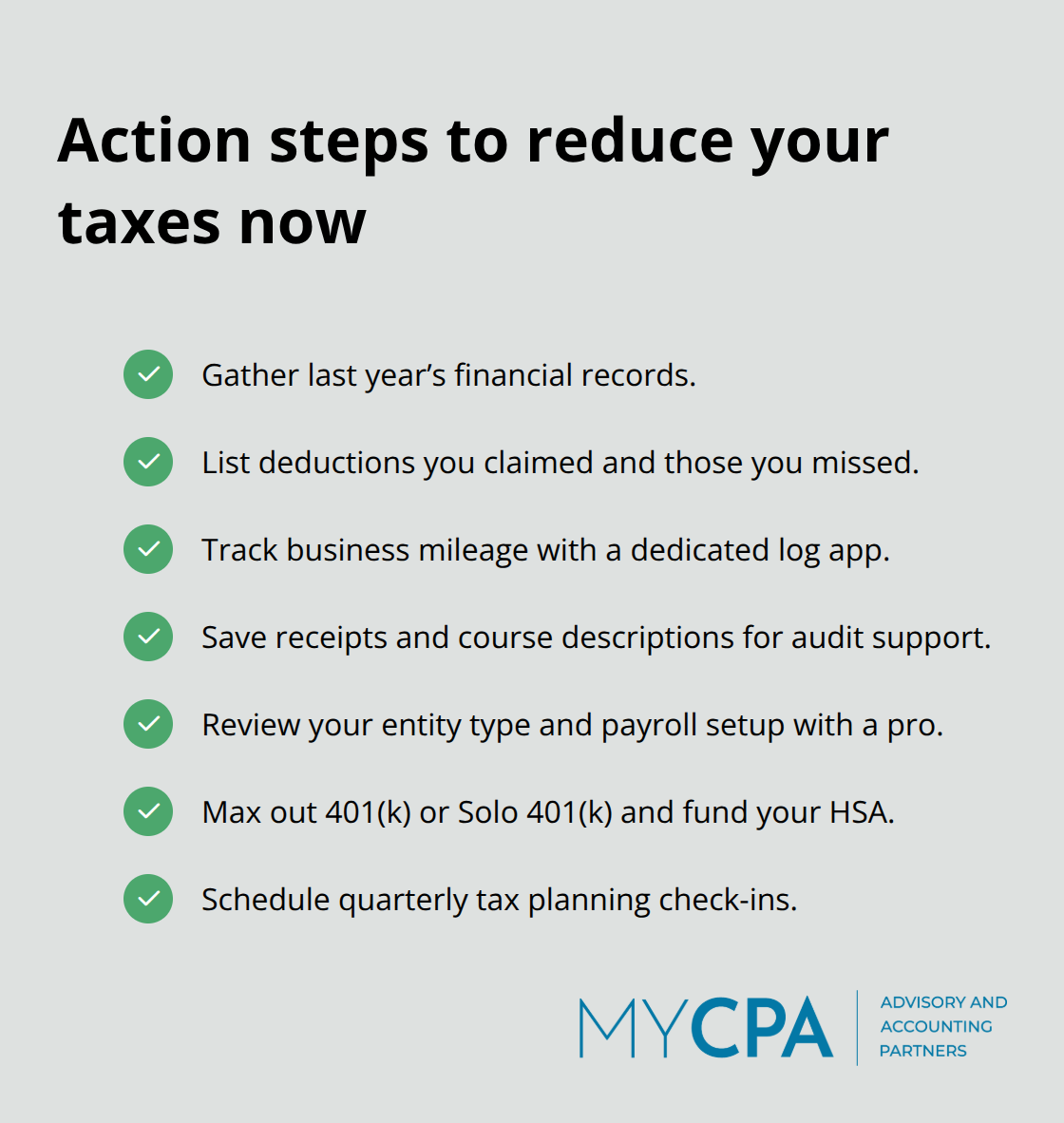
Start by gathering your financial records from the past year and identifying which deductions you claimed and which you missed. Then contact us to discuss your specific situation and implement these strategies with confidence. The sooner you act, the sooner you’ll see the impact on your bottom line.







Privacy Policy | Terms & Conditions | Powered by Cajabra