
Strategic Business Advisory: Aligning Strategy and Finance
Align your strategy and finance with strategic business advisory insights to drive sustainable growth and profitability for your organization.
Your business has a clear vision. But without the right financial strategy backing it, that vision stays stuck on paper.
At My CPA Advisory and Accounting Partners, we help you turn numbers into a roadmap. Strategic financial advisory means connecting what you want to achieve with the metrics that actually matter. When your finances align with your goals, growth becomes measurable and sustainable.
Most businesses fail at this step, and it costs them millions. They set ambitious goals but never translate those goals into the financial metrics that actually drive decisions. The result is scattered effort, wasted resources, and a team that doesn’t understand what success looks like in numbers. Companies with clear visions but no financial framework to support them struggle to execute effectively.
The fix starts with identifying which metrics matter most to your specific business. Not every company needs the same KPIs. A manufacturing firm focused on expansion needs different benchmarks than a service business targeting profitability. Too many businesses track vanity metrics-revenue, for instance-without understanding the health underneath. Revenue alone tells you nothing about whether you’re actually making money or burning cash. Instead, focus on metrics directly tied to your strategic vision. If your vision is to become the market leader in your region within three years, your KPIs should track market share growth, customer acquisition cost, and customer lifetime value.
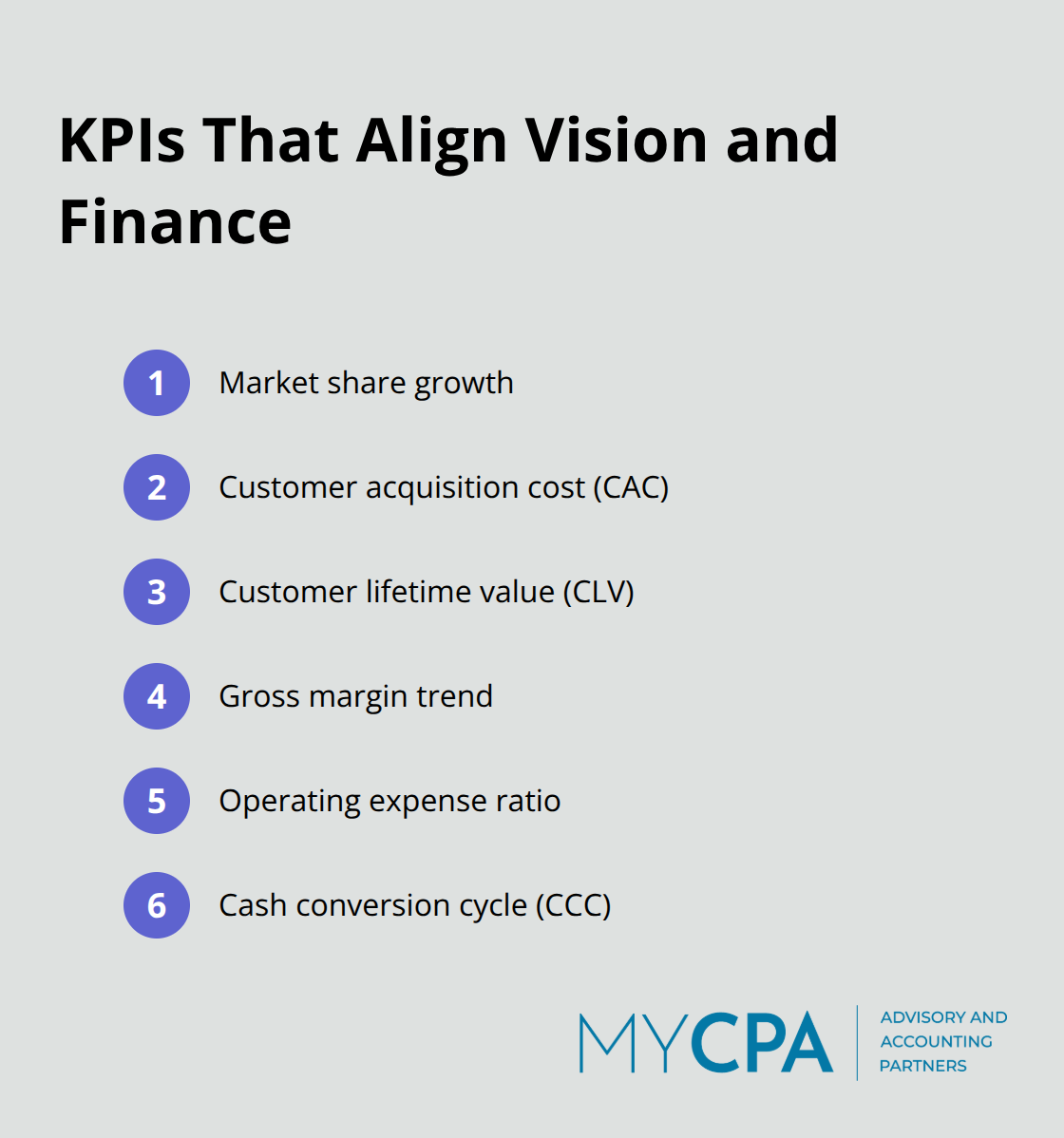
If your vision centers on sustainable profitability, monitor gross margin trends, operating expense ratios, and cash conversion cycle. The difference isn’t the metrics themselves-it’s whether those metrics align with what actually drives your business forward.
Before you build a roadmap, you need to know exactly where you stand. This means pulling together your current financial statements and understanding them with brutal honesty. Many owners avoid this step because the numbers feel overwhelming or disappointing. That avoidance is expensive. We recommend a quarterly financial review where you examine three core areas: your cash position, your profitability by service or product line, and your cost structure. Cash is non-negotiable. A business can be profitable on paper while running out of cash, and that kills growth faster than anything else. Look at your cash conversion cycle-it tracks the time between when you pay suppliers and when customers actually pay you. If that number stretches, your growth will stall. Profitability by line reveals which parts of your business actually make money. Many companies subsidize unprofitable services or products without realizing it, which distorts decision-making.
Your vision needs financial translation. If you want to grow revenue 40% in the next two years, that’s not a complete goal. The real questions are: How much of that growth comes from new customers versus existing customer expansion? What gross margin do you need to maintain to fund that growth? How much working capital will you need? What investment in people or systems is required? This translation is where strategy becomes actionable. We recommend establishing a tiered timeline. For the next 12 months, identify the specific financial milestones that prove you’re on track. For years two through five, establish broader targets and the resource allocation needed to reach them. One practical approach is to work backward from your five-year revenue target and calculate the quarterly growth rate required. If you need to grow from 2 million to 4 million in five years, that’s roughly 15% annual growth. That number immediately tells you something: your current team and systems may not support it, so you need to budget for hiring and infrastructure now. The specificity matters because it shifts accountability from hope to measurable progress.
Once you establish your metrics and timeline, the real work begins. Every major decision-whether to hire, expand into a new market, or invest in technology-should pass through your financial framework. This doesn’t mean you ignore intuition or market opportunity. It means you evaluate those opportunities against your stated vision and financial capacity. A decision that looks attractive in isolation may pull resources away from your core strategic goal. For example, a lucrative one-time project might seem like a win, but if it requires hiring temporary staff and diverts your team’s attention from your primary growth initiative, the true cost is higher than the revenue it generates. We recommend documenting your decision criteria in advance. What return on investment do you require? What timeline matters most? What risks are you willing to accept? When you answer these questions before opportunities arrive, you make faster, clearer decisions that stay aligned with your vision.
Your financial data tells a story, but most business owners never read it. We work with clients who think revenue growth is success, only to discover their cash position is deteriorating and their margins are collapsing. The gap between what you think is happening and what your numbers actually show is where most strategic decisions fail. Cash flow and profitability trends are not the same thing, and treating them as interchangeable will sink your business. A company can report 30% year-over-year revenue growth while simultaneously burning through cash reserves because it finances customer payments with its own working capital. Your first analysis step is separating these two realities.
Pull your monthly cash flow statement for the last 12 months and examine the pattern. Is cash consistent, or does it spike and dip dramatically? Seasonal dips are normal, but if your business is supposed to be growing, your lowest monthly cash balance should still be higher than last year’s lowest point. Profitability tells you margin health, but it is an accounting construct. Cash tells you whether you can actually fund operations and growth. Compare your operating cash flow to your net income each quarter. If they diverge significantly, you have a working capital problem that needs immediate attention. Many growing companies fail because they optimized for revenue without optimizing for cash conversion.
Cost reduction sounds simple until you try it. Most businesses identify their three largest expense categories and assume those are where savings happen. Wrong. We recommend a zero-based review of your operating expenses instead of looking for percentage cuts. List every expense your business incurs, then ask: what revenue or strategic outcome does this expense directly support? If you cannot connect the expense to a measurable business outcome, it is waste. One software subscription your team never uses, one contractor you keep out of loyalty, one office space you maintain because it feels professional-these add up. In a 2 million dollar revenue business, finding 50,000 dollars in unnecessary expenses is not trivial. That is 2.5% of revenue, and it flows directly to profitability.
The second place most businesses miss savings is in their cost structure itself. If your gross margin is 45% but your industry average is 52%, you have a pricing or efficiency problem. Pricing problems are easier to solve than efficiency problems, but both require honest analysis. Can you raise prices without losing customers? If not, can you reduce the cost to deliver your service? The answer usually involves both. This assessment helps you evaluate performance and identify opportunities to improve efficiency or pricing strategies.
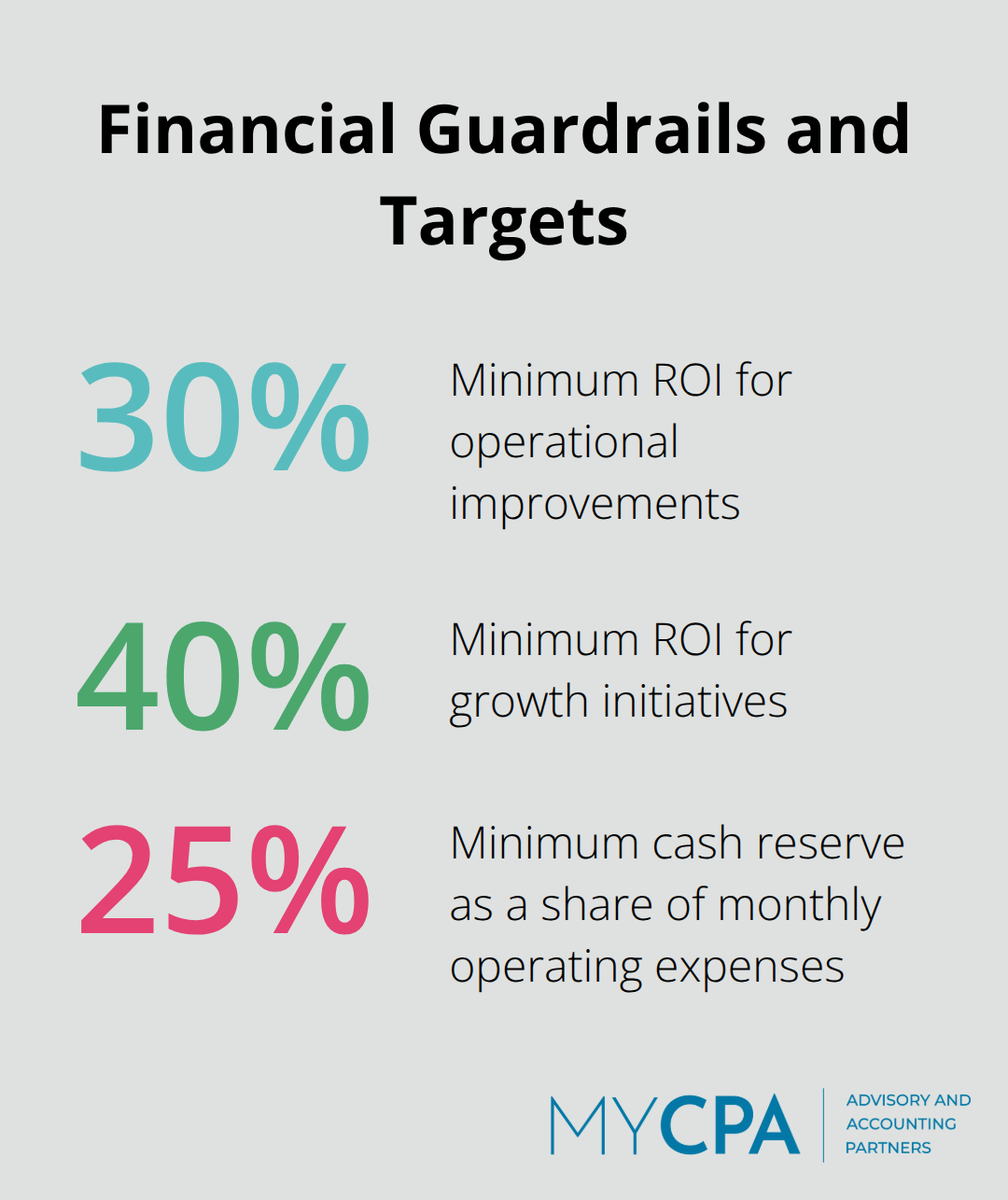
For investment decisions, calculate the actual return including all costs and time. If an investment in new software requires training time, integration work, and ongoing support, the true cost is higher than the license fee. Try requiring a minimum 30% return on investment for operational improvements and a minimum 40% return for growth initiatives. That threshold filters out marginal decisions and forces discipline around capital allocation. Growth investments that barely break even do not deserve your limited resources (and they distract your team from higher-impact work).
This rigor in evaluating opportunities sets the stage for the next critical step: monitoring your financial health throughout the year and adjusting your strategies as conditions change.
The metrics and framework you build mean nothing if you ignore them for eleven months and then panic when the year ends. Most business owners check their financials quarterly at best, which means they miss three months of warning signs before taking action. A cash crunch that develops over two months becomes a crisis by month three if you are not watching it.
The fix is monthly financial reviews focused on three specific actions. First, compare your actual results to the targets you set when you aligned your vision with your financial goals. Are you on pace to hit your quarterly milestones? If not, identify why within the first week of missing a target, not the first week of the next quarter.
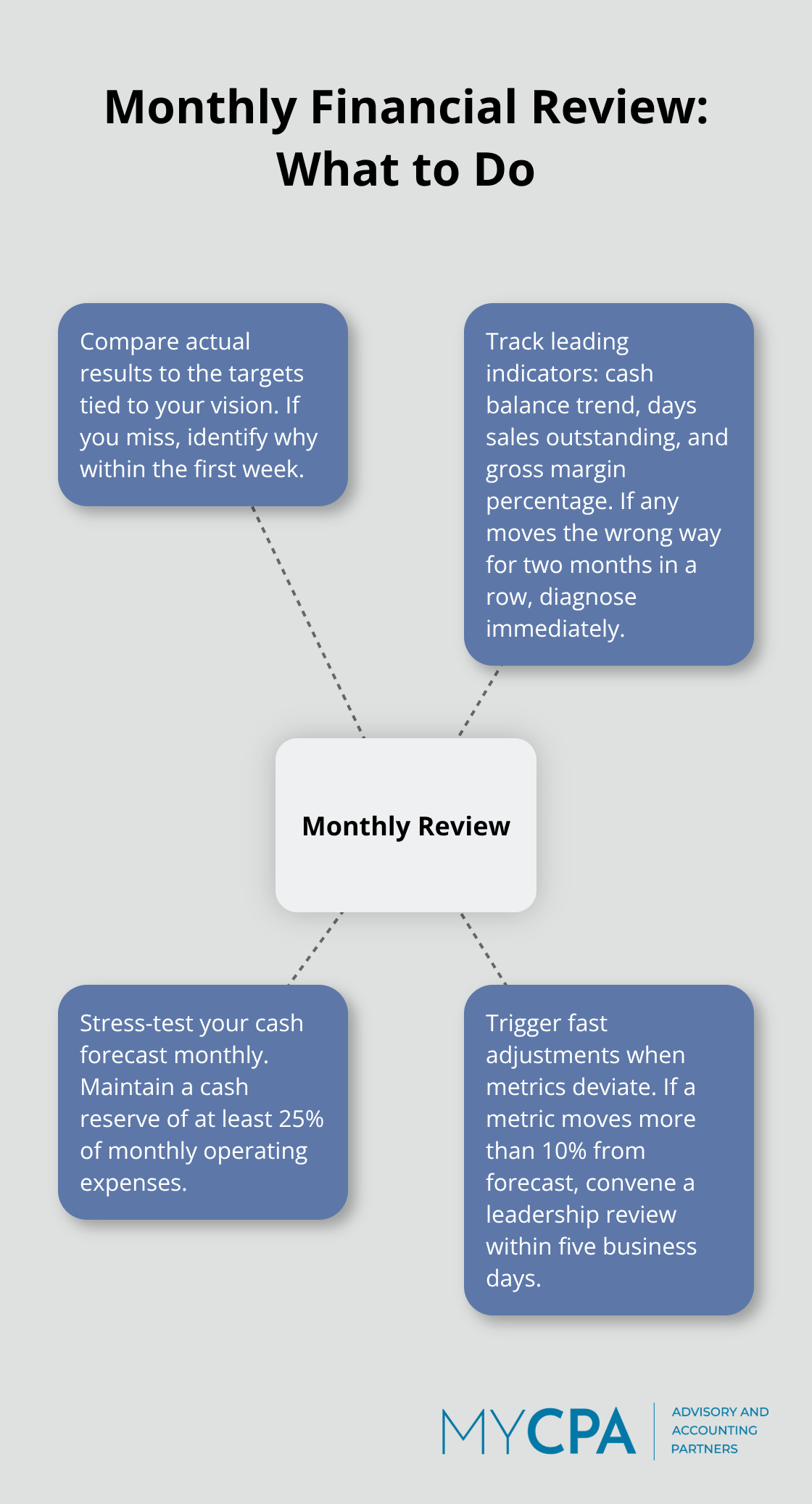
Second, track your three leading indicators that predict future problems. For most businesses, these are cash balance trend, days sales outstanding (how long customers take to pay), and gross margin percentage. If any of these three moves in the wrong direction two months in a row, something in your business is breaking and needs immediate diagnosis.
Third, stress-test your cash forecast monthly. If an unexpected event hit your business tomorrow, could you cover three months of operating expenses? Many business owners discover this answer too late. Try maintaining a cash reserve equal to at least 25% of your monthly operating expenses as a minimum safety threshold. This discipline prevents reactive decision-making and keeps your team focused on strategy instead of survival.
Market conditions shift constantly, and a financial strategy that worked last quarter may work poorly this quarter. The businesses that adapt fastest are the ones that review their strategic assumptions monthly, not annually. When interest rates rise, your cost of capital changes and suddenly an investment that made sense becomes marginal. When a major customer announces a budget cut, your revenue forecast needs immediate revision. When your largest supplier raises prices 12%, your gross margin targets need adjustment and your pricing strategy requires evaluation.
These are not theoretical scenarios; they happen in real business every month. Your response cannot wait for an annual planning cycle. Establish a simple monthly adjustment protocol. If a metric moves more than 10% from your forecast, trigger a review conversation with your leadership team within five business days. Ask three questions: What caused the variance? What decisions does this affect? What action do we take this week? This speed matters because a 10% variance in cash flow over two months becomes a 20% problem that constrains your growth initiatives. The businesses that grow sustainably are not the ones that guess better; they are the ones that notice problems early and course-correct immediately.
Your financial advisor should provide specific, actionable recommendations tied to your actual numbers, not generic advice that applies to any business. If your advisor tells you to increase efficiency without showing you where waste exists in your cost structure, that advice is worthless. If they recommend a new investment without calculating the true return including all direct and indirect costs, they are not protecting your capital.
Actionable recommendations start with your actual data and answer the question: what specific decision should we make this week or month because of what the numbers show? One client discovered through monthly cash flow analysis that their largest customer was paying invoices 45 days late, when the contract specified net 30. Collecting that gap alone freed up 180,000 dollars in working capital without any revenue growth. Another client found that their sales team was spending 40% of time on customers generating only 8% of revenue. Reallocating that time to high-value customers increased revenue 22% without hiring. These are not luck; they are the direct result of asking the right questions of your actual numbers every single month.
Strategic financial advisory transforms how you run your business because it stops treating numbers as a scorecard and starts treating them as a decision-making tool. When your financial metrics align with your vision, growth stops being a hope and becomes a measurable reality. The businesses that win connect every dollar spent to a specific strategic outcome and monitor that connection every single month.
Aligning numbers with your long-term vision means accepting that your financial strategy is not separate from your business strategy-they are the same thing. Your vision tells you where you want to go, and your financial framework tells you whether you are actually getting there. Without that alignment, you waste resources on activities that feel productive but do not move you forward.
Most business owners have the discipline to set goals, but they lack the discipline to monitor progress against those goals every month. That gap is where millions of dollars disappear. Start that work this month by bringing your leadership team together and answering three questions: What does success look like in five years? What financial metrics prove we are on track? What decisions do we need to make differently this month based on our actual numbers? At My CPA Advisory and Accounting Partners, we help business owners build financial strategies that actually work through tailored services designed to give you confidence in your numbers and clarity in your decisions.








Privacy Policy | Terms & Conditions | Powered by Cajabra