
QuickBooks Advisory Services: Optimizing Your Books
Optimize your QuickBooks accounting with our advisory services to streamline finances, reduce errors, and boost business efficiency today.
Your QuickBooks setup is either working for you or working against you. Most business owners don’t realize how many mistakes are hiding in their books until it’s too late.
We at My CPA Advisory and Accounting Partners have seen firsthand how the right QuickBooks advisory services can transform your financial management. This guide shows you exactly what’s going wrong and how to fix it.
Your QuickBooks setup either works for you or works against you. Most business owners treat QuickBooks like a filing cabinet rather than a decision-making tool. Transactions land in accounts without thought to proper classification, accounts stay misconfigured from day one, and reconciliation happens only when tax season arrives. The damage accumulates quietly.
When you misclassify transactions or mix personal and business transactions in the same account, your financial reports become unreliable. You can’t trust your profit margins, you can’t identify which products or services actually make money, and you certainly can’t make smart decisions about where to invest next.
A construction company using generic expense categories instead of tracking labor, materials, and subcontractor costs separately lost visibility into job profitability. A service firm that never separated revenue streams couldn’t tell which clients were actually profitable. These aren’t minor accounting issues-misclassified transactions directly impact your tax planning, distort your financial analysis, and waste hours of cleanup work later.
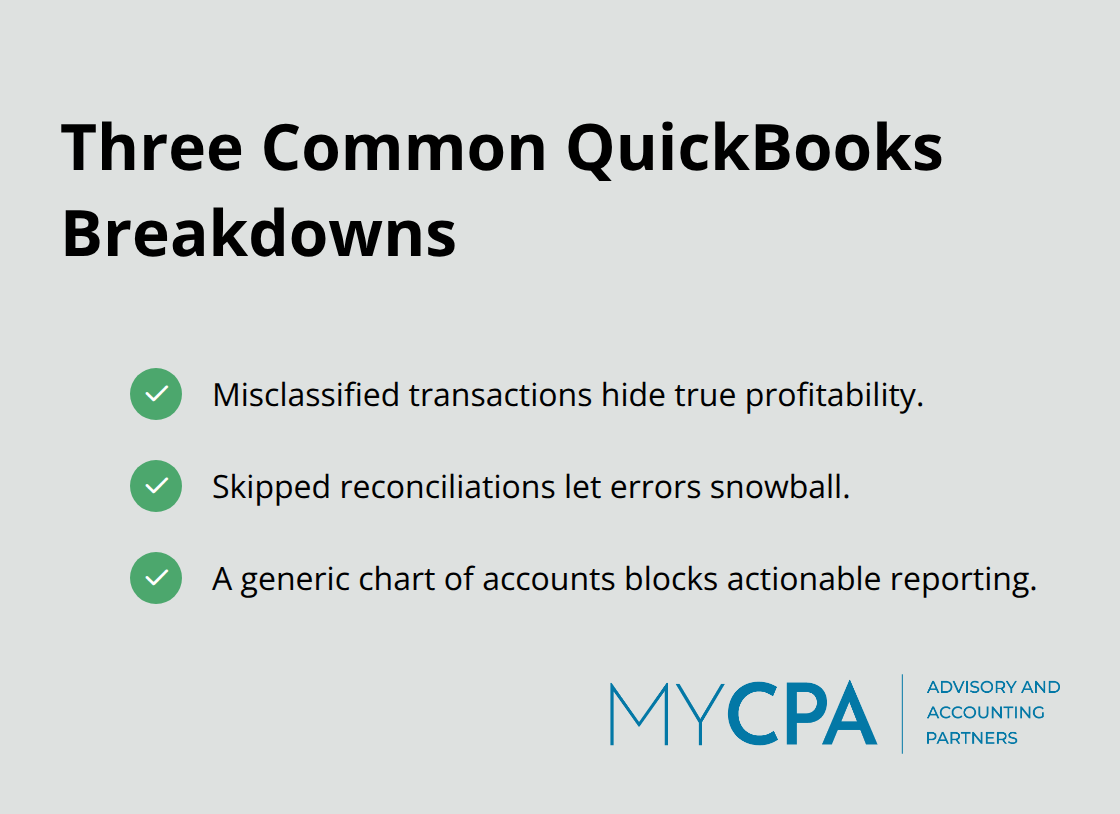
The second major failure point is skipping regular reconciliation and data cleanup. Many owners do a quick bank reconciliation once yearly, right before their accountant files taxes. What happens in between? Unreconciled transactions pile up, duplicate entries slip through, and small errors compound into material misstatements.
If your bank account shows $50,000 but your QuickBooks balance is $48,000, you won’t know whether it’s a timing issue, a missed transaction, or a data entry error until someone investigates. This investigation costs time and money. Without monthly reconciliation, you operate on incomplete information and make decisions based on inaccurate account balances.
The third mistake is failing to customize your chart of accounts for how your business actually operates. QuickBooks comes with a generic default chart of accounts that works for nobody. A retail business needs inventory accounts and cost of goods sold tracking that a service business doesn’t. A multi-location operation needs class or location tracking built into the account structure. A consulting firm with multiple service lines needs revenue accounts segregated by service type.
Using a one-size-fits-all chart of accounts means your reports hide the information you need to run your business effectively. You can’t analyze profitability by location, you can’t see which product line is dragging down margins, and you can’t forecast cash flow accurately because the underlying data is too vague. These structural problems require expert attention to fix properly-and that’s where professional QuickBooks advisory services step in to address what most business owners can’t solve alone.
The problems we outlined don’t fix themselves. Misclassified transactions compound, reconciliation gaps widen, and a poorly structured chart of accounts becomes harder to correct the longer you wait. Professional QuickBooks advisory services address these issues systematically, starting with a complete assessment of your current setup and moving into ongoing optimization.
The first step is a proper QuickBooks setup tailored to your business structure. A professional advisor reviews how you actually operate, not how QuickBooks thinks you should operate. If you run multiple locations, they implement location tracking. If you have distinct revenue streams, they build separate accounts for each. If inventory matters to your bottom line, they configure the inventory module correctly from day one.
This isn’t generic advice. A landscape company needs different account structures than a consulting firm, which needs different structures than a manufacturing operation. A thorough setup eliminates the root cause of misclassification by making the correct account obvious when transactions are recorded. This foundational work saves hundreds of hours in cleanup later and immediately improves the reliability of your financial reports.
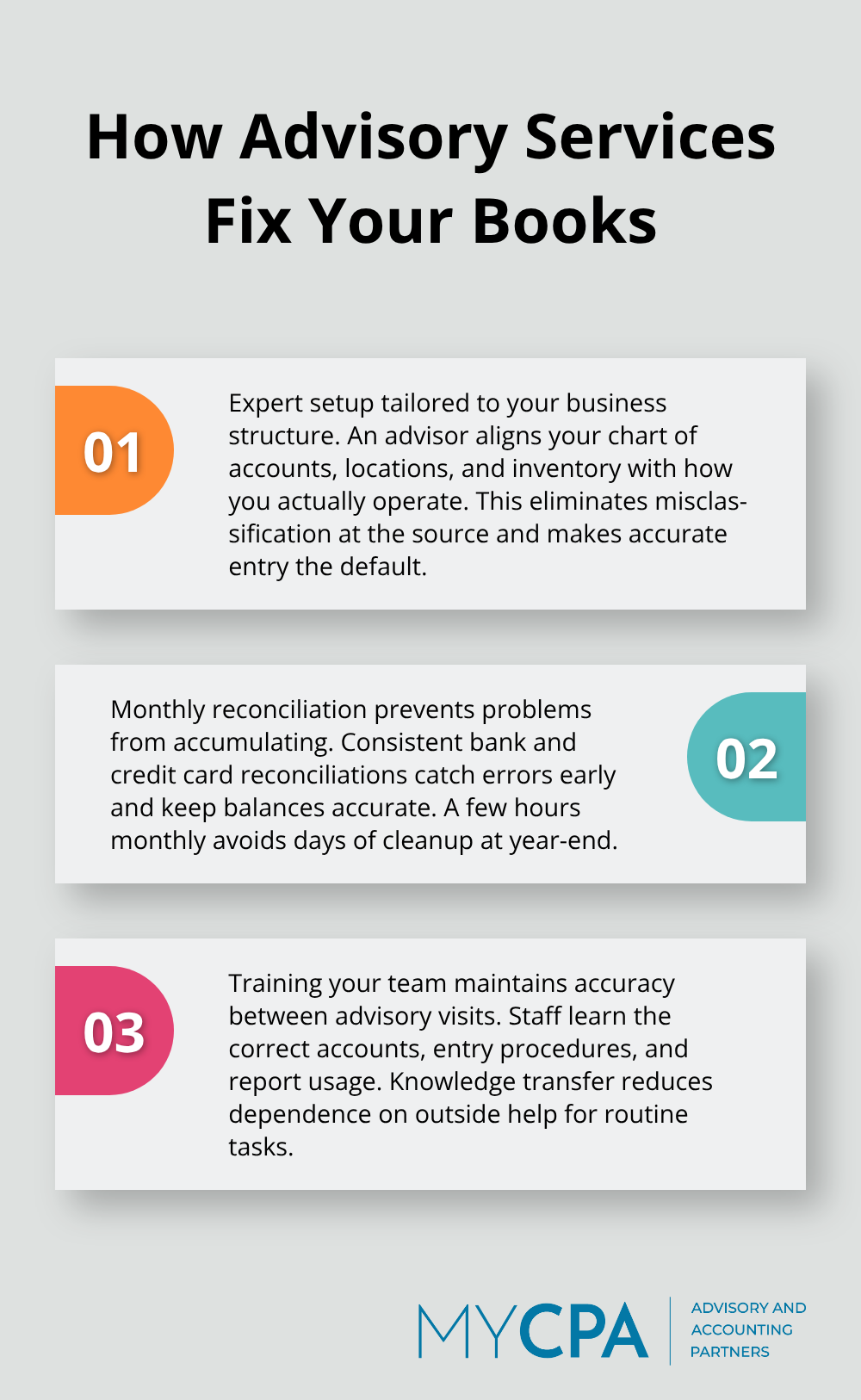
Once setup is complete, ongoing maintenance prevents problems from accumulating. Professional services include monthly bank and credit card reconciliation, which identifies errors before they cascade. Monthly reconciliation takes a few hours when done consistently. Waiting a year means someone spends days or weeks investigating discrepancies.
During monthly reconciliation, transactions get reclassified if needed, duplicate entries are caught, and your account balances stay accurate. This means you know your actual cash position at any point in the month, not just at year-end when your accountant finally looks at the books. Instead of scrambling to organize a year’s worth of transactions in December, everything is already clean and documented.
The third component is training your internal team on QuickBooks. If only one person knows how to use QuickBooks correctly, you have a knowledge bottleneck. When that person leaves or gets busy, accuracy suffers. Professional advisors provide structured training that covers the specific setup for your business.
Your accounting team learns the correct chart of accounts, proper transaction entry procedures, and how to use reports for decision-making. They understand why transactions go into specific accounts, not just where. This knowledge transfer means your team maintains accuracy between advisory visits and catches problems early. Training also reduces your dependence on external advisors for routine tasks, letting you use advisory services for higher-level analysis instead of basic maintenance.
With your books properly structured, reconciled monthly, and your team trained to maintain accuracy, you’re ready to extract real insights from your financial data. The next section shows how to generate reports that actually inform your business decisions.
Clean books mean nothing if you can’t read them. A properly structured QuickBooks system with accurate transactions and monthly reconciliation creates the foundation, but the real value emerges when you extract insights that drive decisions. Most business owners have access to financial reports but don’t know which ones matter or how to interpret them. The profit and loss statement sitting in your QuickBooks is only useful if you understand what’s actually driving your profitability.
A manufacturing company that doesn’t separate labor costs from materials costs can’t identify where margin erosion is happening. A service firm that lumps all overhead into one expense account can’t calculate the true cost to deliver services. You need reports designed specifically for how your business operates. Profit and loss statements should break down revenue and expenses by location, service line, or product category depending on your structure. Cost of goods sold must be accurate and separate from operating expenses, or your gross margin becomes meaningless. Cash flow projections matter more than historical profit reports because they show whether you’ll actually have money in the bank next month. You should generate these reports monthly, not quarterly or annually, so you catch problems while you still have time to fix them.
Your QuickBooks dashboard should display the metrics that directly impact your business health. A retail operation needs to track inventory turnover, which measures how quickly stock moves. According to industry data, fast-moving consumer goods typically turn over 8 to 12 times annually, while specialty retail might turn over 2 to 4 times. If your inventory turnover drops, you have excess stock tying up cash.
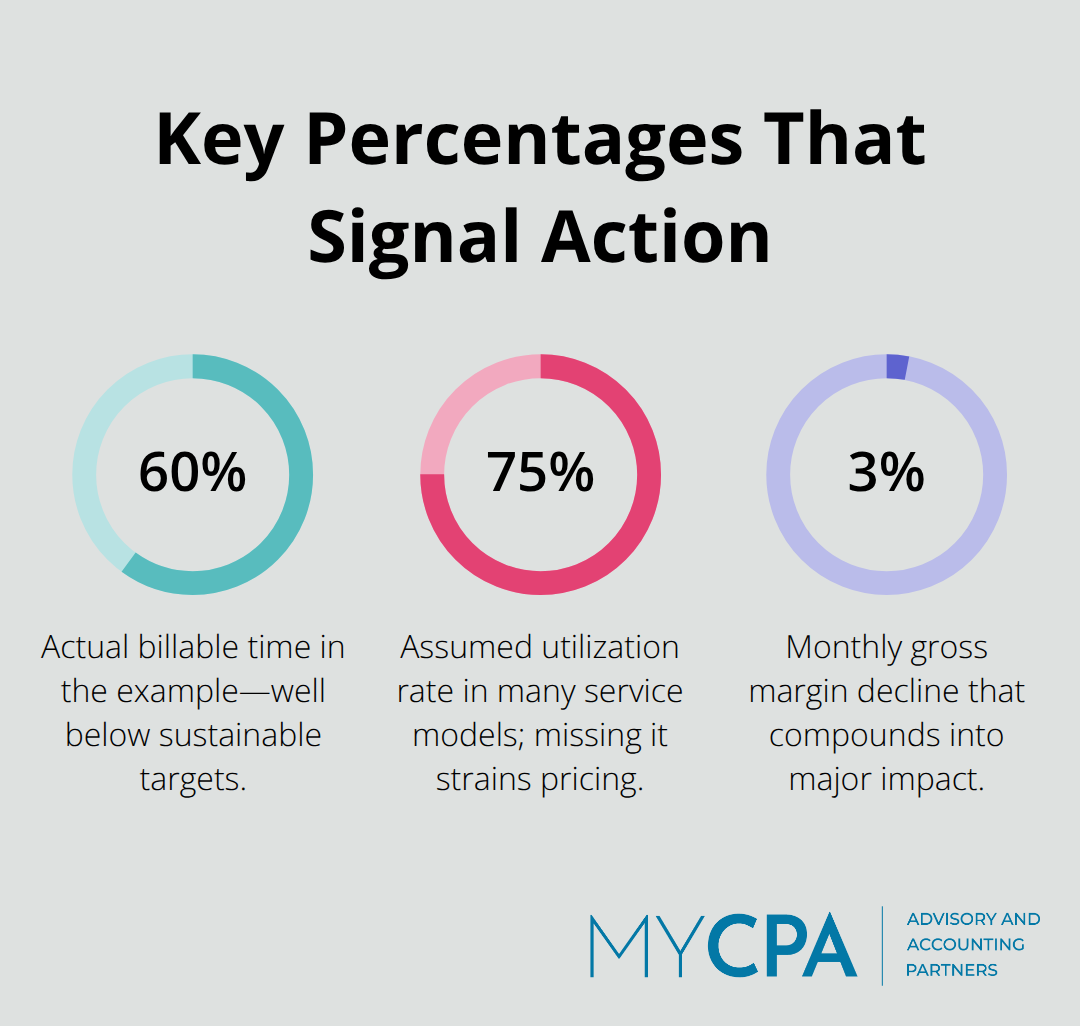
A service business needs to track billable utilization rates and average project margins. If your team is only billable 60 percent of the time but your model assumes 75 percent, your pricing structure is broken. Construction companies must track job profitability in real time, not after projects close, because cost overruns compound quickly on long-term jobs.
Most businesses ignore accounts receivable aging until cash runs dry. If your average customer pays 45 days after invoice but your terms say net 30, you’re financing your customers’ operations. You should track days sales outstanding monthly and set targets based on your actual payment patterns. Debt service coverage ratio matters if you have loans. Banks want to see this ratio above 1.25 to 1.5, meaning your cash flow covers debt payments by that multiple. If your ratio drops, you’re heading toward covenant violations before you realize it.
Data reveals waste that intuition misses. You should run a detailed expense report by account and compare the last three months to the same period last year. What categories grew faster than revenue? A 15 percent jump in office supplies when revenue grew 8 percent signals either waste or a process change that needs attention.
You should analyze your top ten expenses in detail. For most businesses, 80 percent of spending concentrates in roughly 20 percent of accounts. If consulting fees jumped from $8,000 to $15,000 monthly, you need to know whether that’s temporary or structural. You should look at your accounts receivable aging report and identify which customers are slow payers. One customer paying 60 days late when others pay in 15 days represents a cash flow problem with a name. Sometimes it’s worth tightening terms or stopping service to that customer.
You should examine your cost of goods sold breakdown if applicable. A grocery distributor that doesn’t track spoilage and waste separately from cost of goods sold can’t see how much inventory is actually lost. When you see data weekly instead of annually, you move from reacting to problems to preventing them.
Monthly reporting surfaces trends that annual reviews miss. A 3 percent monthly decline in gross margin might seem small until you realize it compounds to 36 percent annually. You catch this trend in month two if you review reports monthly, but you won’t notice it until year-end if you only look at annual summaries.
Track your cash conversion cycle-the time between paying suppliers and collecting from customers. If this cycle lengthens, your working capital needs increase and your cash position tightens. A manufacturing company that pays suppliers in 30 days but collects from customers in 60 days needs enough cash to cover that 30-day gap. If you add inventory holding time to that equation, the gap widens further. You should monitor this metric monthly and adjust payment terms or pricing if the cycle extends beyond your comfort level.
Your QuickBooks system either supports smart business decisions or obscures them. Misclassified transactions, skipped reconciliation, and poorly structured accounts cost you money through missed opportunities, wasted time, and decisions made on incomplete information. Proper QuickBooks advisory services transform your financial data from a compliance burden into a decision-making tool that drives real results.
We at My CPA Advisory and Accounting Partners help business owners optimize their books through tailored QuickBooks advisory services. We assess your current setup, implement proper account structures matched to how your business operates, establish monthly reconciliation routines, and train your team to maintain accuracy. Beyond setup and maintenance, we help you extract insights from your financial data and translate those insights into action.
Schedule a conversation with our team to review your current QuickBooks setup and identify where improvements matter most. Contact My CPA Advisory and Accounting Partners to learn more about our QuickBooks services and how we help business owners like you gain confidence in your financial systems.








Privacy Policy | Terms & Conditions | Powered by Cajabra