
Scalable Growth Strategies: Build Momentum Without Sacrificing Control
Build scalable growth strategies that expand revenue while keeping operations manageable and controlled throughout scaling.
Growing your business fast feels great until you realize you’ve lost control of what made it successful in the first place. At My CPA Advisory and Accounting Partners, we’ve seen countless companies hit this wall-rapid expansion that tanks profitability, dilutes culture, or creates chaos in decision-making.
Scalable growth strategies aren’t about choosing between speed and stability. They’re about building systems that let you expand without losing your grip on operations, finances, or company values.
Expansion without control structures doesn’t feel like a problem until it is. Your team makes decisions independently because they don’t know your standards. Your best customers receive inconsistent service from different departments. Your cash position surprises you at month-end because nobody tracks spending against plan. These aren’t growing pains-they’re design failures. Founders sacrifice profitability within months of scaling when they confuse rapid revenue with actual growth. The difference lies in building control mechanisms before you need them, not after chaos forces your hand.
Culture doesn’t survive growth through hope. Your values exist in your head right now. The moment you hire your tenth employee, those values need to exist on paper with specific behavioral examples tied to hiring, promotion, and daily decisions. BE-CI, a construction services firm, defined five core values-People, Knowledge, Servant, Balance-and embedded them into every hiring and performance conversation as they scaled to 67 employees across 11 offices. Without this documentation, your new regional manager interprets your customer service standard differently than your original team, and suddenly you operate two companies under one name. Document what matters before expansion pressure forces you to compromise.
Every decision that climbs to you is a decision your team didn’t have permission to make. In growing organizations, speed becomes a function of clarity. Define decision rights at every level-who approves contracts, who hires department heads, who can approve budget overruns above a certain threshold. Slang Worldwide, a cannabis retailer, installed Function Accountability Charts to specify who owned which decisions and processes as they expanded. Without clarity, your operations manager escalates a $5,000 purchase order to you because they’re unsure of their authority, wasting both your time and theirs. Your team needs written guidelines about what they can decide independently and what requires escalation. This isn’t micromanagement-it’s the opposite. Clear authority structures free you to focus on strategy instead of approving every tactical choice.
As you add new locations, departments, or product lines, your original standards stay behind unless you codify them. Quality variation emerges not because your new team lacks skill, but because they’ve never seen your delivery benchmarks in writing. Document how you handle client communication, what your service timeline looks like, and what acceptable performance means across different functions. When standards exist on paper (not just in your founder’s memory), new hires learn them faster, regional managers enforce them consistently, and customers experience the same quality whether they work with your original team or your newest hire.
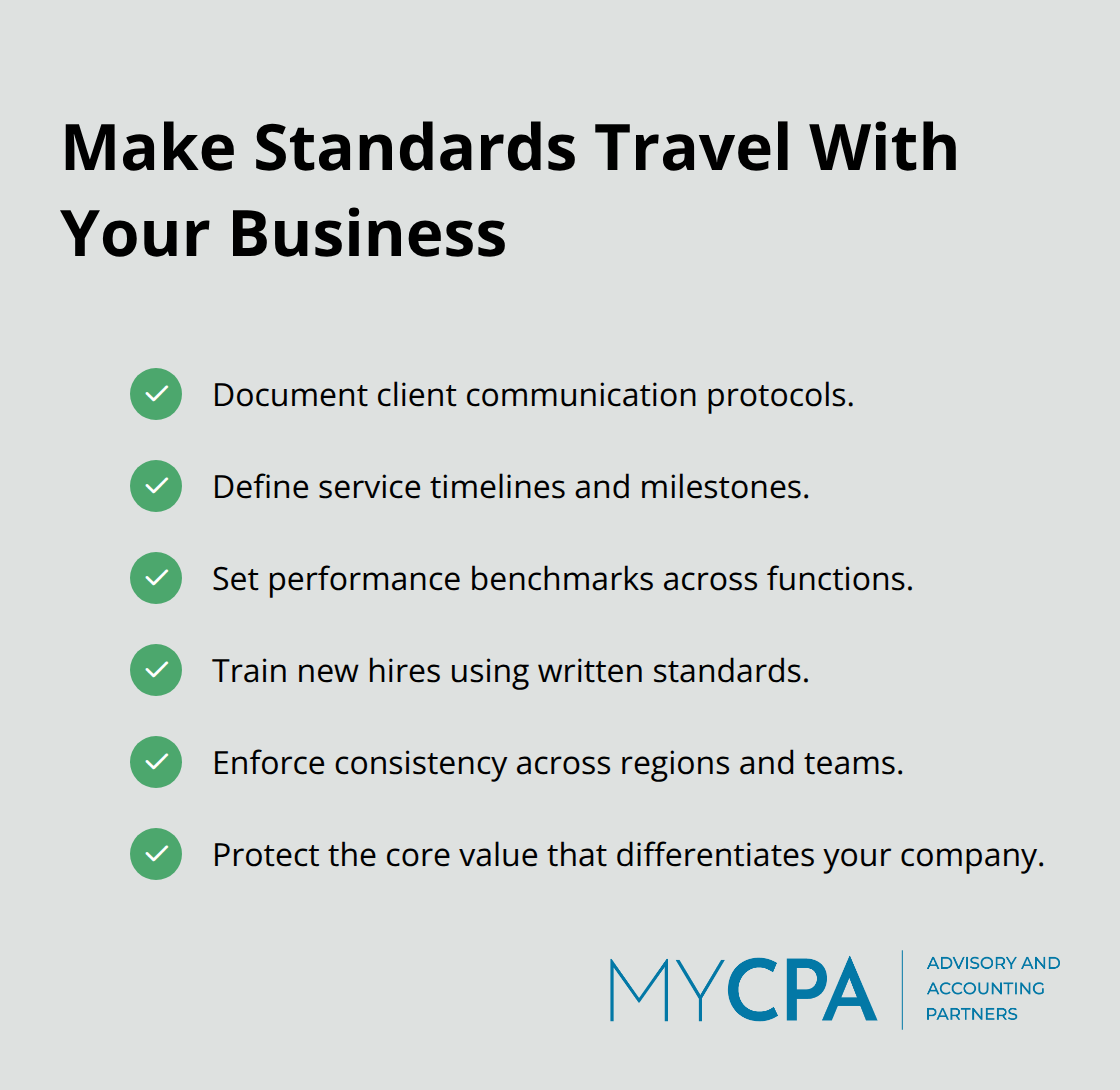
This infrastructure prevents the slow erosion of what made your company valuable in the first place.
Control over growth depends on knowing your numbers in real time. Cash flow surprises, margin compression, and unplanned cost overruns happen when you lack visibility into spending and profitability. The systems you build now-tracking expenses against budget, monitoring cash flow weekly, and forecasting your financial position-become the foundation for confident scaling decisions later.
Systems prevent chaos but most founders build them backward-after expansion creates problems instead of before. The reality is this: you must implement procedures, automate workflows, and delegate authority with precision and ruthlessness about what actually matters. IPS grew from $3M in revenue in 2015 to $38M by 2020 through daily huddles, weekly company-wide meetings, and monthly reviews that forced transparency about metrics nobody could hide from. This wasn’t busywork. This was the operating system that let them scale without the founder becoming the bottleneck. You need a similar infrastructure, but you must build it to your business, not copy it from a template.
Start with what you actually do today, not the aspirational version. Write down exactly how your sales team moves from first contact to contract signature. Document how your operations team onboards a new client, what quality checks they perform, and when they escalate issues. Map your financial close process: who enters data, who reviews it, who catches errors. This isn’t a 200-page manual. Slang Worldwide used Function Accountability Charts to assign ownership of specific processes and decisions as they scaled to multiple locations and product lines. Your documentation should be short enough that a new hire reads it in one sitting and specific enough that they execute it without guessing.
The mistake most founders make is that they document everything, which means nobody reads anything. You should document only the decisions, processes, and standards that directly affect customer experience, profitability, or legal compliance. This focused approach keeps your systems lean and actually useful.
Automation comes next, but only after you’ve eliminated the steps that don’t belong in your process at all. Too many companies automate waste. Before you implement workflow software or connect your CRM to your accounting system, you must eliminate redundant approvals, consolidate data entry, and remove sign-offs that exist only because nobody bothered to question them.
Identify the tasks your team repeats daily without thinking-data entry, report generation, invoice processing, customer follow-ups. These are your automation targets. Platforms like Salesforce and HubSpot can reduce manual work when configured correctly, but configuration requires knowing exactly what you want to automate first. The investment pays off only when you’ve already stripped away the unnecessary steps.
Delegating authority without clear guardrails creates the same chaos you’re trying to escape. Your operations manager needs to know they can approve purchases under $10,000 without asking you, but anything above that requires a conversation. Your sales team lead needs authority to discount up to 15% for annual contracts, but larger discounts require finance approval.
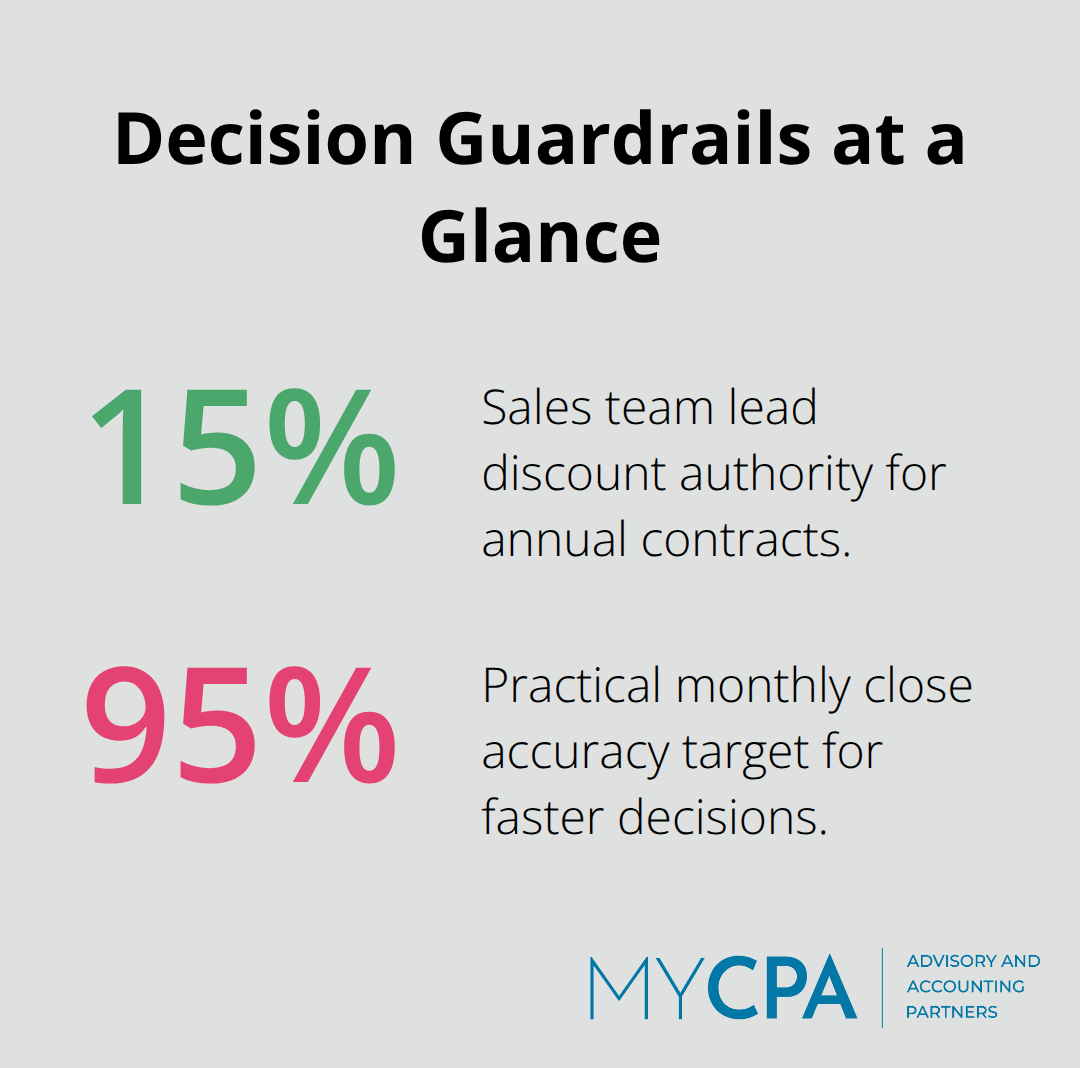
These boundaries exist so people move fast and make decisions, not so you micromanage them.
Valor Home Services uses structured one-on-one meetings between owners and department heads to review decisions made during the week, building trust while maintaining visibility. This approach keeps control without slowing execution. Your team members gain confidence in their authority when they understand exactly where the lines sit, and you gain confidence that decisions stay aligned with your strategy.
The systems that actually stick are the ones you reinforce through regular meetings and reviews. Weekly huddles and monthly financial reviews create the rhythm that keeps your operation transparent and responsive. These meetings aren’t overhead-they’re the mechanism that lets you scale without losing your grip on what’s happening. When your team knows they’ll report on metrics every week, they pay attention to those metrics. When you review cash flow monthly instead of quarterly, you catch problems before they become crises. The infrastructure you build now determines whether growth strengthens your control or erodes it. Your next challenge is making sure the financial systems you put in place actually support the decisions you need to make as you expand.
Your financial systems either pull you toward scaling decisions or push you away from them. Founders who scale revenue by 50% often watch profitability collapse because they never built visibility into cash flow, cost structures, or unit economics. The systems you implement now determine whether growth strengthens your financial position or weakens it.
Cash flow forecasting, not profit reporting alone, is where control lives during expansion. Most accounting software shows you what happened last month, not what happens to your cash next month. You need weekly cash position reports that show deposits, payables, payroll timing, and seasonal fluctuations so you catch shortfalls before they force panic decisions.
Slang Worldwide cut $8.5 million in costs by installing rigorous cash flow discipline and daily monitoring of burn rate before scaling further. They didn’t cut blindly; they tracked exactly where money flowed and made decisions from data, not desperation. Your financial close process should happen monthly, not quarterly. Monthly closes force you to know your numbers within days of month-end so you can react to margin compression, cost overruns, or revenue shortfalls while they’re still small. This timing matters more than perfect accuracy; a close that’s 95% accurate on day five of the month proves infinitely more useful than a 100% accurate close on day twenty-five.
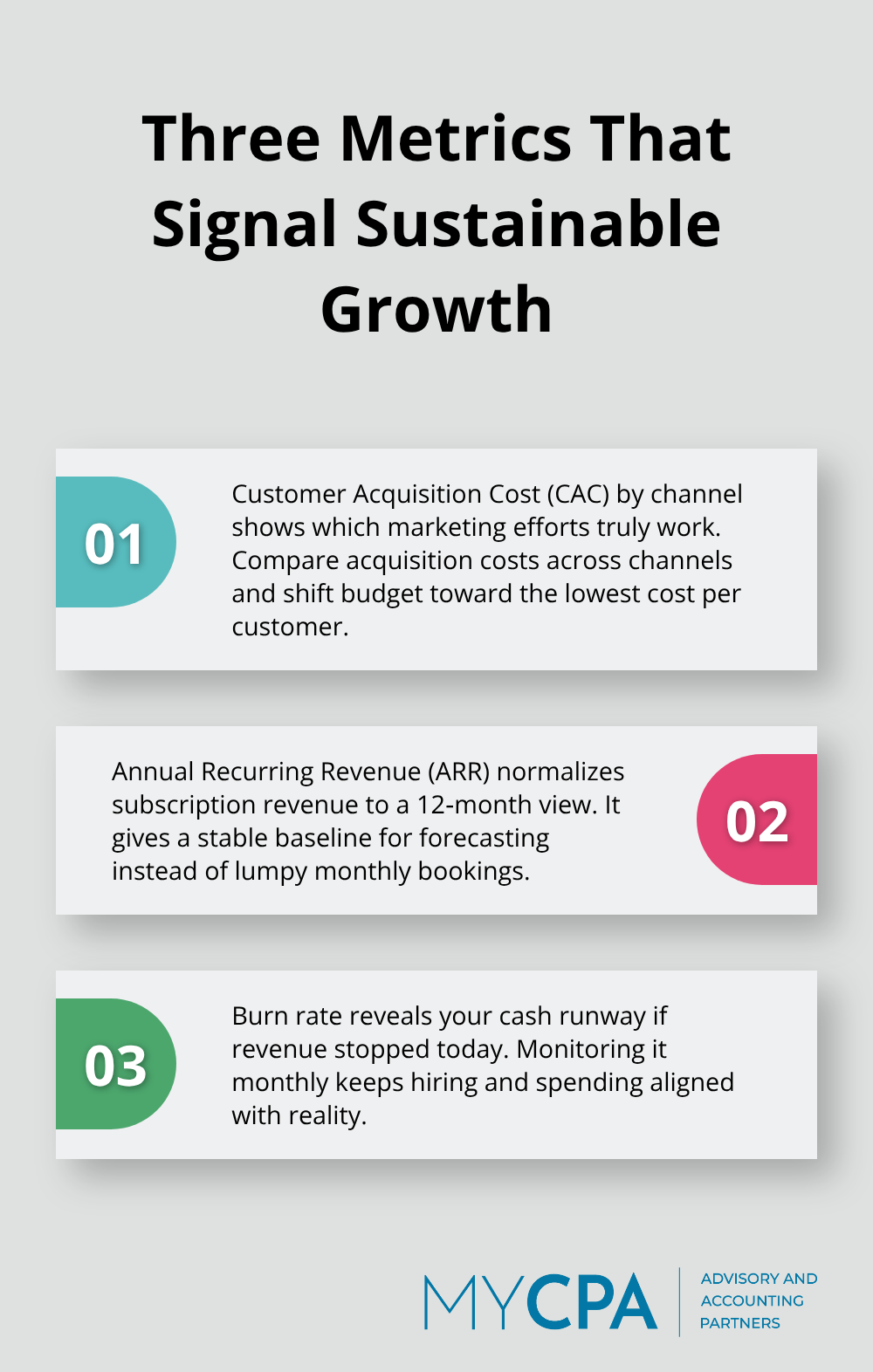
Track three metrics that directly signal whether your growth is sustainable: Customer Acquisition Cost per channel, Annual Recurring Revenue for predictability, and monthly cash burn rate. CAC by channel shows you which marketing efforts actually work; if educational events produce customers at $1,200 per acquisition while sponsorships cost $8,000 per customer, your budget allocation should reflect that reality. ARR normalizes subscription revenue to a twelve-month period, giving you a stable number to forecast against instead of lumpy monthly bookings. Burn rate tells you how many months of runway you have if revenue stops tomorrow.
The moment you add a new location, department, or product line, your fixed costs jump. Payroll, rent, software subscriptions, and compliance costs all increase simultaneously. Most founders assume costs grow linearly with revenue, then panic when they discover costs grow in chunks. You need a cost model that maps each growth initiative to its specific cost structure before you commit resources.
Adding a sales region isn’t a $100,000 decision; it’s a $280,000 decision when you factor in salary, benefits, software licenses, travel, and compliance. Build this model into your expansion planning so you know exactly what profitability looks like at different revenue levels. Many growing companies find their gross margins stay stable but their operating margin compresses because overhead didn’t scale as efficiently as revenue. This is where discipline matters most.
IPS grew to $38 million by enforcing a philosophy that revenue growth must justify the cost structure supporting it. They didn’t hire support staff in advance; they hired when data showed demand required it. This approach means some customers wait slightly longer for responses during rapid growth, but it protects profitability. Your alternative is hiring ahead of demand, watching those employees sit underutilized, and destroying margins.
Taking outside capital to fuel growth means sharing control with investors who have different risk tolerances and time horizons than you do. Equity dilution is obvious, but less obvious is the pressure to hit growth targets that prioritize revenue over profitability. Venture-backed companies often accept negative cash flow for years because investors expect exponential growth; bootstrapped companies must achieve profitability faster because they have no safety net. Neither path is wrong, but the choice shapes every financial decision you make afterward.
If you fund growth through reinvested profits, you move slower but retain complete control. If you take investor capital, you move faster but answer to people who expect specific returns by specific dates. Debt financing sits in the middle; it provides capital without equity dilution, but it creates fixed obligations regardless of whether growth delivers expected returns. Know whether your plan requires $500,000, $2 million, or $10 million before you start pitching investors or negotiating credit lines. Vague funding conversations waste everyone’s time and often result in suboptimal terms.
Scalable growth strategies work only when you build control mechanisms before expansion pressure forces your hand. The companies that scale successfully engineer both speed and stability through documented processes, clear decision authority, and financial visibility. Your financial foundation determines whether growth strengthens or weakens your position, and the systems you implement now shape every expansion decision you make later.
Start this week by mapping your actual processes, not the aspirational version. Identify which decisions, approvals, and workflows slow your team down without adding value, then eliminate those first before you automate anything. Build weekly rhythms around metrics that matter-cash position, revenue pipeline, customer acquisition cost by channel-and set decision authority in writing so your team operates with confidence.
We at My CPA Advisory and Accounting Partners help business owners build the accounting systems and financial visibility that support confident scaling decisions. Our accounting services, QuickBooks expertise, and business advisory work together to give you the real-time financial clarity that scalable growth requires. Contact My CPA Advisory and Accounting Partners to discuss how tailored financial management can support your expansion without sacrificing control.








Privacy Policy | Terms & Conditions | Powered by Cajabra