
Accounting Accuracy Improvements: Techniques That Endure
Boost accounting accuracy improvements with proven techniques that reduce errors, save time, and strengthen financial controls for your business.
Scaling a firm profitably requires more than ambition-it demands a clear financial foundation and strategic execution. We at My CPA Advisory and Accounting Partners help firms navigate this challenge by focusing on what actually moves the needle: cash flow management, operational efficiency, and deliberate growth planning.
This guide walks you through the growth strategies for firms that separate sustainable expansion from costly missteps.
Most accounting and CPA firms operate with incomplete visibility into their true financial position. They track revenue and maybe gross profit, but they miss the metrics that determine whether scaling is possible. Start by mapping your cash conversion cycle, contribution margin by service line, and client profitability. If you cannot answer these three questions in the next 15 minutes, you are not ready to scale: What percentage of revenue converts to actual cash each month? Which services generate margins above 50 percent? Which clients are actually profitable after accounting for service delivery time and overhead allocation?
These answers form your financial foundation. Fidelity research from 2023 shows that organic growth in advisory firms has declined to 3 to 4 percent, signaling a hard ceiling unless your unit economics are bulletproof. Your gross margin should exceed 70 percent if you operate on a retainer model, your cost of acquiring a client should pay back within 12 months, and your lifetime value to customer acquisition cost ratio should sit at 3 to 1 or higher.
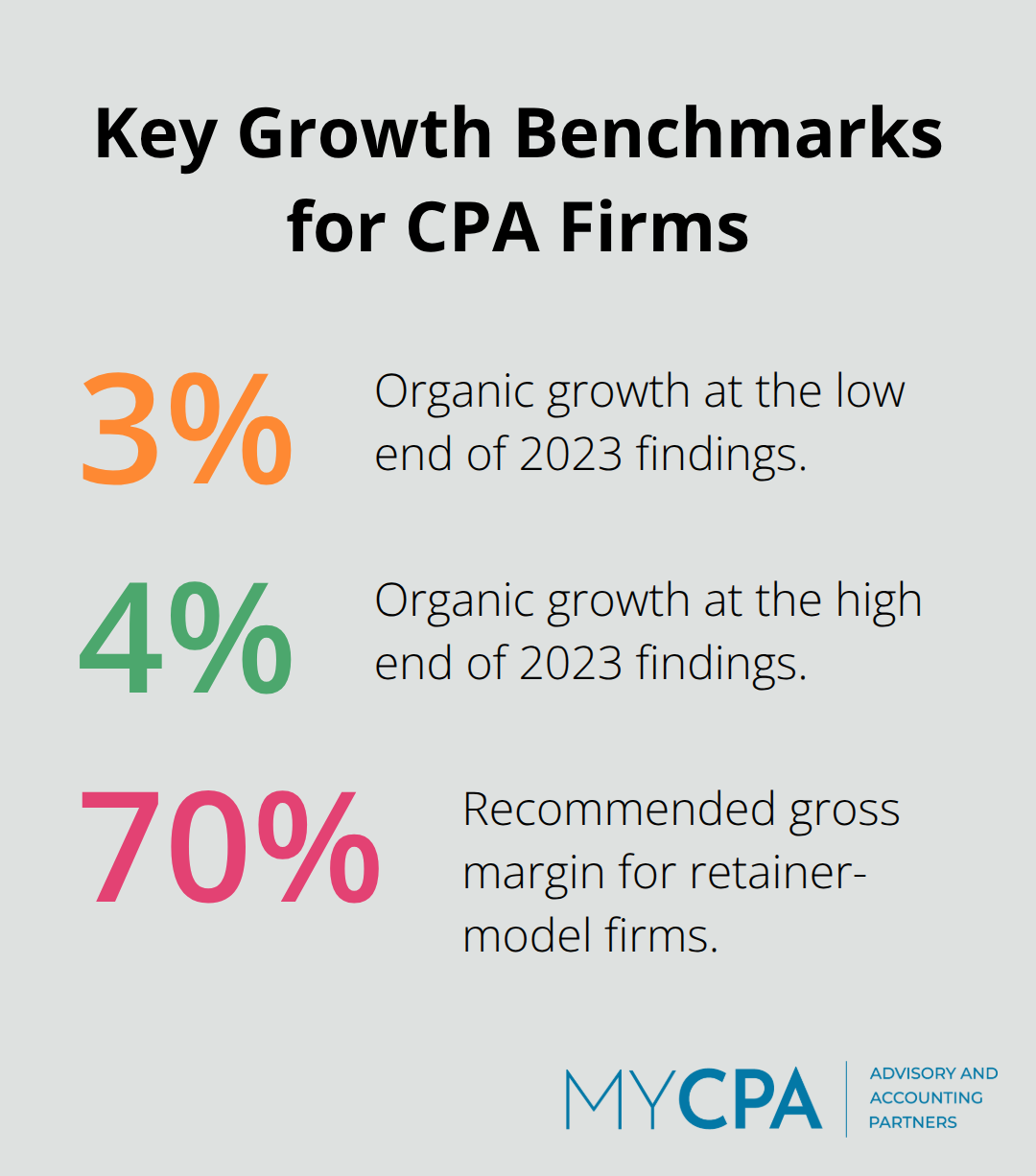
If you fall below these benchmarks, scaling amplifies your problems rather than solving them.
Most firms chase new clients while their existing book leaks profitability through the bottom. Audit your last 12 months of financial data ruthlessly. Segment revenue by service type, client size, and acquisition source. Calculate the true delivery cost for each segment, including your time, staff labor, software subscriptions, and overhead allocation.
You will likely find that 20 percent of your clients generate 80 percent of your profit, while another subset consumes disproportionate resources for minimal return. This is not a judgment; it is a data point that shapes your growth strategy.
Before you hire another person or spend on marketing, identify where your operations leak efficiency. Most firms waste time on manual data entry, redundant client communication, and unstructured service delivery. If your team spends more than 10 hours per week on administrative tasks that could be automated, you have a profitability problem masquerading as a capacity problem.
Map your core workflows: client intake, tax preparation, bookkeeping reconciliation, and reporting. Where do bottlenecks occur? Where do clients ask the same questions repeatedly? These friction points are where technology and process redesign deliver the fastest return. Implement a CRM system if you do not have one, tie it to your accounting software, and automate routine client touchpoints.
A structured onboarding sequence, clearly documented service deliverables, and defined pricing tiers protect margins and create repeatability. This approach positions you to scale without proportional staff growth.
Your competitive position depends on operational clarity. If your closest competitor operates with tighter processes and lower delivery costs, they can undercut your pricing or invest profits back into growth while you stay flat. Knowing your competitive position means understanding not just your numbers but theirs.
Research their service offerings, pricing, and client segments. Where do they win? Where are they vulnerable? This intelligence shapes whether you compete on price, specialization, or client experience. Once you have mapped your financial foundation, audited client profitability, and assessed your competitive standing, you can move forward with strategic planning that actually sticks.
Strategic growth planning fails when firms set revenue targets without anchoring them to unit economics. Start with this approach: calculate your target revenue based on three constraints-available delivery capacity, client acquisition capacity, and profitability per client. If you aim to grow from $500,000 to $750,000 in revenue over 18 months, that growth is meaningless unless you generate at least $375,000 in contribution margin (maintaining your 50 percent threshold) and fit within your team’s realistic capacity. Fidelity’s 2023 research found that firms with structured growth plans achieve roughly double the organic growth rate of those without one. Your plan must specify three things: the exact revenue target, the service lines or client segments driving that revenue, and the delivery model that makes it profitable. Most firms skip this last piece and wonder why scaling feels chaotic.
Revenue targets alone are abstract. Instead, set goals around client acquisition and retention because these directly control revenue. If your average client lifetime value is $15,000 and your target is $750,000 in revenue, you need 50 net new clients over 18 months-roughly three per month. Now the question becomes concrete: can your current lead generation and sales process deliver three qualified leads per month? If your conversion rate is 40 percent, you need 7.5 leads monthly. If your current marketing generates two leads monthly, you have a gap.
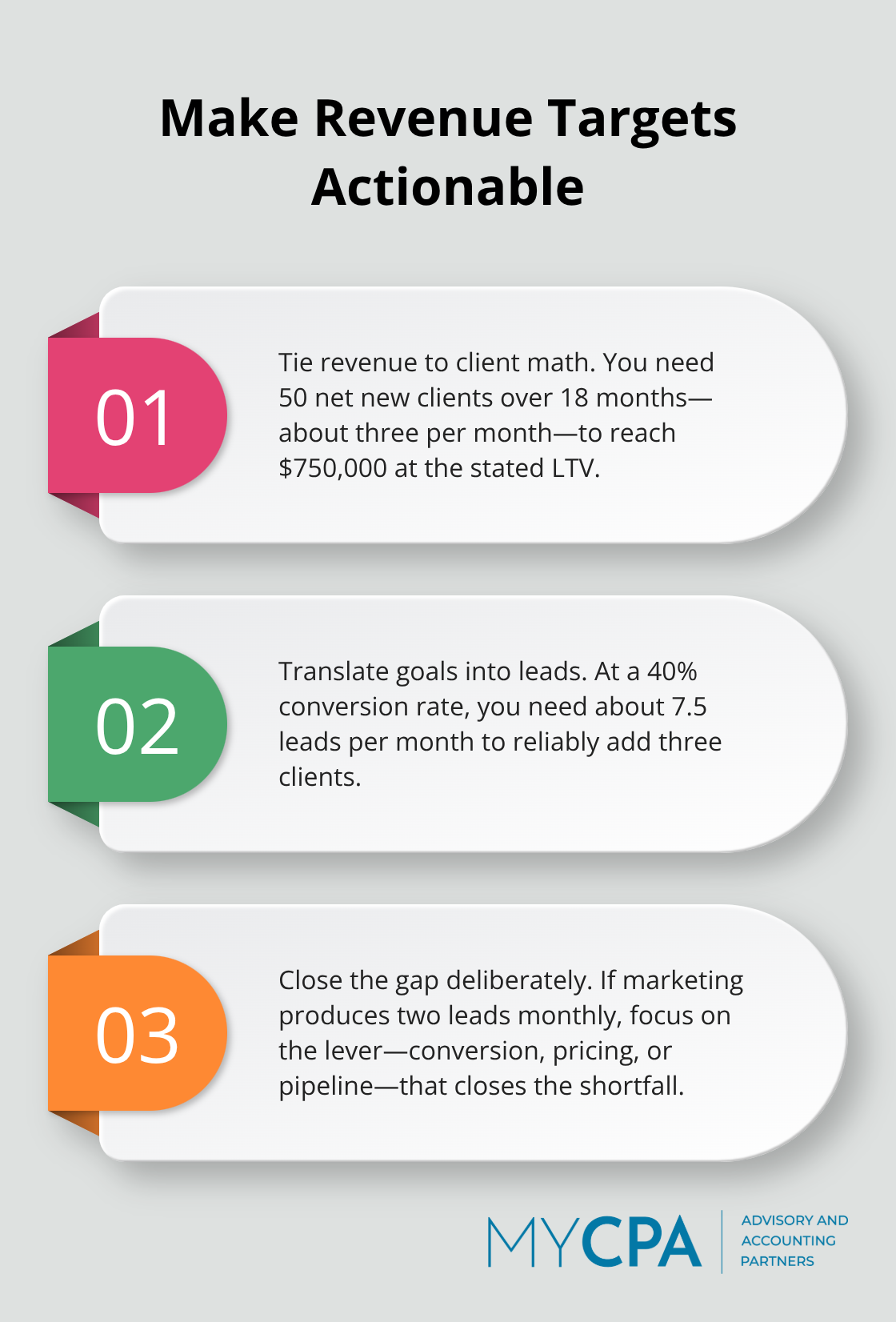
This gap-based approach forces you to identify exactly which growth lever needs to move. Some firms discover they need to improve conversion rates rather than generate more leads. Others find their pricing is too low relative to the effort required, making growth unprofitable. Knowing the gap changes everything about how you plan.
Many firms conflate these two directions and suffer for it. Service expansion means adding tax planning, bookkeeping, or payroll services to your existing client base. Market expansion means targeting a new client type-shifting from small businesses to real estate investors, for example. Service expansion to existing clients typically generates higher margins because acquisition costs are near zero and clients already trust you. Market expansion requires new marketing spend, new positioning, and often new service delivery expertise. If your firm has thin margins or constrained capacity, service expansion should come first. Calculate which of your existing clients would purchase an additional service if offered. If 30 percent of your bookkeeping clients would purchase tax planning, that’s your expansion target. Develop a simple offer, test it with five clients, measure the uptake and delivery cost, then scale. This approach generates revenue with minimal risk because you already know your clients’ needs.
Financial projections for growth fail because they ignore the cost of growth itself. When you acquire a new client, you incur onboarding costs-staff time for intake, software setup, initial planning work. Onboarding costs often consume a significant portion of year-one revenue for that client. Your projection must account for this front-loaded expense. Similarly, if you plan to hire staff to support growth, salary and ramp-up costs hit your profit margin immediately while the revenue benefit lags. A realistic 18-month projection includes month-by-month client acquisition targets, corresponding revenue by month, delivery costs as a percentage of that revenue, and overhead allocation. Most firms project growth as a straight line upward and get blindsided when cash flow tightens in months three through six. Build your projection conservatively-assume 60 percent of your target client acquisition actually happens and that client retention stays flat. If your conservative projection still shows positive contribution margin and cash flow, you have a viable plan.
Growth plans collapse when revenue targets outpace your team’s ability to deliver. Map your current capacity by service line: how many tax returns can your staff complete monthly? How many bookkeeping clients can one team member manage? How many planning conversations can you conduct per week? These numbers form your delivery ceiling. If your team currently handles 40 tax returns monthly and you plan to grow to 60, you need either to hire staff or to improve efficiency. Calculate the cost of each option. Hiring a junior accountant costs roughly $50,000 to $60,000 annually plus benefits and ramp-up time. Implementing automation or process improvements might cost $5,000 to $15,000 upfront but requires no ongoing salary. Your growth plan must specify which capacity lever you pull and when. This clarity prevents you from acquiring clients you cannot serve profitably.
Your financial projections and capacity map now form the foundation for execution. The next step is to identify which operational changes-process improvements, technology investments, or staffing decisions-actually unlock that growth without destroying your margins.
Your financial projections assume your team can deliver services at current efficiency levels. That assumption is wrong. Most accounting firms operate with 15 to 20 percent of their time consumed by tasks that generate zero client value-manual data entry between systems, repetitive client emails, duplicate data verification, and status update meetings. Eliminating this waste directly increases your profit margin and creates capacity for growth without hiring.
Start by tracking how your team spends time for two weeks. Use time-tracking software or have staff log their activities in 30-minute blocks. You will find patterns: a bookkeeper spends four hours weekly reconciling accounts that could be automated, a tax preparer spends three hours weekly chasing missing documents from clients, an admin spends five hours weekly entering the same client information into multiple systems. These are not small inefficiencies-they represent roughly 12 hours per week of billable time per person that vanishes. At a loaded cost of $75 per hour, that is $46,800 annually in wasted capacity per full-time employee. Even a firm with three staff members loses nearly $140,000 in annual capacity to preventable friction.
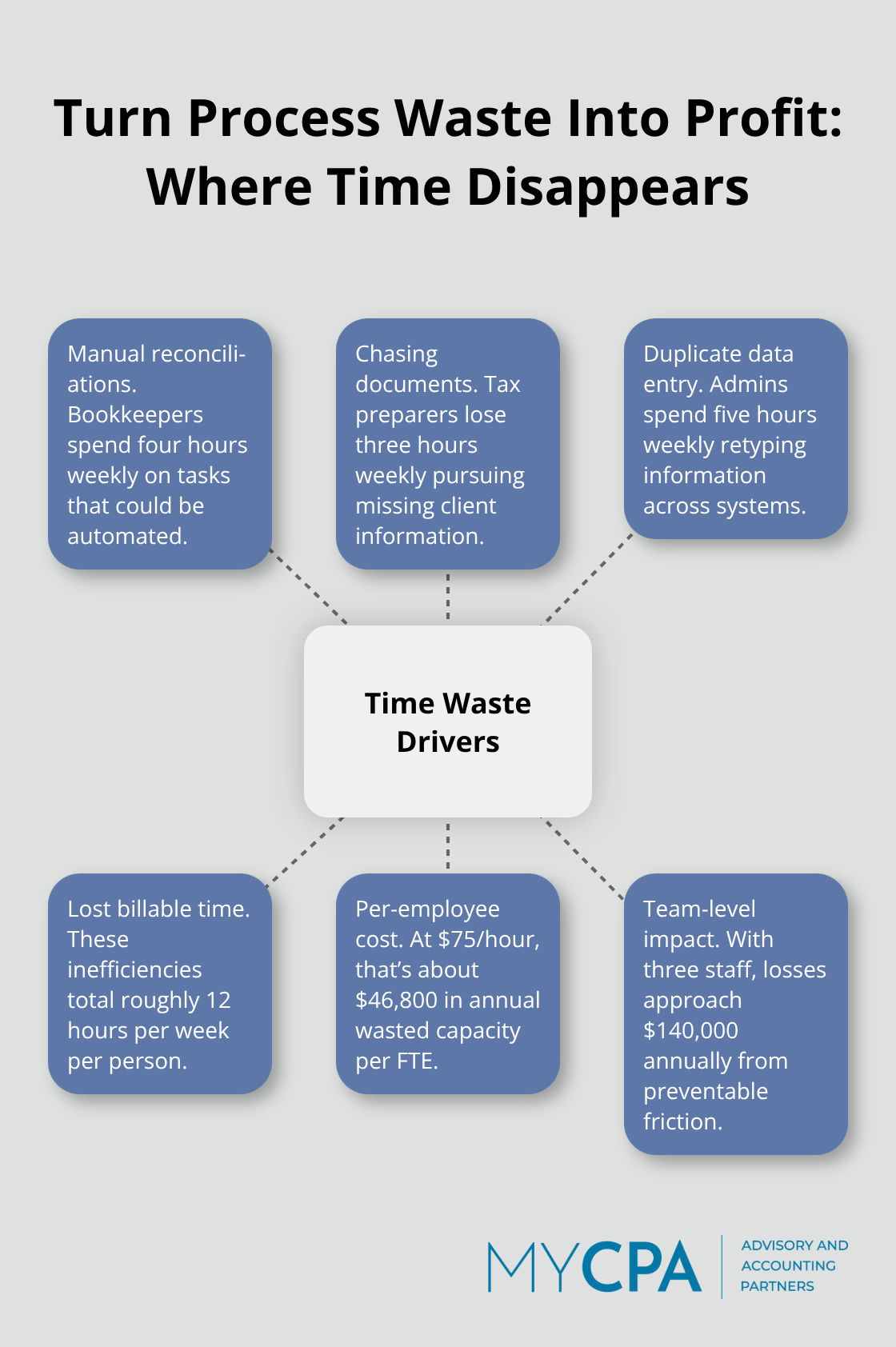
Your first operational move is to identify and eliminate these specific time sinks, not to hire more people.
Process improvements generate faster returns than staffing additions. Implement a CRM system that integrates with your accounting software so client information flows once, not three times. Set up automated client intake forms that populate your database rather than requiring manual data entry. Use document request templates that clients complete electronically instead of email back-and-forth. Build a standard client onboarding checklist that your team completes in a defined sequence, eliminating the ad-hoc chaos that stretches timelines.
These changes cost between $5,000 and $15,000 in software and setup but recover that investment within three months through recovered capacity. The firms that scale profitably invest in process redesign before they invest in headcount.
Most firms subscribe to tools they barely use-seven accounting software platforms when three would suffice, multiple project management systems, separate time-tracking and billing software. Audit your subscriptions immediately. You likely pay $2,000 to $5,000 monthly for redundant tools. Consolidate ruthlessly. Choose one accounting platform, one CRM, one project management system. Integration matters more than feature completeness; a tool that talks to your other systems beats a feature-rich island.
Once you strip waste and optimize your tech, then evaluate staffing. If your team manages capacity comfortably after process improvements, invest those savings into strategic growth instead.
Profitable scaling rests on three foundations: financial clarity, a plan tied to unit economics, and operational efficiency. Most firms skip these steps and watch growth destroy margins instead of multiplying profit. The growth strategies for firms that work start with ruthless financial honesty, not ambition. Your gross margins must exceed 70 percent, your client acquisition cost must recover within 12 months, and your lifetime value to customer acquisition ratio must reach 3 to 1 or higher. Audit your client profitability, map your delivery capacity, and understand your competitive position before you acquire another client.
Strategic planning without execution fails. Your growth plan must specify exact client acquisition targets, the service lines driving revenue, and the delivery model that protects margins. Connect your revenue goals to concrete metrics: if you need 50 new clients over 18 months, you need roughly three per month. If your current marketing generates two leads monthly, you have identified your gap and can invest in the right growth lever instead of spreading effort across tactics that do not move the needle.
Operational excellence separates firms that scale profitably from those that struggle. Before you hire additional staff, recover the 15 to 20 percent of time your team wastes on manual tasks and system friction. Process improvements and technology consolidation cost far less than headcount and deliver faster returns. We at My CPA Advisory and Accounting Partners help firms translate this framework into action through tailored financial services and business advisory that align growth with profitability.








Privacy Policy | Terms & Conditions | Powered by Cajabra