
Tax Compliance Readiness Tips Every Small Enterprise Needs
Prepare your small business for tax season with essential compliance readiness tips. Avoid penalties and stay audit-ready with our practical guidance.
Most business owners have a strategy. But few connect it to actual numbers.
We at My CPA Advisory and Accounting Partners see this disconnect constantly. Your business planning advisory is only as strong as the financial reality behind it. When strategy and numbers don’t align, execution fails, investors walk away, and growth stalls.
This post shows you how to build plans that work.
Strategy without financial backing is just hope dressed up as a plan. Business owners often have solid strategies but no idea whether their numbers actually support them. The Economist Intelligence Unit found that 90% of executives fail to meet their goals, and the primary culprit isn’t weak strategy-it’s broken alignment between what leaders want to achieve and what their finances can support. When you skip the financial rigor, you’re essentially flying blind.

Your team executes projects that sound good but drain cash faster than projected, revenue assumptions sit untested against market reality, and by the time you notice the problem, you’ve already burned through resources that could have gone elsewhere. The companies that win treat financial alignment as non-negotiable from day one, not as an afterthought once strategy is locked in.
Financial projections force honesty. When you map out revenue streams to actual customer acquisition costs, pricing models, and sales cycles, you stop guessing. Many business owners overestimate revenue by 20% to 40% because they assume best-case scenarios will materialize. Underestimating costs is equally common-you forget about the staff you’ll need to hire, the systems upgrades required, or the working capital tied up in inventory. Building realistic expense budgets grounded in your actual operations reveals these gaps before they become crises. Cash flow projections that match your growth plans tell you exactly when you’ll run short, how much buffer you need, and whether you can actually fund expansion without external capital. The businesses that attract serious investors and lenders aren’t the ones with the most ambitious growth targets-they’re the ones with detailed, realistic financial models that show they understand their own economics.
When strategy and numbers align, lenders and investors see competence. A clear business plan that connects strategic goals to financial forecasts demonstrates that you’ve thought through execution, not just dreamed up outcomes. Organizations with strong strategic alignment increase value over the long term, because aligned execution actually delivers the benefits strategy promises. Misaligned plans leak money through duplicate initiatives, underfunded priorities, and projects that consume resources without proportional returns. Investors spot this immediately. They want to see how you’ll convert strategic moves into revenue, how you’ll manage costs as you scale, and what your financial assumptions actually rest on. Lenders want proof that your cash flow can service debt. Neither group trusts plans that treat strategy and numbers as separate conversations.
The gap between strategy and numbers doesn’t close on its own. You need a concrete process to connect your vision to your financial reality-one that maps revenue streams to goals, builds expense budgets tied to actual operations, and creates cash flow projections that reflect your real growth timeline. That’s where the work begins.
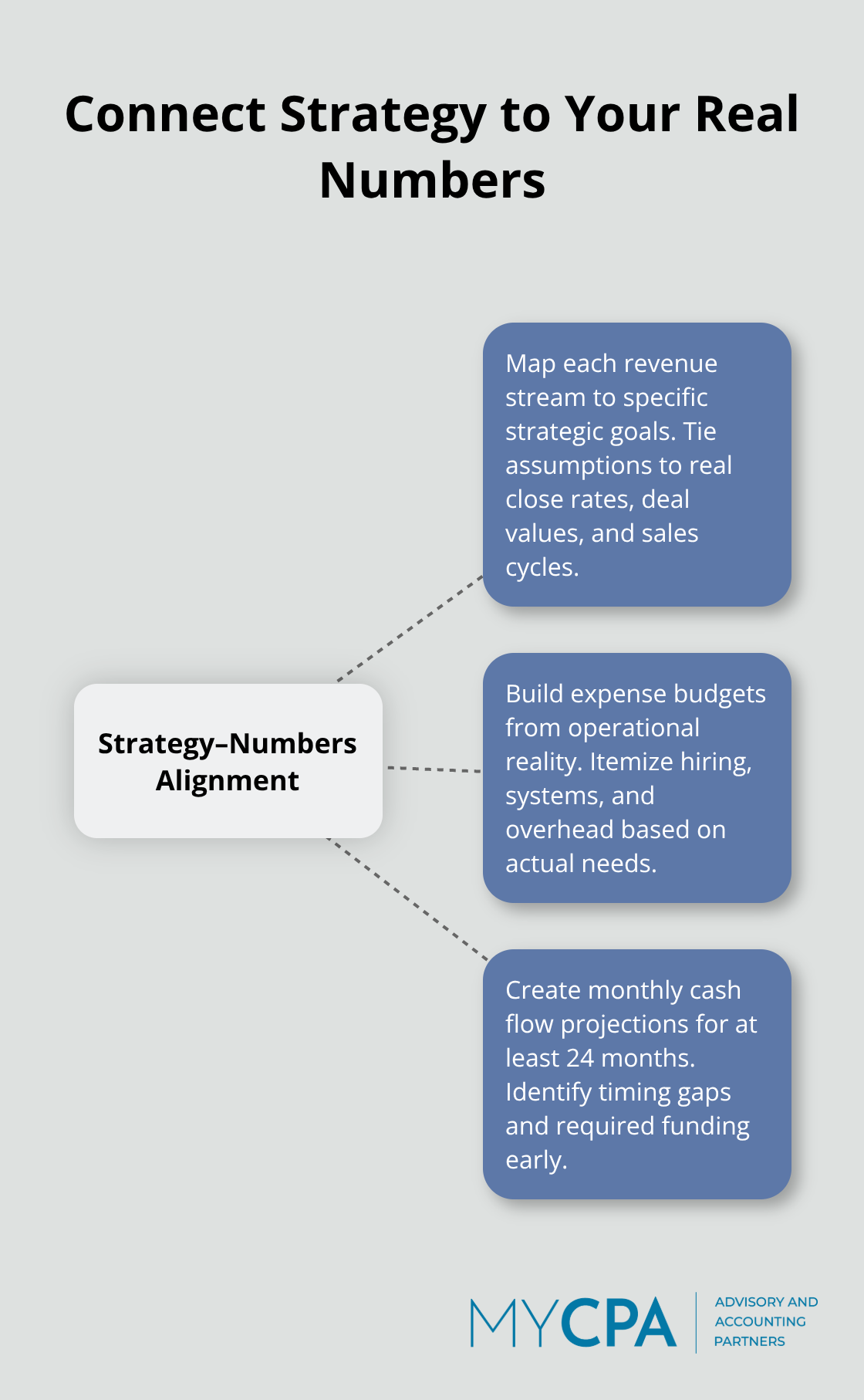
Start by listing every revenue source your business actually generates, then assign each one to a strategic goal. If your strategy targets 30% growth in enterprise clients, that revenue stream must appear in your financial model with realistic assumptions about how many deals close, at what average value, and over what timeframe. Most owners skip this step and instead project revenue as a single percentage increase across the board, which masks whether specific strategic moves will actually pay off. You need to know: How many new customers does each strategic initiative require? What’s your actual customer acquisition cost based on past spending, not industry averages? How long is your sales cycle, and does your cash flow survive the gap between spending on marketing and receiving payment? When you map revenue to strategy this way, you catch disconnects immediately. A goal to expand into a new market sounds good until you model the sales team you’ll need to hire, the marketing spend required, and the six-month ramp before revenue materializes. That’s when you realize you either need to reduce other spending, extend your timeline, or revise your growth target.
Expense budgeting must flow from your operational reality, not from arbitrary percentages. If your strategy requires hiring five new salespeople, that’s not a 10% headcount increase you estimate in a spreadsheet-it’s specific salary, benefits, equipment, and training costs tied to actual job descriptions and market rates in your region. Build your budget line by line from your current operations: What are you spending today on each function? What changes when you execute your strategy? Many owners underestimate because they forget about the hidden costs (the systems upgrades needed to handle higher transaction volume, the additional accounting and compliance work, the management time required to oversee new teams). Once your expense budget reflects reality, you move forward with confidence instead of discovering shortfalls mid-execution.
Create monthly cash flow projections for at least 24 months that show when cash comes in and when it goes out. This reveals your critical funding gaps. A company growing 40% annually often runs out of cash because growth consumes working capital faster than revenue arrives. You’ll see exactly when you need external funding and how much, which lets you approach lenders or investors with confidence instead of desperation. Without this detail, your strategic plan stays theoretical. With it, execution becomes achievable, and you know precisely what financial moves support your growth targets.
The next step moves beyond projections into the mistakes that derail even well-intentioned plans.
Most business owners fail not because they lack ambition but because they treat strategy and finances as separate tracks that magically converge later. Research showing that executives miss their goals points to a specific culprit: the gap between what leaders plan and what their financial model actually supports. This gap appears in three distinct ways, and recognizing them saves you from burning cash on a plan that was broken from the start.
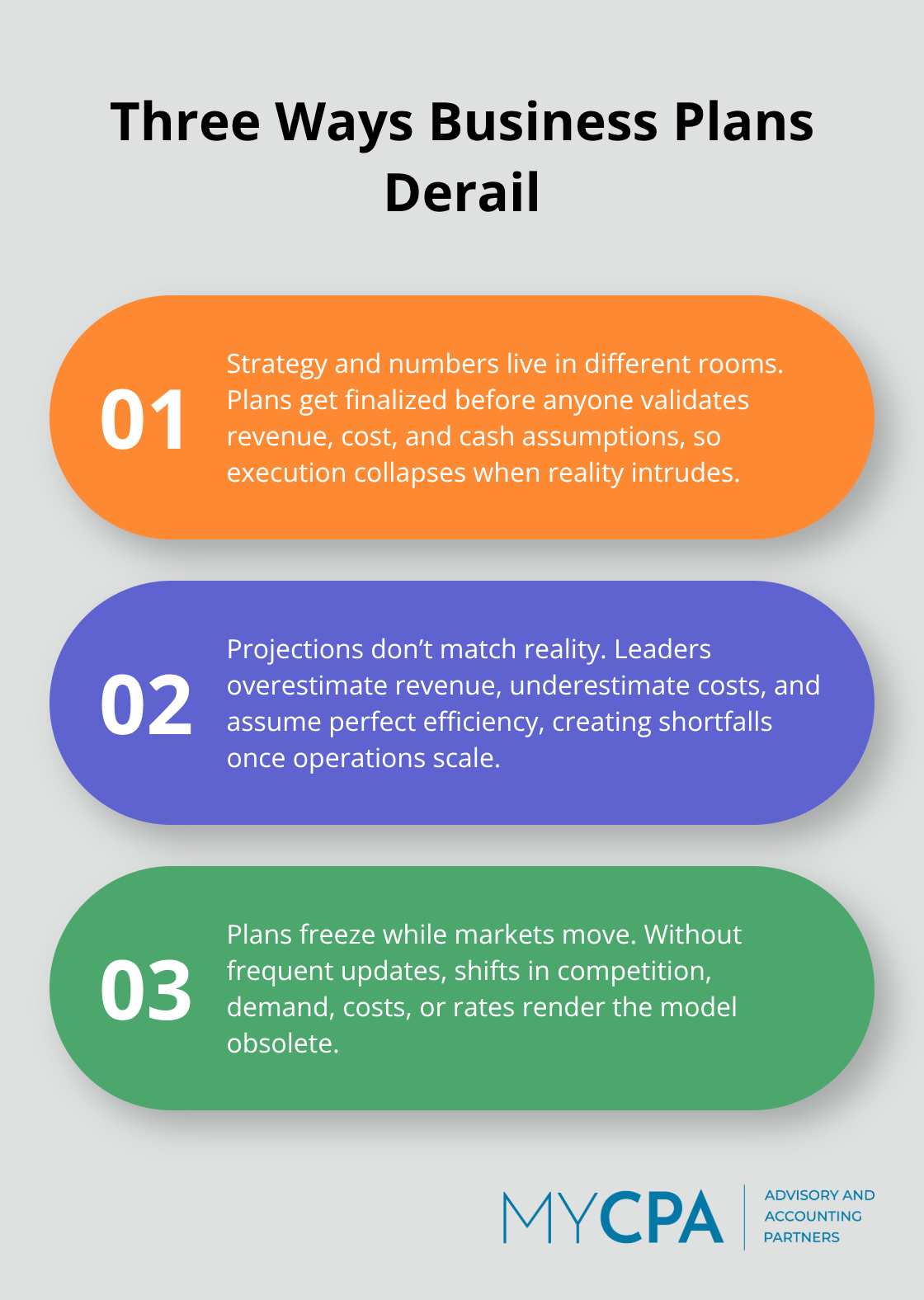
The first mistake is structural. You build your strategy in a conference room, then hand it to someone to add numbers afterward. Strategy gets locked in before anyone tests whether your revenue assumptions hold up against your actual sales cycle, whether your cost structure scales with growth, or whether your cash flow can survive the gap between spending and revenue arrival. This separation creates plans that look good on a slide but fall apart in execution.
The second mistake is numerical. You underestimate expenses and overestimate revenue using best-case scenarios instead of historical data. You assume your team will work at peak efficiency immediately, that customer acquisition will happen faster than it actually does, and that margins will stay constant as volume increases. These assumptions compound into massive shortfalls once execution starts.
The third mistake is static. You build a financial model once and never update it when market conditions shift. Competitors enter your space, customer buying patterns change, supply costs spike, or interest rates move. Your plan stays frozen while reality moves forward. Quarterly reviews catch these shifts; annual reviews miss them entirely.
A business owner we worked with projected 50% revenue growth but hadn’t accounted for the working capital needed to fund inventory for that growth, the additional accounting and compliance work required, or the management layers necessary to oversee expanded operations. Six months in, cash ran dry despite hitting revenue targets. Another owner separated strategy from numbers so completely that the sales team executed on a customer acquisition plan that the financial model showed was unprofitable at scale. They burned through budget pursuing customers they couldn’t afford to serve.
The fix requires treating strategy and numbers as inseparable from day one. Your revenue projections must tie directly to specific customer segments, actual customer acquisition costs from your past spending, and realistic sales cycles based on your industry and sales process. Your expense budget cannot be a percentage increase-it must flow from operational reality, line by line, showing exactly what hiring, systems, and overhead changes your strategy requires. Your cash flow model must run monthly for at least two years, identifying the exact month you’ll face a funding gap and how much capital you need. Most critically, you must revisit these numbers quarterly, not annually. Market shifts happen faster than annual planning cycles, and your financial model must flex when reality changes.
Your business plan only works when strategy and numbers move together from start to finish. The gap between what you want to achieve and what your finances can support is where most plans collapse. Companies that win treat financial alignment as foundational, not optional, and they map revenue to specific goals, build expense budgets from operational reality, and project cash flow monthly to catch funding gaps before they become crises.
Markets shift, competitors move, and customer behavior changes, which means your plan cannot stay frozen after approval. Quarterly financial reviews catch these shifts and let you adjust before misalignment costs you months of wasted execution. A business planning advisory partnership accelerates this work because experienced advisors spot the disconnects between your vision and your financial model that you might miss on your own. We at My CPA Advisory and Accounting Partners work with business owners to connect vision to financial reality, build financial models that reflect your actual operations, and create a rhythm of quarterly reviews that keep your plan aligned with market conditions.
The work starts now. If your current plan separates strategy from numbers, or if you haven’t reviewed it in months, that’s your signal to reconnect. Visit us at My CPA Advisory and Accounting Partners to explore how we support business owners in aligning their vision with numbers that work.








Privacy Policy | Terms & Conditions | Powered by Cajabra