
Month-End Close Process: Best Practices for Accurate Reporting
Streamline your month-end close process with best practices for accurate financial reporting and stronger accounting controls
Growing a business without a clear strategy is like throwing money at problems and hoping something sticks. Most business owners hit a wall when scaling because they lack the financial insight and operational planning needed to expand responsibly.
At My CPA Advisory and Accounting Partners, we’ve seen firsthand how growth advisory services transform companies from stuck to thriving. The difference between sustainable expansion and costly mistakes comes down to having expert guidance that’s tailored to your specific situation.
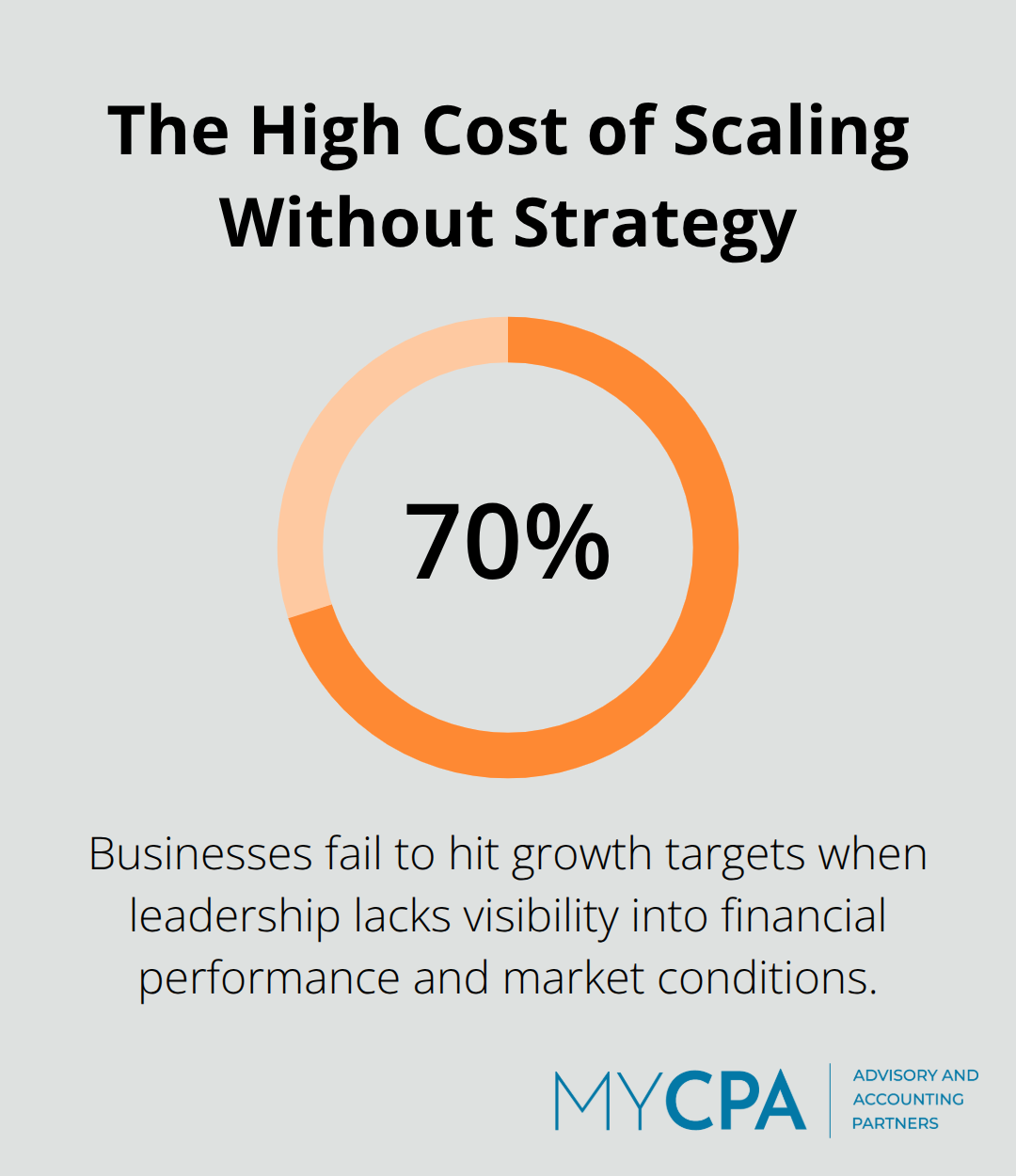
Companies that scale without professional guidance typically stumble on three fronts: they mismanage cash during expansion, they enter markets without understanding competitive dynamics, and they build operational systems that collapse under new volume. McKinsey research shows that 70% of businesses fail to achieve their growth targets because leadership lacks visibility into financial performance and market conditions. The cost of these missteps is substantial-a business that expands too fast without proper cash forecasting can face working capital crises that threaten survival, even when revenue climbs. Operational bottlenecks emerge when systems designed for smaller operations suddenly handle triple the transactions.
Hiring accelerates without clear role definition, creating redundancy and cultural friction. Market entry decisions happen on intuition rather than competitive analysis, leading companies into segments where they have no defensible position.
The difference between companies that scale sustainably and those that crash is access to real financial and market data. Businesses that implement formal performance dashboards-tracking metrics like cash conversion cycle, customer acquisition cost, and gross margin by segment-make faster, more accurate decisions. Highly data-driven organizations are three times more likely to report significant improvements in decision-making compared to those who rely on intuition. Strategic planning grounded in actual numbers prevents the common mistake of chasing revenue growth while margins erode. A company might hit a sales target but destroy profitability if pricing strategy and cost structure don’t align. Competitive positioning requires understanding where your business stands relative to direct competitors on price, service delivery speed, and product quality. Without this baseline, expansion efforts target the wrong customer segments or attempt to compete on factors where you have no advantage. Market expansion decisions should rest on feasibility analysis that evaluates market size, customer willingness to pay, regulatory barriers, and your operational capacity to serve new regions or segments effectively.
Sustainable expansion demands a written roadmap that connects financial capacity to operational capability to market opportunity. This roadmap identifies which growth initiatives create the most value relative to risk and capital requirements. Companies with formal expansion plans outperform those without them because the planning process itself surfaces conflicts and dependencies that would otherwise emerge as costly surprises during execution. Strategic guidance includes stress-testing your assumptions about customer demand, pricing elasticity, and competitive response. A business might assume it can capture 15% market share in a new segment, but competitive analysis and customer research often reveal that realistic penetration is 4-6%. Planning also addresses operational readiness. Adding new revenue streams requires new capabilities in production, fulfillment, customer support, or sales. If those capabilities don’t exist, growth targets become fiction. Professional advisory services help you build realistic timelines for capability development and identify where external partnerships or acquisitions make more sense than internal development. The alternative-aggressive growth without this structure-typically results in quality degradation, customer dissatisfaction, and brand damage that takes years to repair.
These financial and operational realities shape what growth advisory services actually address in practice.
Growth advisory services address three interconnected areas that determine whether expansion succeeds or stalls. Cash flow management sits at the foundation because companies with strong revenue growth often fail due to working capital shortages. When a business scales, inventory needs increase, accounts receivable stretch longer, and operating expenses spike before new revenue stabilizes. A company expanding from 10 million to 20 million in annual revenue might need an additional 2-3 million in working capital just to fund the transition. Without visibility into cash conversion cycles and seasonal patterns, owners make expansion decisions blind to their actual financial capacity.
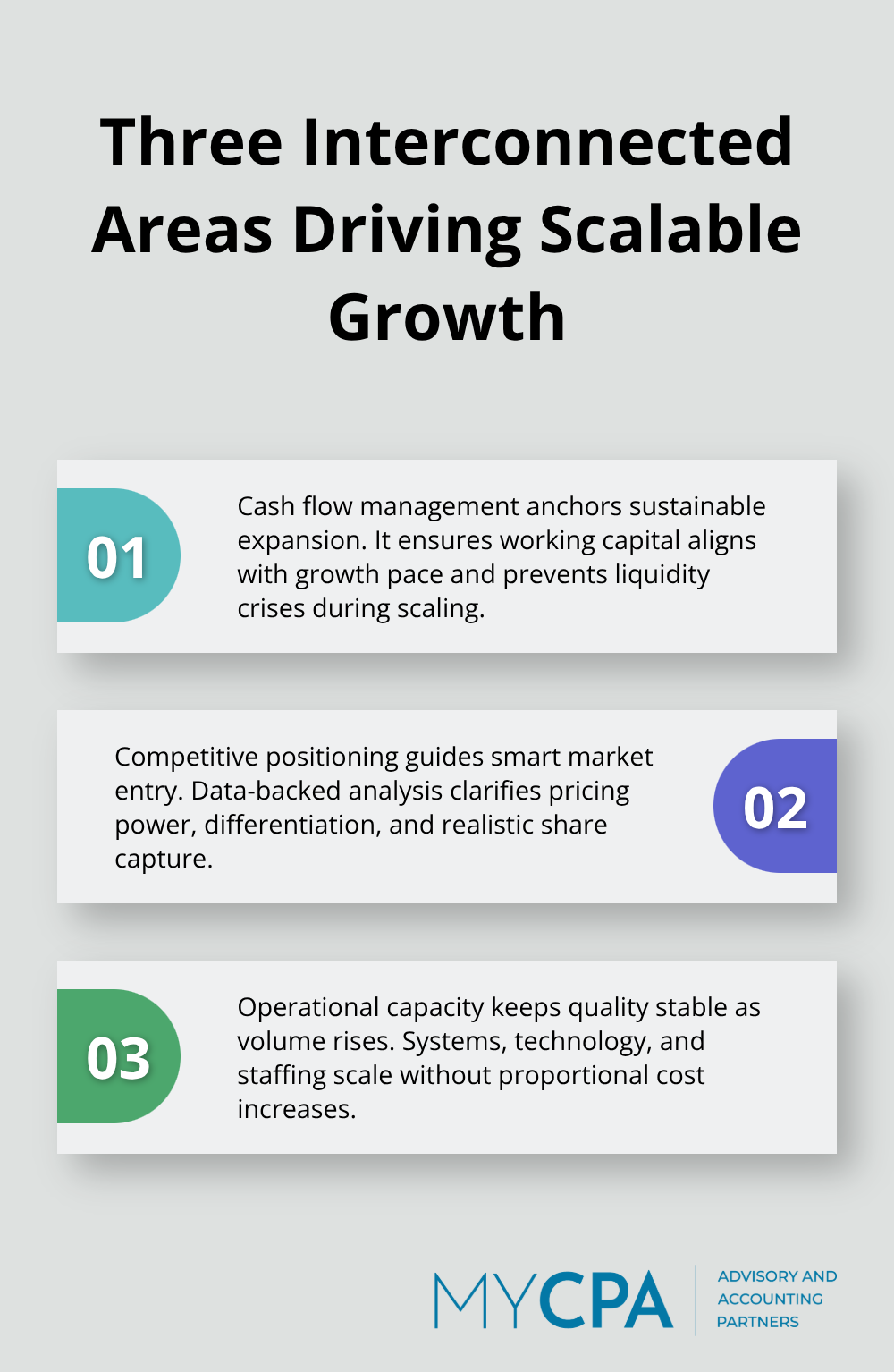
Growth advisory services map your cash position month by month, identify where capital gets trapped, and build forecasts that show exactly when and how much external funding you need. This prevents the scenario where a profitable company runs out of cash mid-expansion because management confused accounting profit with available cash.
Cash flow management directly controls how fast you can grow without external financing. Most business owners underestimate how much working capital expansion demands. When you expand into new markets or add product lines, customers typically take 30-60 days to pay while you must pay suppliers upfront. Growth advisory services quantify this gap and build cash flow forecasts that show the exact timing of cash needs. They also identify opportunities to accelerate collections through tighter payment terms or factoring arrangements, and negotiate extended payment terms with suppliers to ease cash pressure. The goal is to grow at a pace your cash position can sustain without constant emergency financing that erodes profitability through interest costs.
Competitive positioning during market expansion requires understanding where your business actually stands relative to direct competitors. Too many companies enter new markets based on anecdotal customer feedback rather than systematic competitive analysis. You need to know your competitor’s pricing structure, their service delivery timelines, their customer retention rates, and where they hold defensible advantages. Market research firms project the advisory services market will grow significantly, driven largely by businesses recognizing they need professional guidance on market entry decisions. This growth reflects a shift toward data-backed expansion rather than guesswork. Entering a new market or segment without understanding competitive dynamics is expensive. Growth advisors conduct feasibility analysis that maps market size, customer willingness to pay, and your realistic market share potential. This analysis prevents the common mistake of assuming you can capture market share at the prices and service levels that work in your existing business. A company strong in its home market might discover that new geographic markets have entrenched competitors with lower cost structures or that customer preferences differ enough to require product modifications. Systematic competitive analysis also reveals whether markets are consolidating around dominant players, which signals whether entry timing makes sense.
Operational scaling presents the third critical challenge because systems designed for smaller operations collapse under volume. A business that processes 100 customer orders daily through spreadsheets and manual workflows cannot suddenly handle 500 orders without infrastructure changes. Growth advisory services help identify operational bottlenecks that will emerge as you scale, prioritize capability investments, and determine whether to build capabilities internally or partner with external providers. Operational scaling requires building systems that handle volume without proportional cost increases. Growth advisory services map current processes, identify where manual work creates bottlenecks, and design scalable alternatives. This includes decisions about technology investments, hiring structure, and outsourcing partnerships. The alternative is organic growth where operational chaos eventually constrains revenue because quality suffers and customer satisfaction declines.
These three areas-cash flow, competitive positioning, and operational capacity-form the foundation for expansion decisions. Understanding how they interact reveals which growth initiatives your business can actually execute.
The real value of growth advisory services emerges when advisors assess your actual business condition, not the version you imagine. Most business owners operate without a clear picture of their financial health relative to their growth ambitions. An honest assessment exposes the gap between where you are and where you need to be before expansion happens. This diagnostic process identifies specific constraints that will sabotage growth if left unaddressed.
A company might have strong revenue but terrible cash conversion, meaning expansion will trigger a liquidity crisis. Another might have excellent unit economics but lack the management infrastructure to coordinate across multiple locations or product lines. The assessment also reveals hidden operational inefficiencies that drain profitability during scaling. Many businesses spend more on customer acquisition than industry benchmarks, or their gross margins lag competitors. These gaps become catastrophic when you scale because inefficiencies compound with volume.
An advisor quantifies these gaps with precision so you understand exactly what needs to change before growth happens. This assessment typically examines your financial statements for the past 24-36 months, your current operational workflows, your competitive positioning, your customer acquisition and retention patterns, and your management team’s capacity to handle complexity. The output is a clear-eyed view of business health that removes emotion from expansion decisions.
Once you understand your actual position, customized roadmaps translate that assessment into a sequenced action plan. Generic growth playbooks fail because they ignore industry-specific dynamics and your particular constraints. A roadmap for a manufacturing business scaling production capacity looks completely different from a roadmap for a professional services firm adding new practice areas.
Your roadmap specifies which growth initiatives to pursue first, what capabilities you must build or acquire before scaling, what external funding you need and when, and what metrics you’ll track to confirm you’re progressing toward targets. The roadmap also includes decision triggers that tell you when to accelerate, pause, or pivot. A company might commit to expanding into a new geographic market only if customer acquisition costs in that market stay below 18% of first-year revenue. If early testing shows CAC will be 24%, the roadmap tells you to either adjust pricing or abandon that market rather than proceed blindly.
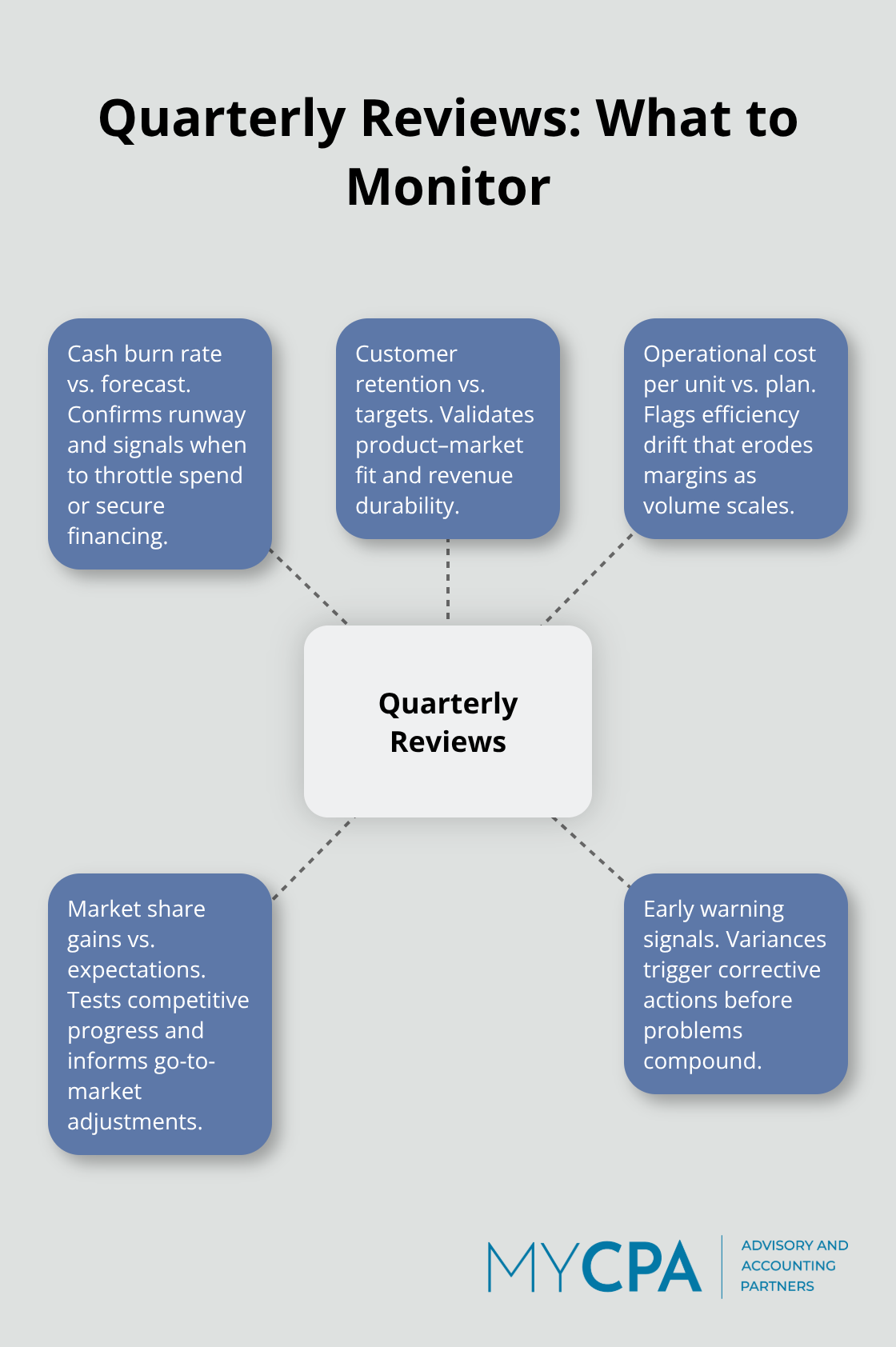
Ongoing performance monitoring transforms the roadmap from a static document into a living management tool. Quarterly reviews of financial metrics, operational KPIs, and market progress reveal whether assumptions are holding or need adjustment. Companies with formal quarterly business reviews outperform those without them on revenue growth metrics.
Monitoring includes tracking cash burn rate against forecast, customer retention against targets, operational cost per unit against plan, and market share gains against competitive expectations. When actual performance diverges from forecast, monitoring creates early warning signals that allow you to course-correct before small problems become existential threats. This continuous feedback loop separates sustainable expansion from companies that hit a growth ceiling and plateau indefinitely.
Sustainable expansion rests on three foundations: accurate visibility into your financial position, realistic understanding of market opportunities, and operational systems that scale without breaking. Most businesses fail at expansion not because they lack ambition but because they attempt growth without addressing these fundamentals. Growth advisory services exist specifically to bridge this gap between aspiration and execution.
An honest assessment of where your business actually stands removes guesswork from expansion decisions. You need to examine your cash conversion cycle, understand your true unit economics, and identify operational bottlenecks that will sabotage expansion if left unaddressed. Many business owners operate with incomplete financial information, making growth decisions based on revenue figures while ignoring cash flow realities or hidden inefficiencies that compound with scale.
Once you understand your actual position, a customized roadmap translates that assessment into sequenced action that specifies which growth initiatives to pursue first, what capabilities you must build before scaling, and what metrics will tell you whether you’re progressing toward targets. Quarterly reviews of financial metrics and operational KPIs keep you on track, surfacing divergences from forecast early enough to course-correct before small problems become threats. We at My CPA Advisory and Accounting Partners provide the personalized financial plans and proactive guidance that transform growth from a risky gamble into a managed process through our business advisory and consulting services.








Privacy Policy | Terms & Conditions | Powered by Cajabra