
Financing Options for Startups: Navigating Early-Stage Capital
Explore financing options for startups and discover how to secure early-stage capital through equity, debt, and alternative funding sources.
Your business strategy means nothing if your finances can’t support it. We at My CPA Advisory and Accounting Partners see this disconnect constantly-companies chase ambitious goals while their cash flow tells a different story.
Strategic business advisory works best when finance and strategy operate as one unit, not separate departments pulling in different directions. This alignment is what separates thriving businesses from those stuck in constant firefighting mode.
The gap between what a business wants to achieve and what its finances can actually support creates real costs. When strategy and finance operate separately, companies waste time and money on initiatives that drain resources faster than anticipated. A business might commit to aggressive expansion while cash reserves are already depleted, or invest heavily in a new product line without understanding the actual margin impact.
This misalignment forces constant course corrections, delays critical investments, and pulls management attention away from core operations. The damage isn’t just financial-it’s operational. Teams become frustrated when strategies shift unexpectedly because cash flow tightened. Departments blame each other for unrealistic timelines. Decision-making slows down because nobody trusts the numbers they’re working with.
Your financial statements contain the intelligence you need to make better decisions. Revenue trends show which products actually generate profit, not just volume. Cost breakdowns reveal where money disappears and where efficiency gains are possible. Cash flow projections tell you exactly how long you can sustain different growth rates.
Too many business owners make strategic decisions based on market trends or competitive pressure rather than their own financial reality. A competitor launches a new service, so you launch one too-without analyzing whether your margins support the investment. A market opportunity appears attractive, so you pursue it-without checking whether you have the cash to fund the ramp-up period.
Strategic decisions should start with financial analysis, not market hype. What does your data show about profitability by customer segment? Which revenue streams have the highest margins? How much cash can you safely invest in growth without jeopardizing operations (payroll, vendor payments, debt service)?
These questions must be answered before you commit resources to any major initiative. Your financial statements answer them. The problem is that most business owners don’t read their statements with strategy in mind. They look at the bottom line and move on. Strategic finance requires a different approach-one that connects every number to your business goals and identifies where capital should flow next.
The gap between strategy and finance doesn’t close itself. Business advisory services work by taking raw financial data and converting it into decisions you can act on immediately. Most accounting firms hand you statements and call it done. Strategic advisors ask why your gross margins declined, what that means for your pricing strategy, and whether you should exit certain customer segments altogether.
This isn’t about creating fancy reports that sit on a shelf. Your P&L, balance sheet, and cash flow statement contain specific insights that change how you allocate capital and pursue growth. When a business owner sees that their highest-revenue customer segment actually has the lowest margins, strategy shifts.
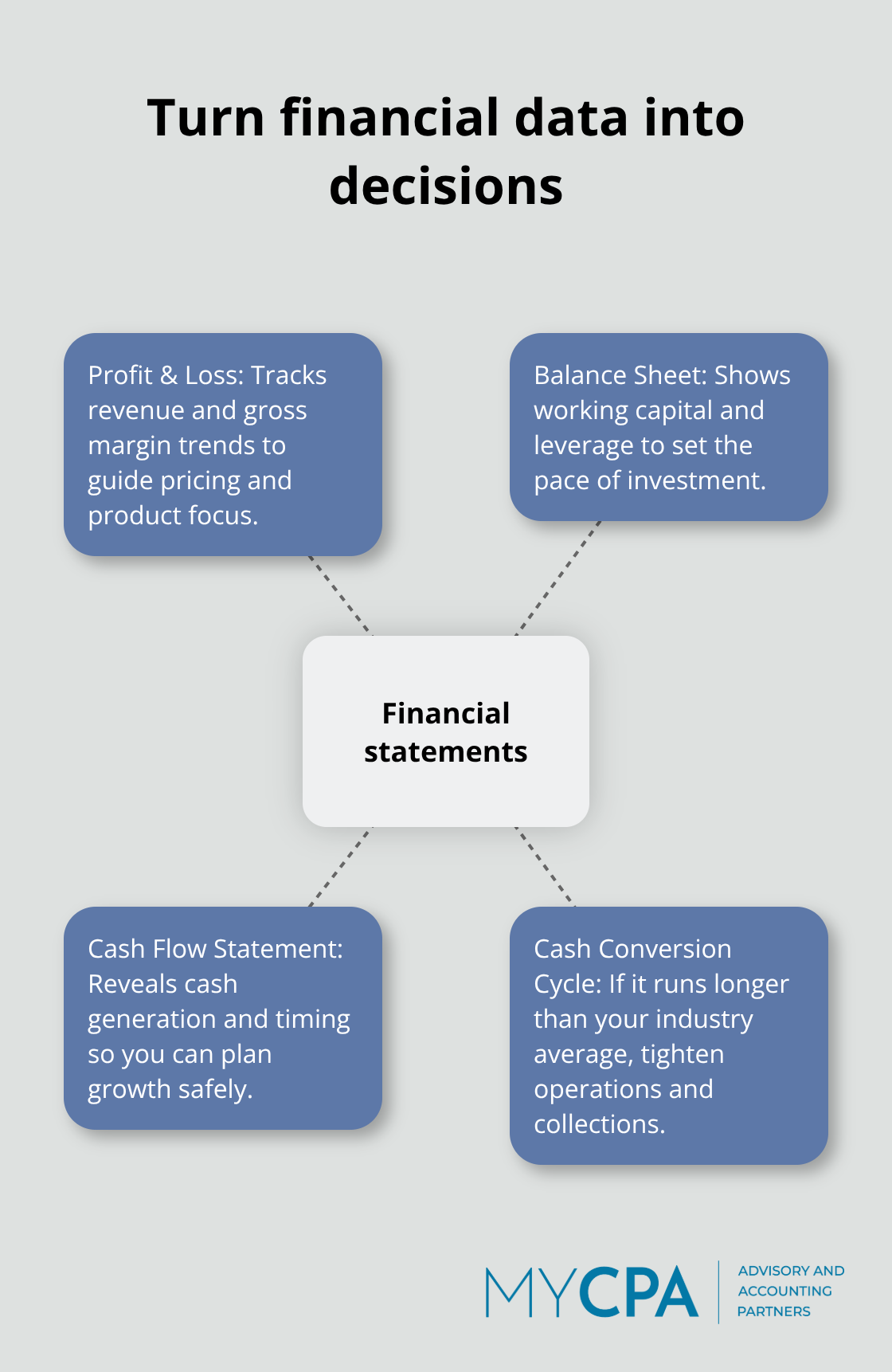
When they understand that their cash conversion cycle runs longer than their industry average, operational decisions change immediately.
Your financial statements reveal what your future opportunities actually are. Cost structure tells you where you have pricing power. Customer acquisition costs show which marketing channels actually work. Inventory turnover and accounts receivable aging expose operational inefficiencies that directly impact cash flow.
A business might sit on the ability to increase prices by 5-8% without losing customers, but without someone analyzing your numbers against industry benchmarks, you’ll never know. Your financials also show which revenue streams have the highest margins and which ones drain resources. This analysis (when done correctly) points you toward the growth opportunities that actually fit your business model, not the ones that sound attractive in theory.
Proactive planning stops the financial surprises that derail strategy. Instead of discovering in month nine of your fiscal year that you’re tracking toward a cash shortfall, a strategic advisor flags it in month three when you still have time to adjust. This means cutting discretionary spending before it becomes urgent, accelerating collections before cash gets tight, or delaying an expansion until conditions improve.
Companies that operate this way don’t panic during downturns because they’ve already planned for them. They adjust pricing, reduce expenses, or shift resources before cash pressure forces their hand. The difference between reactive and proactive financial management shows up in how smoothly a business executes its strategy during uncertain periods.
The real problem isn’t that financial data doesn’t exist-it’s that business owners don’t have someone translating it into strategic action. You’re focused on running operations, managing teams, and serving customers. Financial analysis requires time and expertise you may not have in-house. Without this translation layer, your strategy remains disconnected from your financial reality, and opportunities stay hidden in your statements.
This disconnect between what your numbers show and what your strategy pursues is exactly where the biggest mistakes happen. A business commits to aggressive expansion while cash reserves are already depleted. Another invests heavily in a new product line without understanding the actual margin impact. These aren’t failures of ambition-they’re failures of alignment.
Most businesses fail not because they lack ambition, but because they chase growth without understanding their financial capacity to support it. Business owners commit to expansion plans that require cash they don’t have, revenue targets that depend on margins that don’t exist, and timelines that ignore how long it actually takes to convert sales into cash. A business with 30% gross margins cannot operate like one with 60% margins, yet owners often structure growth initiatives as if financial constraints don’t apply to them.
The fatal mistake is treating cash flow as something that will naturally follow revenue growth, when in reality, growth often accelerates cash burn before it generates returns. According to research from the U.S. Bank, 82% of business failures result from poor cash management, not lack of sales. This means a company can hit revenue targets while simultaneously running out of money. The difference between a business that survives growth and one that collapses under it comes down to one factor: understanding exactly how much cash you can deploy toward growth without jeopardizing payroll, vendor payments, and debt obligations.
The second critical mistake is chasing revenue while ignoring what that revenue actually costs to deliver and collect. A business might celebrate landing a major new customer without analyzing the 90-day payment terms that customer demands, the custom product modifications required to win the deal, or the working capital needed to fund production before payment arrives. This is where the disconnect between accounting and strategy becomes dangerous.
Your accountant tracks the revenue and records it as income, but nobody connects that to the cash timing problem it creates. A company growing 40% year-over-year while its accounts receivable days climb from 30 to 60 is actually deteriorating financially, not improving. The revenue looks impressive on paper while cash pressure mounts behind the scenes.
The third mistake compounds the first two: making major strategic decisions on incomplete financial information. Business owners make expansion decisions, pricing changes, and product investments based on top-line revenue numbers, market trends, or competitor moves rather than analyzing actual profitability by customer, product line, or channel. You might maintain a customer relationship that loses money every quarter simply because the revenue number looks impressive.
You might invest in a new market segment because competitors entered it, without calculating whether your cost structure supports competing in that space. Strategic finance requires connecting every decision to three specific data points: gross margin by revenue stream, cash conversion cycle for each customer segment, and fixed cost coverage ratio before committing to variable growth expenses. Without this analysis, your strategy is built on incomplete information and expensive assumptions.
The businesses that grow sustainably operate with strategy and finance as a single system. When your growth plans rest on actual financial capacity rather than market optimism, execution becomes predictable and repeatable. When every major decision connects back to cash flow, margins, and profitability by customer segment, you stop making expensive mistakes that drain resources and derail momentum.
This alignment requires someone translating your financial data into strategic decisions and flagging problems before they become crises. Strategic business advisory services create this connection by examining your numbers and asking the questions that matter: Can your cash flow support this expansion? Which customer segments are actually profitable? Where is capital being wasted? U.S. Bank research shows that poor cash management contributes to 82% of business failures, while businesses that understand their financial constraints before committing to growth strategies execute faster and adjust more efficiently during downturns.
Contact My CPA Advisory and Accounting Partners to discuss how we can strengthen the connection between your strategy and financial reality. We help business owners close the gap between what they want to achieve and what their finances can actually support, identifying where capital should flow and preventing the financial surprises that derail execution.








Privacy Policy | Terms & Conditions | Powered by Cajabra