
Tax Compliance Readiness Tips Every Small Enterprise Needs
Prepare your small business for tax season with essential compliance readiness tips. Avoid penalties and stay audit-ready with our practical guidance.
Startups fail for many reasons, but cash flow problems rank among the deadliest. Without visibility into your money movements, you can’t make smart decisions about hiring, inventory, or growth.
At My CPA Advisory and Accounting Partners, we’ve seen firsthand how cash flow forecasting techniques separate thriving startups from those that run out of runway. This guide walks you through proven methods to predict your financial future with confidence.
Poor cash flow management kills startups faster than bad products or weak marketing. According to CB Insights’ analysis of startup failures, 70% of failed startups cite running out of capital as a primary reason. The brutal reality is that many of these companies weren’t unprofitable on paper-they simply couldn’t see their money movements clearly enough to act before it was too late.
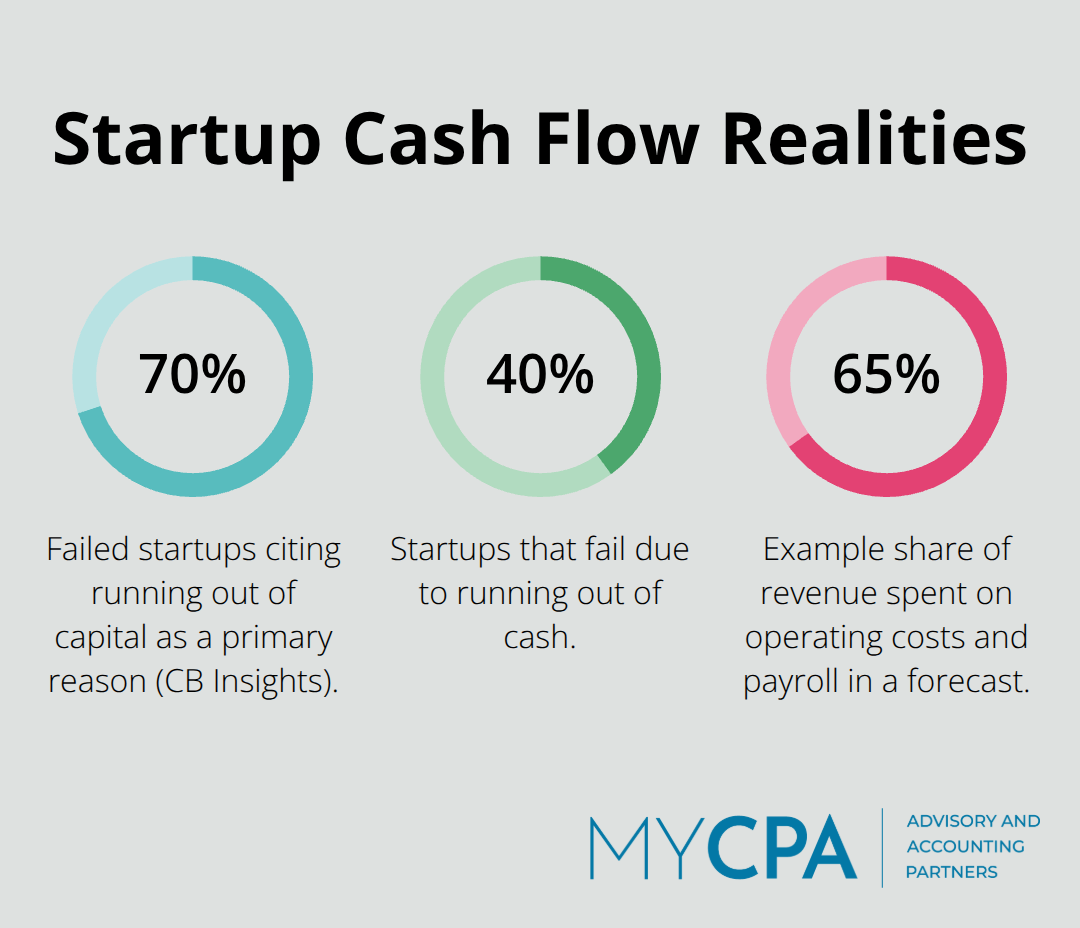
When you lack visibility into when cash actually arrives and leaves your business, you make decisions in the dark. You might hire too aggressively, commit to inventory you can’t afford, or miss the warning signs that you’re burning through your runway. The gap between accounting profits and actual cash in the bank destroys more startups than almost anything else. Nearly 40% of startups fail due to running out of cash, and the problem compounds because visibility gaps often cause slow, insidious declines that feel manageable until they suddenly aren’t.
Accurate cash flow forecasting flips this dynamic entirely. Instead of reacting to crises, you anticipate them. A solid forecast shows you exactly when money hits your account and exactly when it leaves, down to the specific week or day. This timing focus separates forecasting from budgeting-a budget tells you how much you should spend, but a forecast tells you when you actually have the cash to spend it.
The direct method works especially well for startups because it captures real payment delays from customers and processors. If your customers pay Net-30 but you need cash today, a traditional budget misses that gap entirely. Your forecast catches it and forces you to plan accordingly. When you spot a potential cash shortage three months out instead of discovering it when your payroll bounces, you have time to cut costs, accelerate collections, or arrange bridge financing. This early warning system is the difference between a controlled adjustment and a business-ending crisis.
Founders often assume they need to choose between growth and financial prudence, but that’s a false choice. Accurate forecasting actually enables faster growth because it removes the guesswork. When you know your cash position with confidence, you can invest in hiring, marketing, or product development without fear. You can say yes to opportunities because you’ve already modeled the cash impact. You can say no to distractions because you understand what they’ll cost.
The companies that grow sustainably treat cash flow management as a weekly habit, not an annual exercise. They compare their actual cash flows to their forecast every week, spot deviations early, and adjust their plans before small problems become big ones. This cadence of review-weekly for short-term horizons, monthly for medium-term planning-keeps the forecast honest and actionable. Teams that skip this step often find their forecasts become stale within weeks, useless for decision-making. The next section walks you through the specific methods that transform raw financial data into a roadmap you can actually trust.
The forecasting method you choose depends entirely on your startup’s maturity and data availability. Early-stage founders with minimal historical data need a different approach than companies with two years of transaction records. Match your method to your reality rather than forcing data into a framework that doesn’t fit.
The percentage of sales method works best when you have consistent revenue patterns and predictable expense ratios. If your startup has operated for at least six months and your monthly revenue stays within a recognizable range, this method produces quick, actionable forecasts. Calculate your average monthly revenue, then apply your historical expense ratio to project future cash needs. For example, if you spend 65% of revenue on operating costs and payroll, a month with $50,000 in revenue tells you to expect roughly $32,500 in outflows. This simplicity makes it ideal for monthly board reviews, but it fails spectacularly if your expenses are lumpy or seasonal.
The historical method demands deeper data: pull your last three to six months of actual bank transactions, categorize them by type, and identify patterns in timing and amounts. Document how long customers take to pay (if you invoice), when your largest recurring bills hit, and whether any costs spike in particular months. This method catches real payment delays that percentage-based calculations miss entirely. If your payment processor holds funds for two days or customers consistently pay Net-45 instead of Net-30, the historical method reveals these gaps. Most startups underestimate cash timing by weeks, and this method forces you to confront actual payment schedules.
The build-up method suits founders launching their first product or entering a new market with no comparable data. Start with your fixed costs: payroll, rent, insurance, and recurring subscriptions. Layer in variable costs tied to your specific growth plan, such as contractor hours or cloud infrastructure spending that scales with users. Add a contingency buffer of 15–20% for unexpected costs that always materialize.
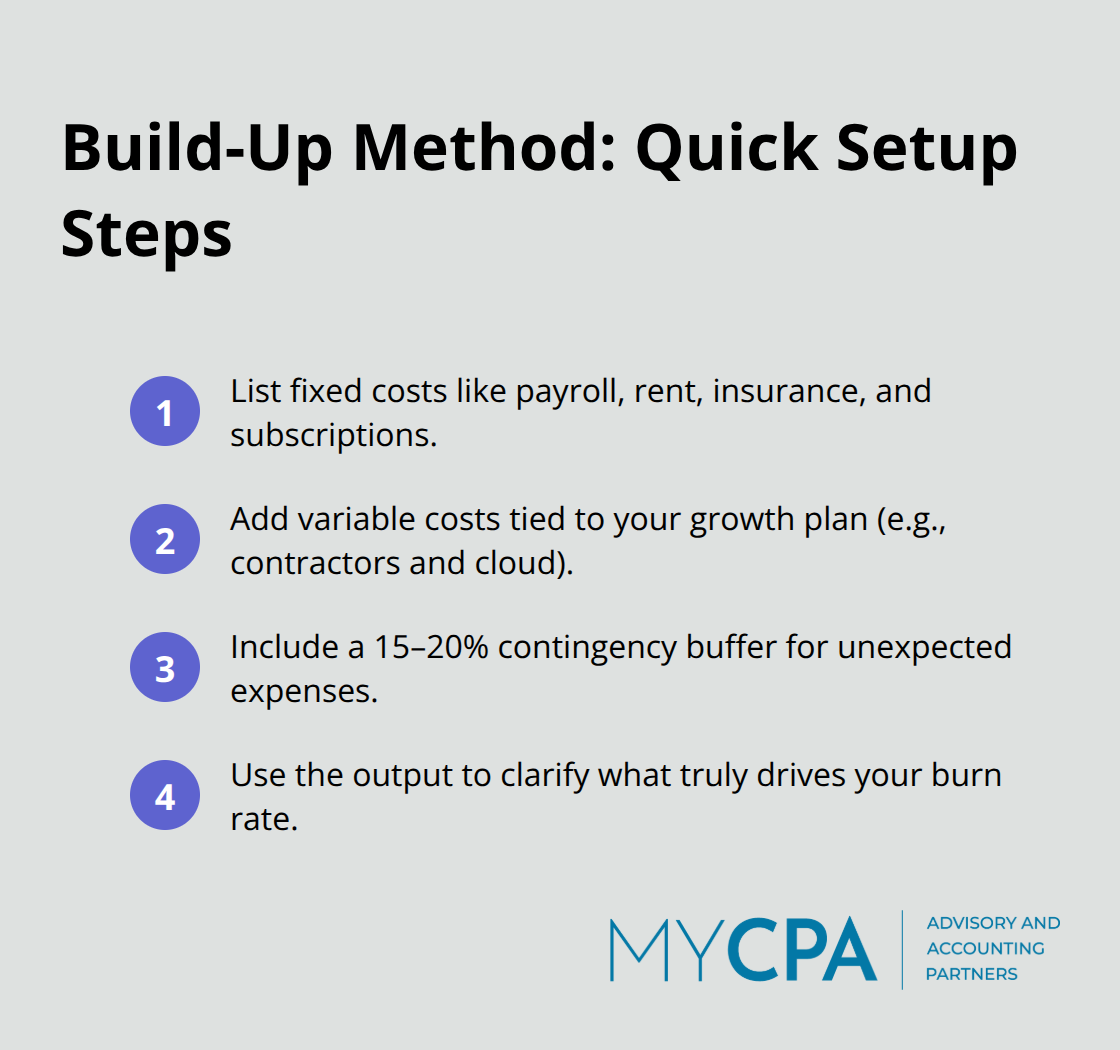
This method requires you to justify every expense and think critically about what actually drives your burn rate.
Update your build-up forecast monthly as you gather real transaction data, then transition to the historical method once you have three months of actual spending patterns to anchor your projections. This progression reflects how your startup matures from planning mode into execution mode. The tools you select to run these forecasts matter just as much as the method itself-spreadsheets work for simple models, but accounting software solutions catch timing issues that manual tracking misses.
Most startups waste months trying to build the perfect forecast in Excel before realizing they’ve created a maintenance nightmare instead of a planning tool. The spreadsheet approach works initially because it’s free and flexible, but it fractures quickly once you add multiple revenue streams, processor payment delays, or contractor invoices with irregular timing. Start with a simple Google Sheets template that captures your fixed costs, variable costs, and expected cash inflows across a 13-week rolling window. This timeframe balances detail with manageability-weekly granularity for the next three months catches real payment timing issues without forcing you to predict six months out with false precision.
Create separate rows for payroll, rent, cloud tools, and processor payouts to avoid lumping categories together and missing critical timing gaps. Each row should show the exact week when money leaves your account, not when you incur the expense. This distinction matters enormously: your rent payment hits on the first of the month, but your cloud tool subscription might charge on the 15th, and your processor might hold funds for two days before depositing them. A well-structured spreadsheet forces you to think about these timing details instead of glossing over them. The moment your forecast stops fitting on one screen or updating takes more than 30 minutes weekly, you’ve outgrown spreadsheets and need software that connects directly to your bank accounts and accounting platform.
Accounting software solutions eliminate the manual data entry that kills forecast accuracy. Platforms like QuickBooks Online or Xero pull transactions automatically, reducing the gap between actual spending and your forecast. Real-time integration means your forecast updates as invoices post and payments clear, preventing the stale projections that render most forecasts useless within weeks.
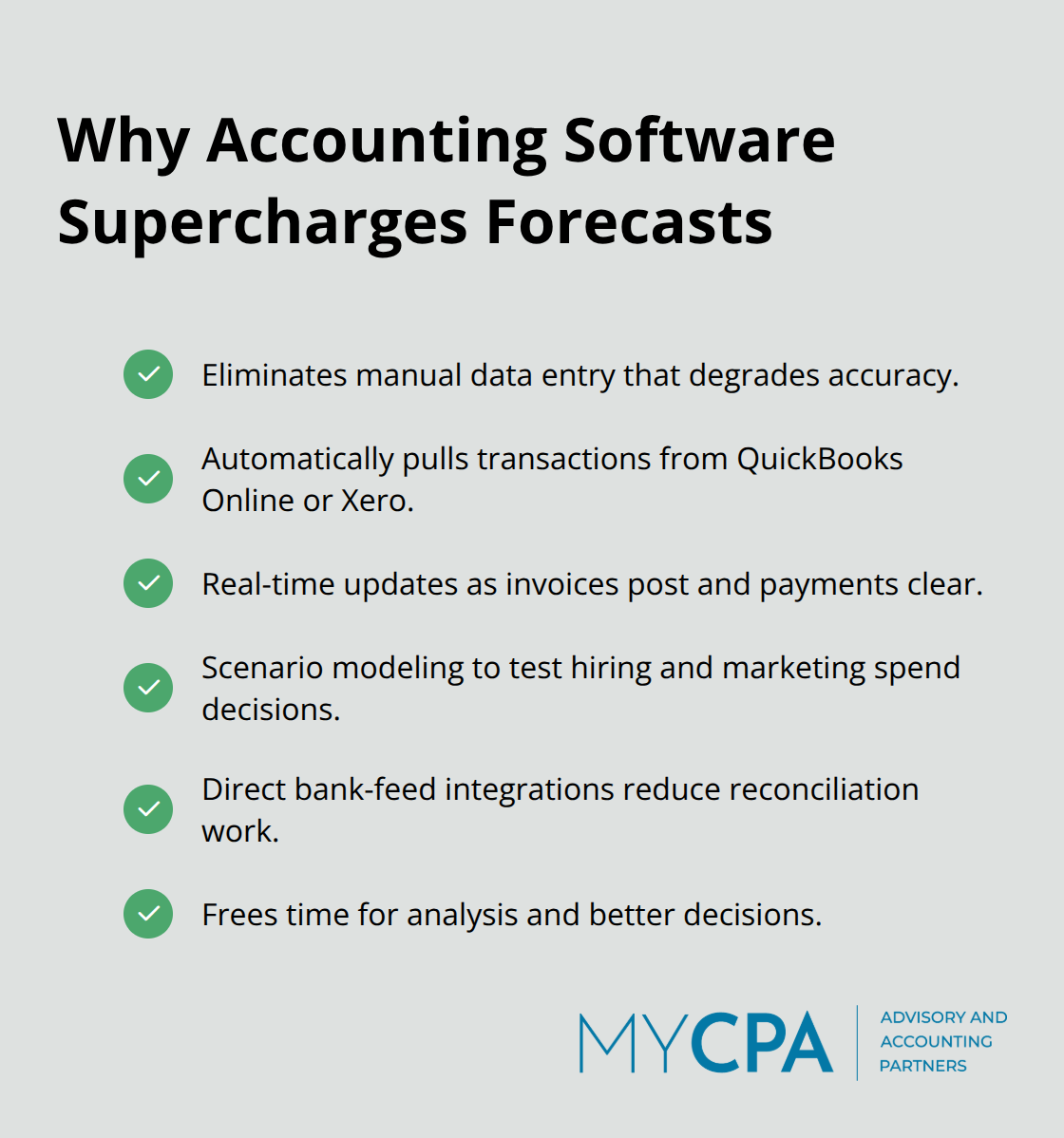
More advanced tools built specifically for startups offer scenario modeling that lets you test hiring decisions or marketing spend increases against your cash position instantly. Start with accounting software that integrates directly with your bank feeds rather than tools requiring manual transaction entry. The time you save on data entry translates directly into time spent analyzing what the numbers actually mean.
Once your forecast reaches a certain complexity-multiple revenue streams, international payments, or subscription billing with variable churn-consider working with a financial advisor who specializes in startup cash management. They’ll challenge your assumptions about customer payment timing, flag expense categories you’ve overlooked, and stress-test your worst-case scenario to expose hidden vulnerabilities. This partnership prevents the common founder mistake of building forecasts that look good on paper but crumble when reality diverges. The advisor’s role isn’t to manage your forecast continuously but to validate it quarterly and help you interpret what deviations between forecast and actuals actually signal about your business health.
Cash flow forecasting techniques work only when you actually use them. The methods we’ve covered-percentage of sales, historical analysis, and build-up forecasting-all force you to think about timing, not just totals. Your forecast sits worthless in a spreadsheet if you never review it, but it becomes powerful when you compare it to actual results weekly and adjust your plans based on what the numbers reveal. Startups that survive treat cash flow management as a weekly discipline, not a quarterly checkbox.
Start simple and pick the forecasting method that matches your current data and startup stage. Use a spreadsheet or accounting software to track actual cash movements, then compare your forecast to reality every week. This rhythm of planning, executing, and reviewing separates startups that control their destiny from those that run out of cash by accident. When your forecasting model grows too complex or your assumptions feel uncertain, that’s the moment to bring in professional guidance.
We at My CPA Advisory and Accounting Partners help startup founders build forecasts they can trust and interpret what the numbers actually mean for their business. Our business advisory services include personalized financial plans and proactive advice tailored to your stage and challenges. Your cash flow forecast is the financial roadmap that lets you grow with confidence instead of fear.








Privacy Policy | Terms & Conditions | Powered by Cajabra