
Growth Strategies Startups: Practical Playbook for Early Stage Scaling
Scale your startup fast with proven growth strategies, tools, and tactics designed for early-stage companies.
Most startups fail because they scale before they’re ready. We at My CPA Advisory and Accounting Partners have seen firsthand how growth strategies for startups work best when built on a solid foundation of product-market fit, smart pricing, and sustainable customer acquisition.
This playbook walks you through the exact steps to validate your market, structure your revenue model, and build sales channels that actually work. Skip the vanity metrics and focus on what matters.
Product-market fit is not a feeling or a hypothesis. It’s a measurable state where your product solves a real problem for a specific group of customers who will pay for it and tell others about it. Too many founders confuse early enthusiasm with genuine fit. A handful of excited beta users or friends who like your idea does not mean you’ve found product-market fit. You need to move beyond anecdotes and start collecting hard evidence.
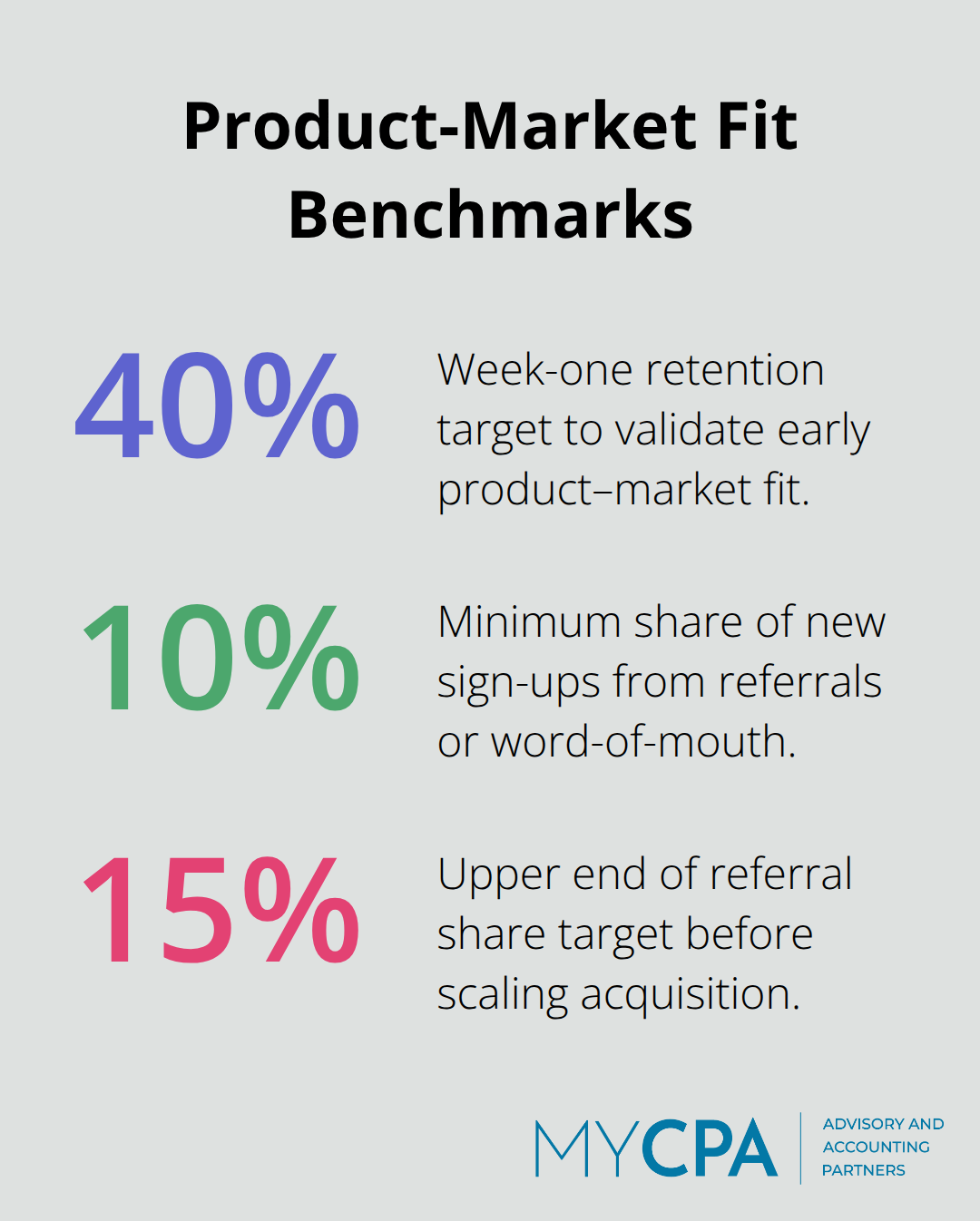
The first evidence comes from retention data. If customers sign up and disappear after two weeks, you don’t have fit. If they stick around for three months and actively use your product, that’s a signal worth paying attention to. Week-one retention is the metric that matters most in early validation. If fewer than 40 percent of your new users remain active after seven days, your product is not compelling enough yet. This doesn’t mean you’ve failed; it means you need to identify where users drop off and fix the activation experience before you scale acquisition.
The second source of validation is customer feedback tied directly to pricing and willingness to pay. Stripe’s early success came from building a product that developers actually wanted to integrate, not from guessing what the market needed. They obsessed over a seven-line code integration and real-time support, which reduced friction so dramatically that adoption became inevitable. Your testing should follow a similar pattern. Run small, disciplined experiments with real money changing hands. If you’re offering a service, charge something, even if it’s discounted. If you’re building software, ask customers to pay before you’ve built the full feature set. This reveals who genuinely needs your solution versus who likes the idea.
After you collect feedback from paying customers, iterate ruthlessly on the parts that matter most. Don’t add features randomly; prioritize based on what your actual users struggle with. Use product analytics to track where users encounter friction. Improving activation from 20 percent to 40 percent has the same revenue impact as doubling traffic, and those gains compound over time as you scale.
The clearest sign of product-market fit is organic growth through word-of-mouth and referrals. Dropbox scaled to over 4 million users primarily through a referral program that incentivized sharing with free extra storage. That explosive growth only happened because the core product was so useful that users wanted to recommend it. If you’re spending heavily on ads to acquire customers but retention is weak and referrals are near zero, you don’t have fit yet.
Scale aggressively only after you see two clear signals: retention rates above 40 percent in week one and organic referral or word-of-mouth acquisition accounting for at least 10 to 15 percent of new sign-ups. These numbers tell you the product is doing its job and customers believe in it enough to recommend it. Before you hire a sales team, raise a large funding round, or build out marketing infrastructure, hit these benchmarks with your current resources.
Moving fast matters, but moving in the wrong direction wastes time and capital. Once you’ve validated these signals, your next step is to structure a revenue model that captures the value you’ve created and sustains growth as you scale.
Pricing is where most startups leave money on the table or price themselves out of the market entirely. The mistake founders make is treating pricing as a math problem based on costs plus margin. It’s not. Pricing is a market signal that tells customers whether your solution is worth their time and money. Stripe didn’t charge based on the cost of processing transactions; they charged based on the value developers gained from not building payment infrastructure themselves. Shopify didn’t undercut competitors on price; they charged based on the time and complexity their platform eliminated for merchants. Founders who price based on customer value, not internal costs, build sustainable businesses faster.
Start with small experiments at different price levels over two to four weeks. If your product serves businesses, test pricing at $50 per month, $150 per month, and $300 per month. Track which tier converts best and which customers choose which option.
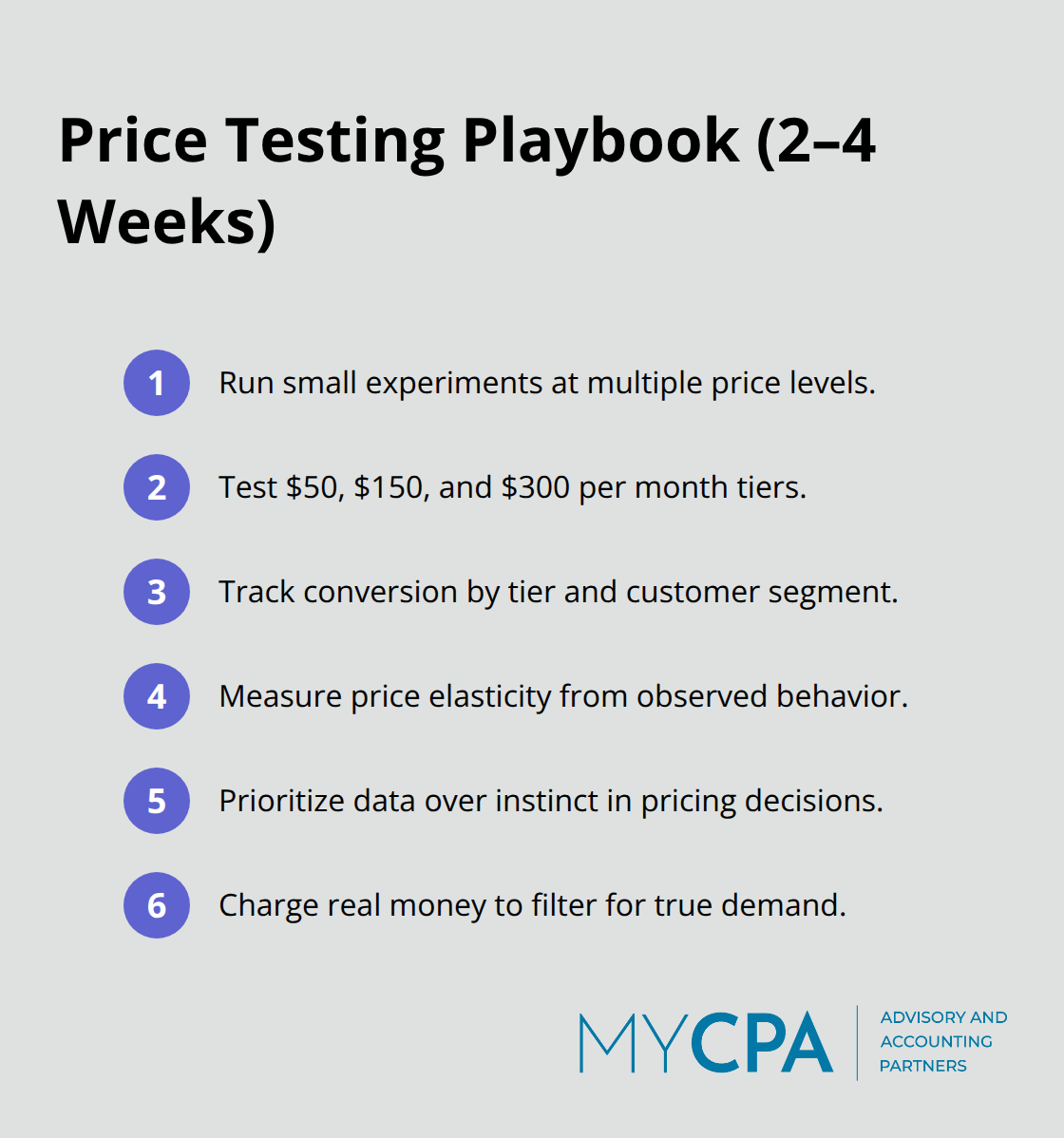
This reveals price elasticity in your specific market without requiring months of analysis. The data you collect matters more than your initial instinct. Run these tests with real money changing hands to separate genuine demand from casual interest.
Subscription pricing works best when your product delivers ongoing value that compounds over time. If customers use your software daily and it saves them five hours weekly, they’ll happily pay monthly. If your product solves a single problem and customers need it only once, forcing a subscription model creates friction and churn. Freemium models accelerate adoption but cannibalize your revenue if the free tier is too generous. OpenAI monetized its technology through an API-first model, allowing developers to build applications on top of its foundation. This approach works because developers see immediate value in accessing powerful capabilities without upfront infrastructure costs.
For your startup, freemium makes sense only if your free users convert to paid at freemium conversion rates above 3 to 5 percent. Below that threshold, you’re spending money acquiring users who never become customers. Test freemium for six weeks with clear conversion triggers built into your free experience, then measure actual conversion rates. If you’re below 3 percent, move to a free trial model instead. Offer 14 days of full access, require a credit card upfront, and track how many trial users convert to paying customers. This model typically converts at 20 to 40 percent, which is dramatically higher than freemium.
After you’ve tested initial pricing, collect structured feedback from customers about their willingness to pay. Ask paying customers directly: at what price would this product feel too expensive to consider? At what price would you question the quality? These questions reveal your price ceiling without requiring sophisticated analysis. Document responses from at least 20 to 30 customers across different company sizes and industries. Look for clustering around specific price points. If most customers say anything above $200 per month feels expensive, that’s your market signal. Ignore the outliers who claim they’d pay $1,000; focus on the median response.
Adjust your pricing within 30 days based on customer feedback. Waiting months to optimize pricing leaves revenue on the table while competitors capture market share. When you raise prices, do it selectively: increase pricing for new customers while grandfathering existing customers at their original rate. This approach minimizes churn while testing whether higher prices stick with new cohorts. Track the conversion rate and churn rate for the new price tier separately. If new customer conversion drops below 20 percent, the price increase was too aggressive. If conversion stays above 30 percent and churn remains flat, the increase is sustainable.
Your pricing strategy directly impacts which customers you attract and how long they stay. The next step is identifying the sales and marketing channels where those customers actually spend their time and building repeatable processes to reach them at scale.
Most startups waste months testing five platforms at once, then wonder why their budget disappears without results. Start with one channel and saturate it completely for four to six weeks before adding a second. For B2B SaaS startups, outbound email or LinkedIn typically generates the fastest signal. For consumer apps, a single community platform like Reddit or Discord works better. The reason is straightforward: testing one channel properly takes discipline, but it reveals whether your message resonates before you burn cash on paid ads or hire a marketing team.
Airbnb cross-posted listings to Craigslist without spending on advertising, which dramatically increased visibility and bookings. This worked because they found where their audience already spent time and tapped into existing trust. Your first channel should answer two questions: where do your potential customers already spend time online, and which channel yields measurable results within one to two weeks with your current resources?
If you’re selling to accountants or finance professionals, LinkedIn outbound works fast. If you’re building developer tools, Hacker News and GitHub discussions generate qualified leads. If you’re targeting small business owners, Facebook and Google Business Profile posts often convert higher than you’d expect. The key is choosing one channel where you can run meaningful tests on $20 to $50 per day for one to two weeks.
Dozens of rapid cycles across a single channel beat a single clever hack across multiple platforms. Track impressions, clicks, signups, and replies separately for each test. After two weeks, decide whether to double down or pivot to a different channel based on concrete data, not gut feeling.
Once you’ve identified a working channel, build a repeatable sales process that doesn’t require founder involvement for every deal. Manual, high-touch outreach after signup-a real email 24 hours after someone creates an account-typically yields 5 to 10 times higher response rates than automated sequences because it signals real attention. This approach also provides qualitative insights about what’s actually stopping users from getting value.
Use this feedback to fix your onboarding before scaling acquisition. After you’ve run the experiment loop three to four times per month with clear bets and measured results, hire specialists to scale the channel you’ve validated. Never hire a full sales team until one or two channels reliably acquire customers and you need more volume than your current team can handle, which typically happens around Series A or Series B funding.
Until you scale, measure what actually matters: activation rate, week-one retention, and referral rate. These three metrics connect directly to revenue and retention. Ignore vanity metrics like total signups or email opens. Calculate your customer acquisition cost by dividing total marketing spend by new customers acquired in a specific month.
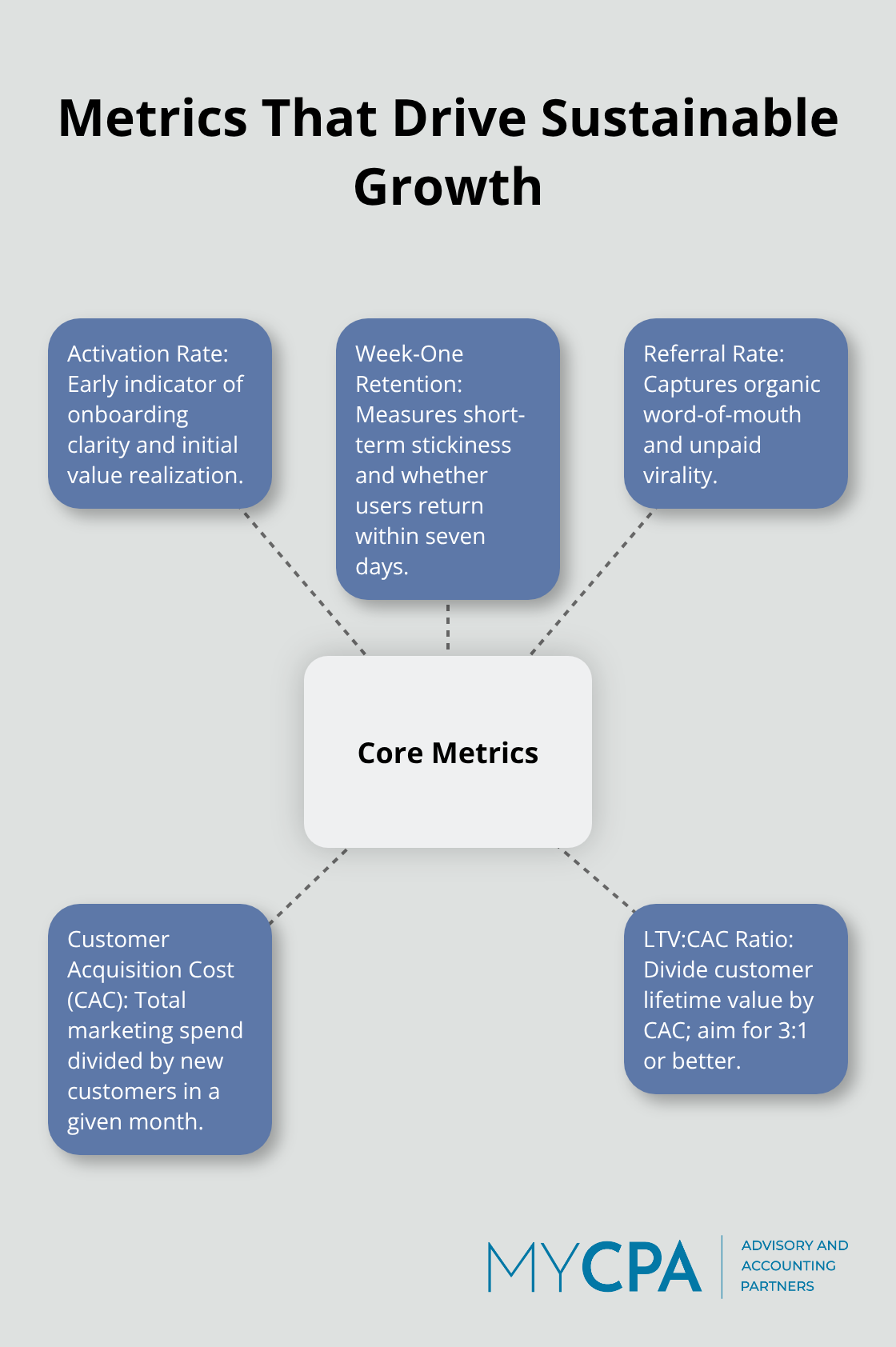
Then divide your customer lifetime value by your acquisition cost to get the ratio.
If your CAC is $500 and your LTV is $2,000, you have a healthy 4-to-1 ratio. If your CAC is $800 and LTV is $1,200, you’re spending too much to acquire customers who don’t stay long enough. Most sustainable startups maintain a 3-to-1 LTV-to-CAC ratio minimum. Track these numbers weekly and adjust your channel spend or messaging based on which cohort of customers generates the highest LTV relative to acquisition cost.
Speed matters here: ship a landing page in one night, react to what’s working within hours, and call churned customers the same day to fix issues before the next sprint. This pace compounds into a significant competitive advantage when most competitors move at quarterly planning cycles. Scalable growth strategies that prioritize rapid iteration and measurement allow you to outpace competitors who rely on slower, traditional approaches to market testing and customer feedback loops.
Sustainable growth beats vanity metrics every single time. We at My CPA Advisory and Accounting Partners have watched startups collapse despite impressive signup numbers because they optimized for the wrong measurements. A thousand signups mean nothing if 900 disappear after week one, and a million-dollar revenue projection means nothing if your customer acquisition cost exceeds what customers actually pay you.
Growth strategies for startups rest on three pillars: validate product-market fit with real retention data and paying customers before you scale acquisition spending; price based on customer value, not internal costs, and adjust quickly based on what your market tells you; identify one working sales channel, saturate it completely, and measure what matters-activation, retention, and customer lifetime value relative to acquisition cost. Most startups fail because they scale before they’re ready, but you won’t be one of them if you follow this approach and track week-one retention above 40 percent, organic referrals accounting for at least 10 to 15 percent of new customers, and an LTV-to-CAC ratio that hits a 3-to-1 minimum.
Speed compounds into competitive advantage when you move faster than quarterly planning cycles. Ship landing pages overnight, react to what’s working within hours, and call churned customers the same day to fix issues before the next sprint. We at My CPA Advisory and Accounting Partners offer business advisory and consulting services designed to help you build personalized financial plans and make proactive decisions about cash flow, tax efficiency, and resource allocation as you grow.








Privacy Policy | Terms & Conditions | Powered by Cajabra