
Tax Compliance Readiness Tips Every Small Enterprise Needs
Prepare your small business for tax season with essential compliance readiness tips. Avoid penalties and stay audit-ready with our practical guidance.
Small errors in your financial records compound quickly. A misplaced decimal or missed reconciliation can distort your entire financial picture, leading to poor decisions and damaged credibility with lenders and investors.
At My CPA Advisory and Accounting Partners, we’ve seen how financial reporting accuracy transforms businesses. When your numbers are reliable, you gain the confidence to plan strategically and manage cash flow effectively.
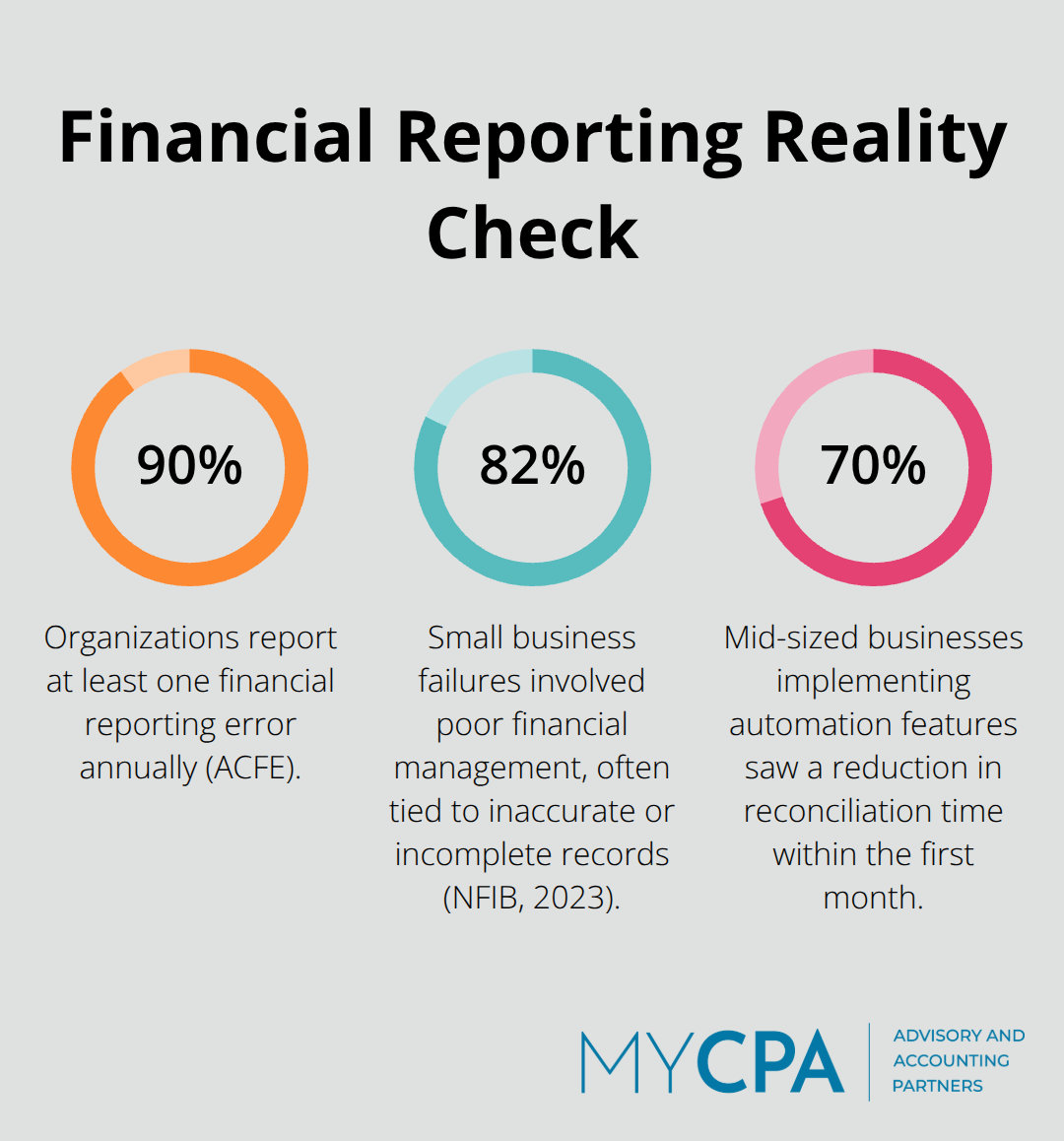
Most business owners think financial mistakes happen in obvious places, but they don’t. A study by the Association of Certified Fraud Examiners found that 90% of organizations experience at least one financial reporting error annually, yet many never discover them until audits or lender reviews. The real problem is that errors compound silently. When you misclassify a $50,000 equipment purchase as a repair expense, your profit margins look artificially high, your tax liability gets calculated wrong, and your balance sheet becomes unreliable for decision-making. We at My CPA Advisory and Accounting Partners see this constantly: business owners make decisions based on numbers they trust, only to find those numbers were distorted from the start.
Revenue recognition errors and expense categorization mistakes are the most common culprits. The IRS reports that improper expense classification alone accounts for significant adjustments during audits. When you categorize operating expenses as capital investments, or vice versa, your financial statements no longer reflect reality. This isn’t just an accounting problem-it creates cascading issues. Lenders reviewing your financials see inconsistent profitability, investors lose confidence, and your tax strategy falls apart. Many business owners make these mistakes because they lack clear documentation policies or don’t understand tax treatment differences. You need to establish written procedures for how each expense category gets handled, train your team on those procedures, and use accounting software that enforces consistent classification rules. Most modern accounting platforms allow you to create expense categories and assign them automatically based on transaction descriptions, which eliminates manual error.
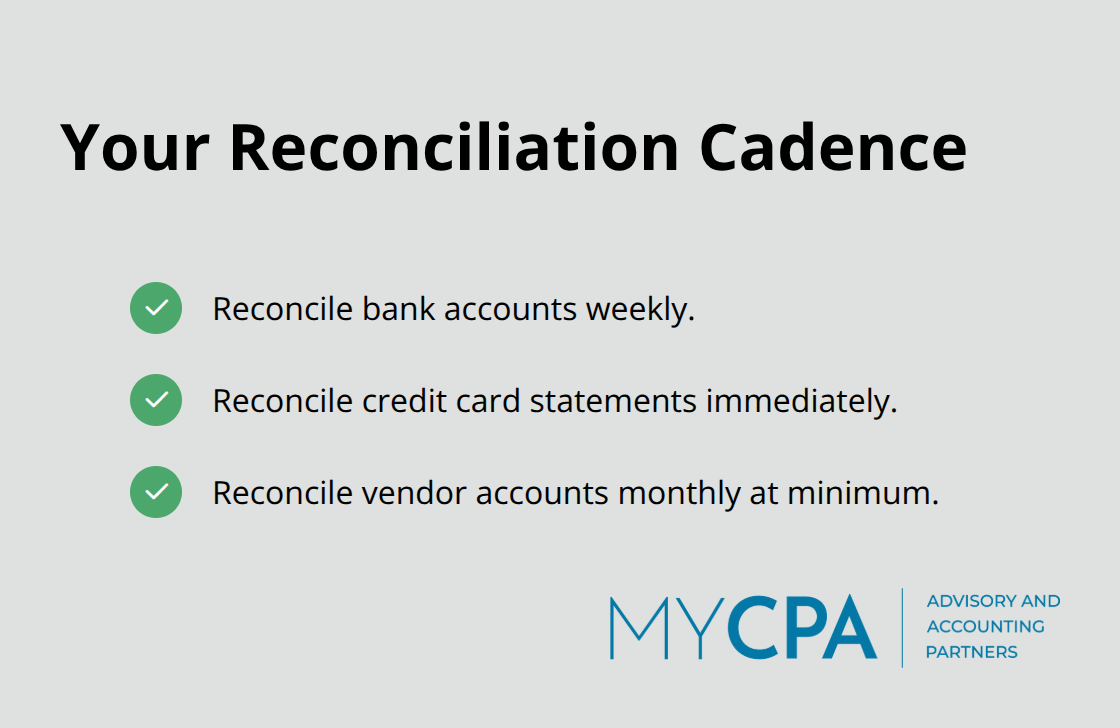
Reconciliation mistakes represent another major category of financial reporting failures. When your bank account doesn’t match your accounting records, most businesses assume it’s a timing issue and move forward. That assumption costs money. Unreconciled accounts can hide fraud, duplicate payments, missing deposits, or processing errors that compound over time. A 2024 survey found that companies spending less than two hours monthly on reconciliation experienced more discrepancies than those with dedicated weekly processes. You need to reconcile bank accounts weekly, credit card statements immediately, and vendor accounts monthly at minimum. Automated reconciliation tools now handle this work efficiently-software like QuickBooks or Xero flags mismatches instantly and suggests corrections. The key is making reconciliation non-negotiable rather than treating it as optional cleanup work.
Missing invoices, undated checks, or vague transaction descriptions create massive problems during audits or lender reviews. Lenders specifically cite incomplete documentation as a reason for declined credit applications. When you can’t explain a transaction or produce supporting evidence, auditors flag it as a control deficiency. This damages your credibility permanently. Your documentation system should include digital storage for all invoices and receipts, clear descriptions for every transaction, and approval workflows that require sign-off before payments post. This isn’t busywork-it’s the foundation that makes your financial statements defensible and your business trustworthy.
The errors we’ve outlined share one common thread: weak internal controls allow them to persist. When you implement approval processes, segregate financial duties, and conduct regular reviews, you catch problems before they distort your entire financial picture. These controls don’t require expensive systems or complex procedures. They require discipline and accountability. Your accounting team needs clear authority limits, documented approval chains, and regular spot-checks of transactions. This foundation positions you to move forward with confidence into the practices that maintain accuracy across your entire financial operation.
Accurate financial reporting stops being abstract the moment you need to make a real decision. When your revenue and expense numbers are correct, your profit margins reflect reality, not wishful thinking. This matters because business owners who operate on distorted financial data make decisions that destroy profitability. A 2023 study from the National Federation of Independent Business found that 82% of small business failures involved poor financial management, and most of those failures traced back to inaccurate or incomplete financial records. The owners didn’t lack intelligence or ambition-they simply couldn’t see their actual financial position.
Strategic planning requires numbers you can trust completely. When you know exactly how much cash your operations generate each month, you can forecast accurately for the next quarter. You can identify which products or service lines actually generate profit versus which ones drain resources. You can spot cash flow problems before they become crises. Most business owners treat financial reporting as a compliance task rather than a decision-making tool. The difference is profound. A company with accurate monthly financial statements can adjust pricing, cut unprofitable services, or invest in growth opportunities with confidence. A company operating on unreliable numbers makes those same decisions blindly and often regrets them.
Cash flow forecasting becomes exponentially more valuable when your historical data is accurate. If your past financial records contain misclassified expenses or unreconciled accounts, your forecasts will be wrong. Lenders and investors recognize this immediately. According to a 2024 survey, lenders cite inconsistent or unclear financial records as the primary reason they deny credit applications to small businesses. The issue isn’t that lenders are skeptical-it’s that inaccurate financial reporting genuinely indicates higher risk.
Investors approach accuracy the same way lenders do. Private equity firms and venture capital investors conduct financial due diligence specifically to verify that your reported numbers match reality. They’ll find discrepancies, and discrepancies damage trust permanently. The credibility you build through accurate financial reporting translates directly into better borrowing terms, lower interest rates, and faster funding decisions. This credibility isn’t earned through marketing claims-it’s demonstrated through clean, consistent, well-documented financial records that auditors and lenders can verify independently.
When we at My CPA Advisory and Accounting Partners review financial statements for business owners seeking loans, we often discover classification errors or missing documentation that would trigger automatic rejection from lenders. These aren’t intentional problems, but they cost real money in declined credit lines, higher interest rates, or delayed funding. The path forward requires moving beyond reactive financial management and establishing systems that maintain accuracy throughout your entire operation.
Accuracy in financial reporting doesn’t happen by accident. It requires deliberate systems that force consistency and catch problems before they spread through your records. The most effective approach combines three working parts: clear internal controls that prevent errors from entering your system in the first place, automation tools that eliminate manual data entry mistakes, and regular verification processes that surface discrepancies immediately. Most businesses transform their financial reliability within 90 days simply by implementing these three elements systematically.
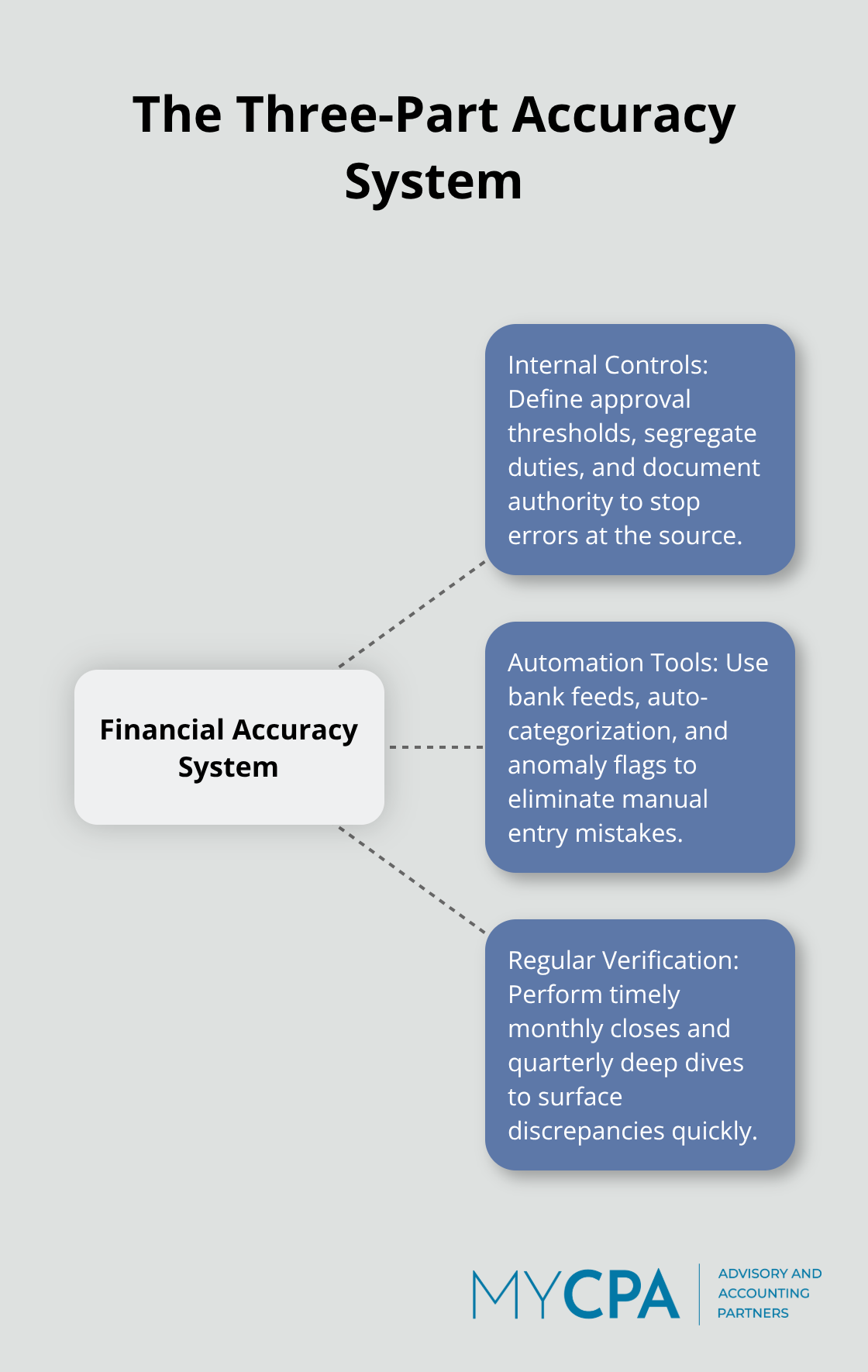
Your internal controls need to establish who can approve what, and at what dollar amount. Most businesses operate without clear approval thresholds, which means expenses slip through without proper review. Set a rule that any transaction over a specific amount requires documented approval from someone other than the person requesting it. Separate the person who authorizes spending from the person who records it and the person who reconciles it. This segregation of duties is the single most effective control against both errors and fraud.
Create a written approval matrix that clearly states approval authority by transaction type and amount. For example, department managers might approve expenses under $5,000, controllers approve $5,000 to $25,000, and ownership approves anything above that. Document every approval with initials, dates, and supporting evidence attached to the transaction. This takes 30 seconds per transaction but prevents months of investigation later. Train your team on these procedures quarterly and conduct surprise audits where you pull random transactions and verify that approval happened before payment posted.
Accounting software like QuickBooks Online or Xero removes the manual data entry work that generates most classification errors. Set up your chart of accounts with clear naming conventions that make misclassification nearly impossible. If you sell both products and services, create separate revenue accounts for each. If you have multiple locations, create expense accounts by location.
Configure your software to assign accounts automatically based on transaction descriptions, so when a supplier is tagged as utilities, that expense posts to utilities automatically every time. Use bank feeds to pull transactions directly from your bank rather than entering them manually. This eliminates transposition errors and timing delays. Set up rules within your accounting software that flag unusual transactions for review (for instance, if someone posts a $50,000 transaction to an account that normally sees $2,000 monthly, the software can require manager approval before posting). Most mid-sized businesses that implement these automation features see a 70% reduction in reconciliation time within the first month. The time your team saves goes toward verification and analysis rather than data entry.
Monthly financial reviews should happen within 10 business days of month-end, not weeks later when memories fade and problems become harder to trace. Review your balance sheet accounts specifically. Ask yourself whether the balances make sense. If accounts receivable jumped 40% with no corresponding sales increase, something’s wrong. If accrued expenses suddenly disappeared, investigate.
Review your income statement line by line, comparing current month to the same month last year and to your budget. Significant variances require explanation and investigation. Conduct a detailed reconciliation of your three most critical accounts: cash, accounts receivable, and accounts payable. These three accounts affect your ability to pay bills and forecast cash flow. Reconcile them within five business days of month-end.
Schedule a quarterly deep-dive review with your accounting team or external accountant where you examine unusual transactions, review approval documentation, and verify that internal controls actually happened as designed. This quarterly meeting should take two to three hours and should examine at least 20 transactions selected randomly across the month (most businesses that implement this quarterly review process identify control failures or classification errors within the first quarter, fix them, and then operate cleanly for years afterward).
Inaccurate financial reporting costs businesses far more than most owners realize. Beyond declined loans or failed audits, poor financial data leads to strategic mistakes that drain profitability for years. A business owner making decisions on distorted numbers might cut a profitable service line, overspend on inventory, or miss cash flow problems until they become crises.
We at My CPA Advisory and Accounting Partners work with business owners who’ve experienced this exact scenario. They operated for months or years on financial statements they thought were accurate, only to discover classification errors, unreconciled accounts, or missing documentation that undermined their entire financial picture. The solution is straightforward: implement clear internal controls, deploy accounting software that automates classification and reconciliation, and conduct regular monthly and quarterly reviews that catch problems before they spread.
Most businesses that implement these three elements systematically see dramatic improvements within 90 days and establish the financial reporting accuracy foundation they need to make confident decisions. Our team provides accounting services, QuickBooks setup and management, and business advisory support tailored to your specific situation, and we work with you to build systems that maintain accuracy throughout your operation so you can trust your numbers completely. Contact us to learn how we help business owners strengthen their financial foundation.








Privacy Policy | Terms & Conditions | Powered by Cajabra