
Compliance Risk Assessment to Strengthen Your Controls
Strengthen your compliance controls with a thorough risk assessment. Learn proven strategies to identify vulnerabilities and reduce regulatory exposure.
Compliance failures cost U.S. companies an estimated $14.82 million per incident, according to IBM’s 2024 Cost of a Data Breach Report. Yet many organizations operate without a clear picture of their actual compliance risks.
A compliance risk assessment reveals exactly where your controls fall short and what regulations apply to your business. We at My CPA Advisory and Accounting Partners help companies identify these gaps before they become costly problems.
Compliance risk isn’t abstract. It’s the gap between what regulations require and what your business actually does. Organizations face three primary categories of compliance exposure that threaten operations from different angles.
Regulatory risks stem from federal, state, and local requirements specific to your industry. Healthcare companies must follow HIPAA, financial institutions face SEC regulations, and manufacturers deal with EPA standards. Operational risks emerge when your internal processes don’t align with these requirements-inadequate data security, poor record retention, or inconsistent policy application across departments all create exposure. Reputational risks hit hardest because they’re difficult to quantify and recover from. When a compliance failure becomes public, customer trust erodes quickly.
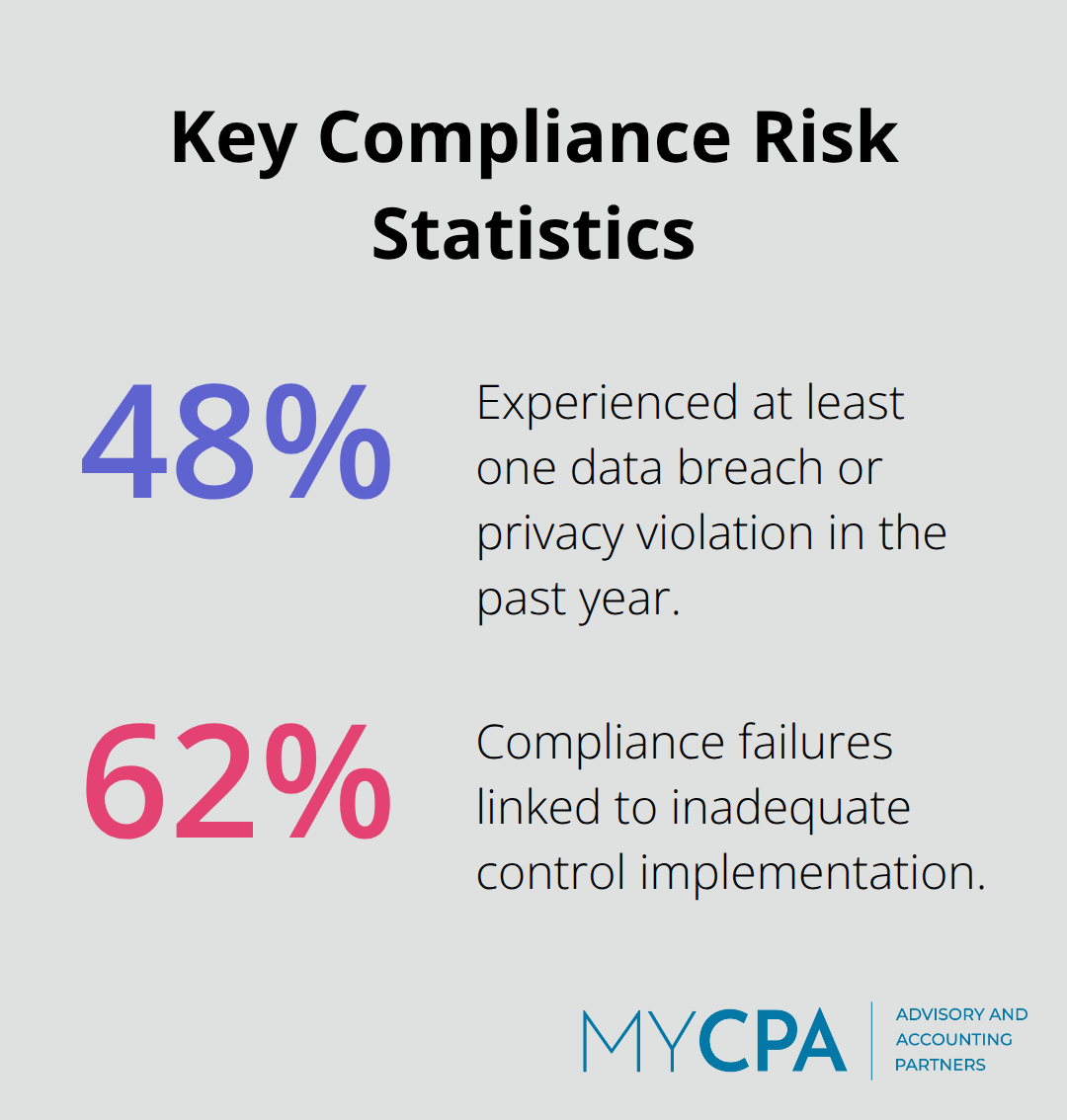
A 2023 Deloitte survey found that 48% of those surveyed experienced at least one data breach or privacy violation in the past year, a 14-point increase from 2023. The financial impact extends far beyond immediate fines. Organizations typically experience direct costs through regulatory penalties, legal fees, and remediation expenses, but indirect costs often dwarf these figures.
Lost productivity during investigations, increased insurance premiums, reduced market valuation, and customer attrition compound the damage significantly. Small to mid-sized businesses face particular vulnerability because they often lack dedicated compliance teams. According to the 2024 Ponemon Institute report, organizations with fewer than 500 employees spend an average of 1.5 times more per employee on compliance management than larger enterprises, yet still experience higher breach rates.
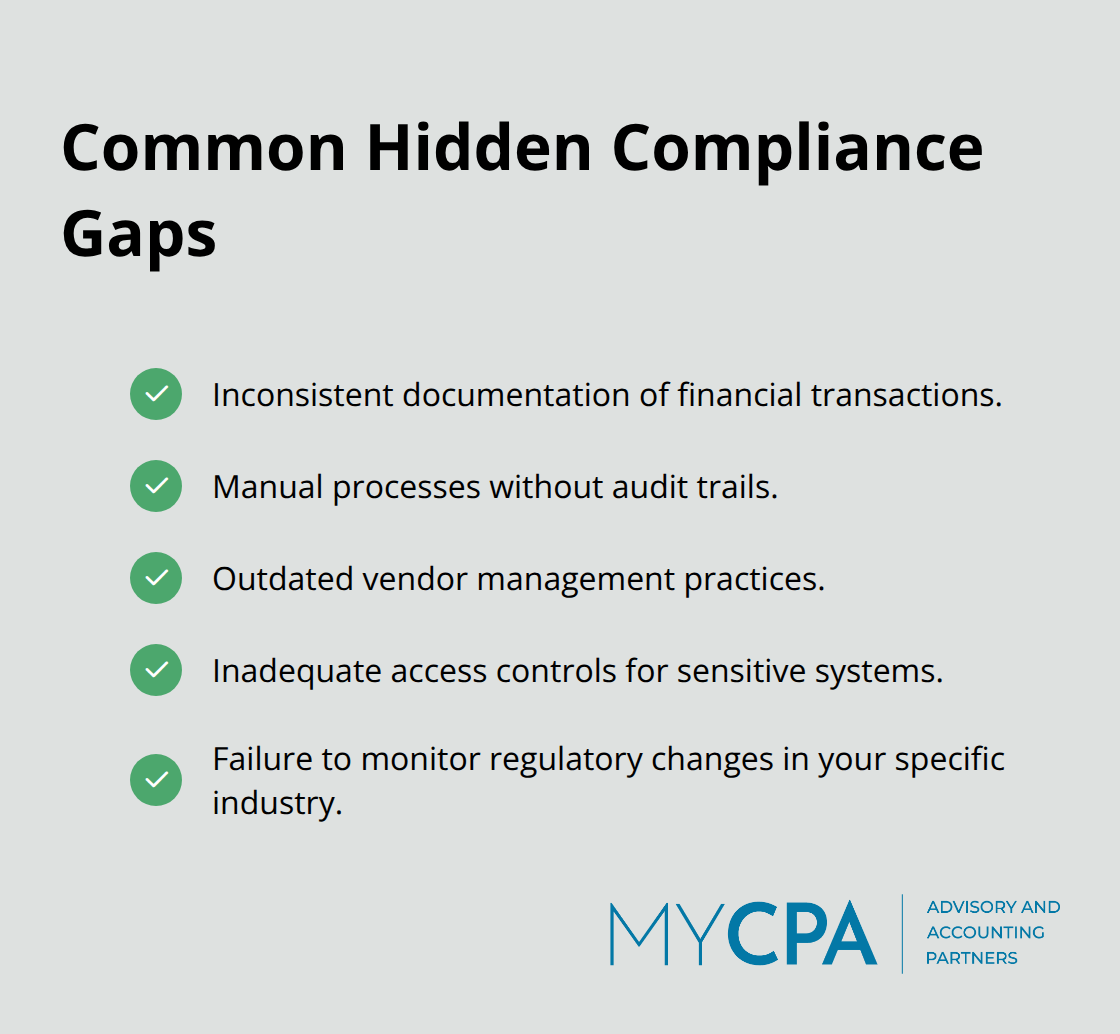
The most dangerous compliance gaps hide in plain sight. Inconsistent documentation of financial transactions, manual processes without audit trails, outdated vendor management practices, inadequate access controls for sensitive systems, and failure to monitor regulatory changes in your specific industry all create serious exposure (and most business owners don’t realize how vulnerable they are until problems surface).
These vulnerabilities require systematic identification and remediation. The next step involves conducting a thorough compliance risk assessment to map your current state against regulatory requirements and identify exactly where your controls fall short.
A compliance risk assessment without structure wastes time and misses critical vulnerabilities. Start with a regulatory inventory specific to your industry, then map your actual controls against those requirements. Document every regulation that applies to your business at federal, state, and local levels. Most companies discover they’re subject to far more requirements than they realized.
A manufacturer selling products across state lines faces EPA regulations, OSHA standards, state labor laws, and potentially FDA requirements if their products contain certain materials. Write these requirements down explicitly rather than relying on general knowledge. Assign ownership to specific departments or individuals so someone remains accountable for monitoring changes in each regulatory area. This prevents the dangerous assumption that compliance is everyone’s responsibility, which typically means nobody owns it.
Document your current controls and processes exactly as they function today, not as you believe they should function. Walk through actual workflows, review system access logs, examine how records are retained, and observe how decisions get made. Many organizations discover significant gaps between documented procedures and what employees actually do.
Compliance Officer Association found that 62% of compliance failures stem from inadequate control implementation rather than unclear requirements. Map each control against the specific regulatory requirement it addresses. If a requirement has no corresponding control, flag it immediately. If a control exists but doesn’t actually address the requirement, that’s worse because you have false confidence in your compliance posture.
Evaluate each control for effectiveness by testing whether it actually prevents, detects, or corrects non-compliance. A policy that exists but isn’t enforced provides zero protection. Controls without monitoring systems, automation, or clear consequences for violations typically fail when pressure increases (and pressure always increases during audits or investigations).
Document weaknesses honestly and prioritize remediation based on regulatory risk and business impact rather than ease of implementation. Quick fixes often create bigger problems later. This assessment reveals not just what’s broken, but what needs fixing first-information that shapes your control strengthening strategy.
Your assessment revealed the gaps. Now you need controls that function in the real world, not just on paper. This means written procedures that employees actually follow, systems that catch problems automatically, and a team trained to recognize compliance issues before they escalate. The difference between companies that experience compliance failures and those that don’t typically comes down to execution, not sophistication. A Fortune 500 company with elaborate compliance infrastructure still fails when controls break down at the operational level. Small to mid-sized businesses succeed when they implement straightforward, monitored controls that fit their actual workflows.
Start with your compliance-critical processes and write down exactly how they work today, then systemize what works and eliminate what doesn’t. Your policies need to reflect reality, not aspirations. If your current procedure for approving vendor payments takes three days but your documentation says one day, rewrite the documentation to match actual practice, then build controls around that timeline.
This approach prevents the dangerous gap between what your team actually does and what your policies claim they do. Regulatory agencies scrutinize this gap intensely during audits. When your documentation matches your operations, you demonstrate a functioning control environment rather than a theoretical one.
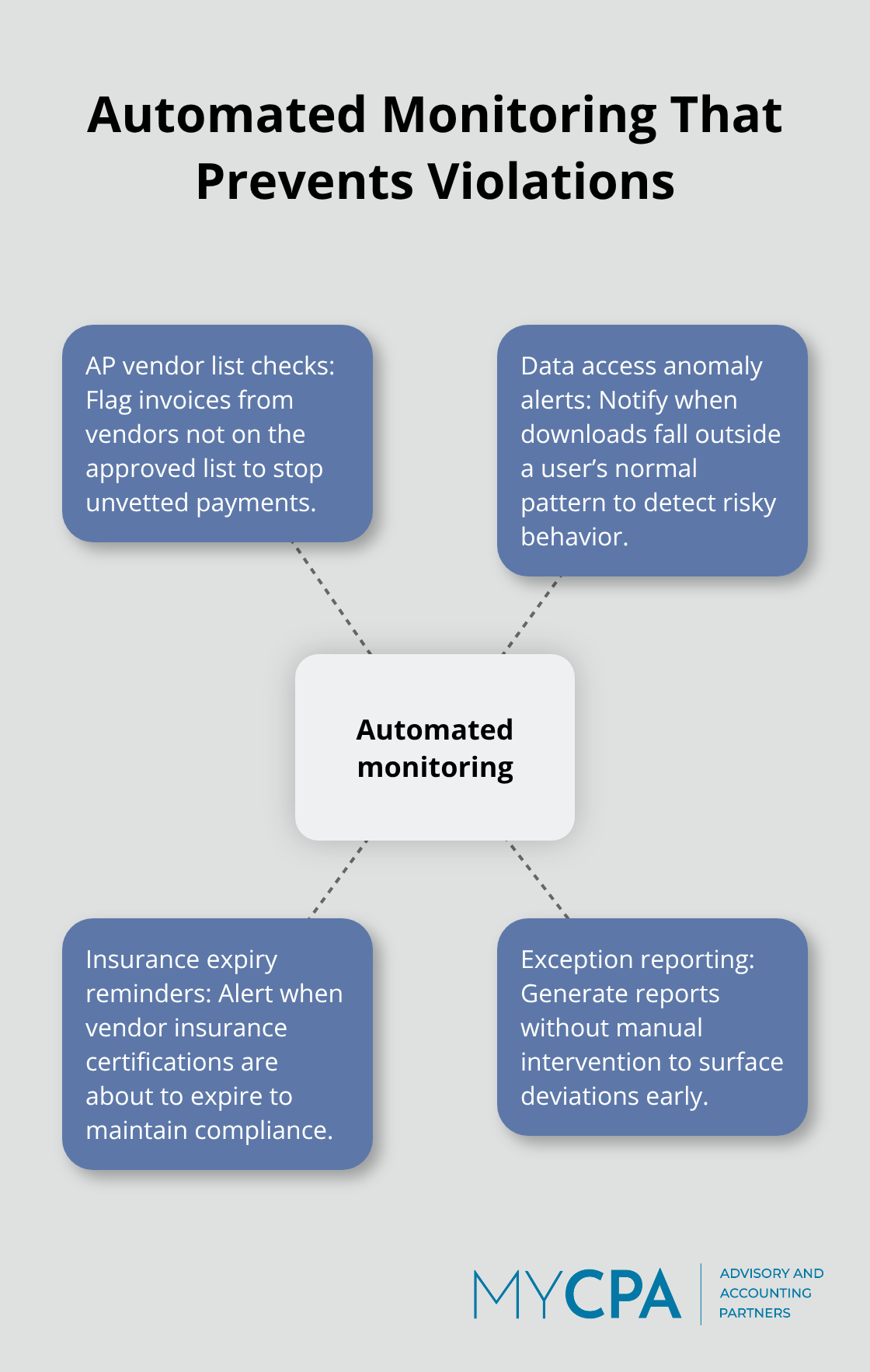
Automated controls should flag deviations before they become violations. Organizations using automated controls detected fraud faster than those relying on manual reviews. This matters because regulatory agencies view detection speed as evidence of a functioning control environment.
Implement monitoring that generates exception reports without requiring manual intervention. Your accounts payable system should automatically flag invoices from vendors not on your approved list. Your data access logs should automatically alert you when someone downloads files outside their normal pattern. Your system should automatically notify you when vendor insurance certifications expire.
These aren’t complex implementations, but they transform compliance from something you hope happens to something you verify happens.
Your team needs specific training tied to their actual responsibilities, not generic annual compliance videos nobody remembers. A payroll administrator needs different training than an IT administrator, who needs different training than a sales manager. Compliance training works best when it addresses real scenarios your business faces. Walk through what happens when a customer requests their data under privacy regulations. Show your team the exact steps they should take. Have them practice the process. Test them later to confirm they retained the information.
Treat compliance training as ongoing education rather than an annual checkbox. Quarterly refreshers on high-risk areas maintain awareness far better than single annual sessions. When regulatory changes affect your business, training should happen immediately, not at your next scheduled session. This approach keeps compliance top-of-mind and prevents the knowledge decay that occurs between annual training cycles.
A compliance risk assessment reveals vulnerabilities that most business owners never see until regulators or auditors expose them. The systematic approach we’ve outlined transforms compliance from a reactive scramble into a managed process. You now understand where your regulatory obligations lie, how to map your current controls against those requirements, and exactly what needs strengthening to close the gaps.
The real work happens after the assessment completes. Documenting procedures that match your actual operations, automating monitoring systems, and training your team on specific responsibilities creates a control environment that functions in practice, not just on paper. This is what separates companies that experience compliance failures from those that don’t-execution matters far more than complexity.
We at My CPA Advisory and Accounting Partners work with business owners to translate compliance requirements into practical controls that fit your actual operations. Our business advisory and consulting services help you develop personalized financial plans that address both compliance obligations and tax efficiency. Contact our team to schedule a review of your current regulatory obligations and identify which areas pose the greatest risk to your business.








Privacy Policy | Terms & Conditions | Powered by Cajabra