
Tax Reduction Strategies for Smart Tax Planning
Discover tax reduction strategies that lower your bill legally. Learn deductions, credits, and planning tactics from our CPA experts.
Most business owners rely on generic financial advice that doesn’t fit their specific situation. This approach leaves money on the table and creates unnecessary tax burden.
At My CPA Advisory and Accounting Partners, we’ve seen firsthand how personalized business guidance transforms financial outcomes. When strategies align with your actual business model and goals, profitability follows.
Generic financial advice treats every business the same way. A tax strategy that works for a service-based consulting firm won’t optimize cash flow for a manufacturing operation with seasonal revenue swings. Business owners often follow standard recommendations only to discover they’re paying thousands more in taxes than necessary or missing critical deductions specific to their industry. The problem intensifies when your business structure, revenue model, and growth stage don’t match the template advice was built around. A sole proprietor scaling to an LLC faces completely different tax implications than someone running an S-corp with multiple employees. Without strategies aligned to your actual situation, you compete with one hand tied behind your back while your competitors with tailored plans pull ahead.
Construction companies, e-commerce businesses, professional services, and retail operations each face distinct financial challenges that generic advice glosses over. A construction firm manages project-based income that requires completely different cash flow planning than a SaaS company with recurring monthly revenue. Real estate investors benefit from depreciation strategies that don’t apply to retail owners. The tax code offers hundreds of deductions and credits, but only a fraction apply to your specific business model. Identifying which ones actually reduce your tax burden requires understanding your exact revenue sources, expense patterns, and growth trajectory. Without this specificity, you either miss opportunities or claim deductions that don’t fit your situation, creating audit risk. Personalized strategies recognize these industry realities and build plans around them rather than forcing your business into a standard framework.
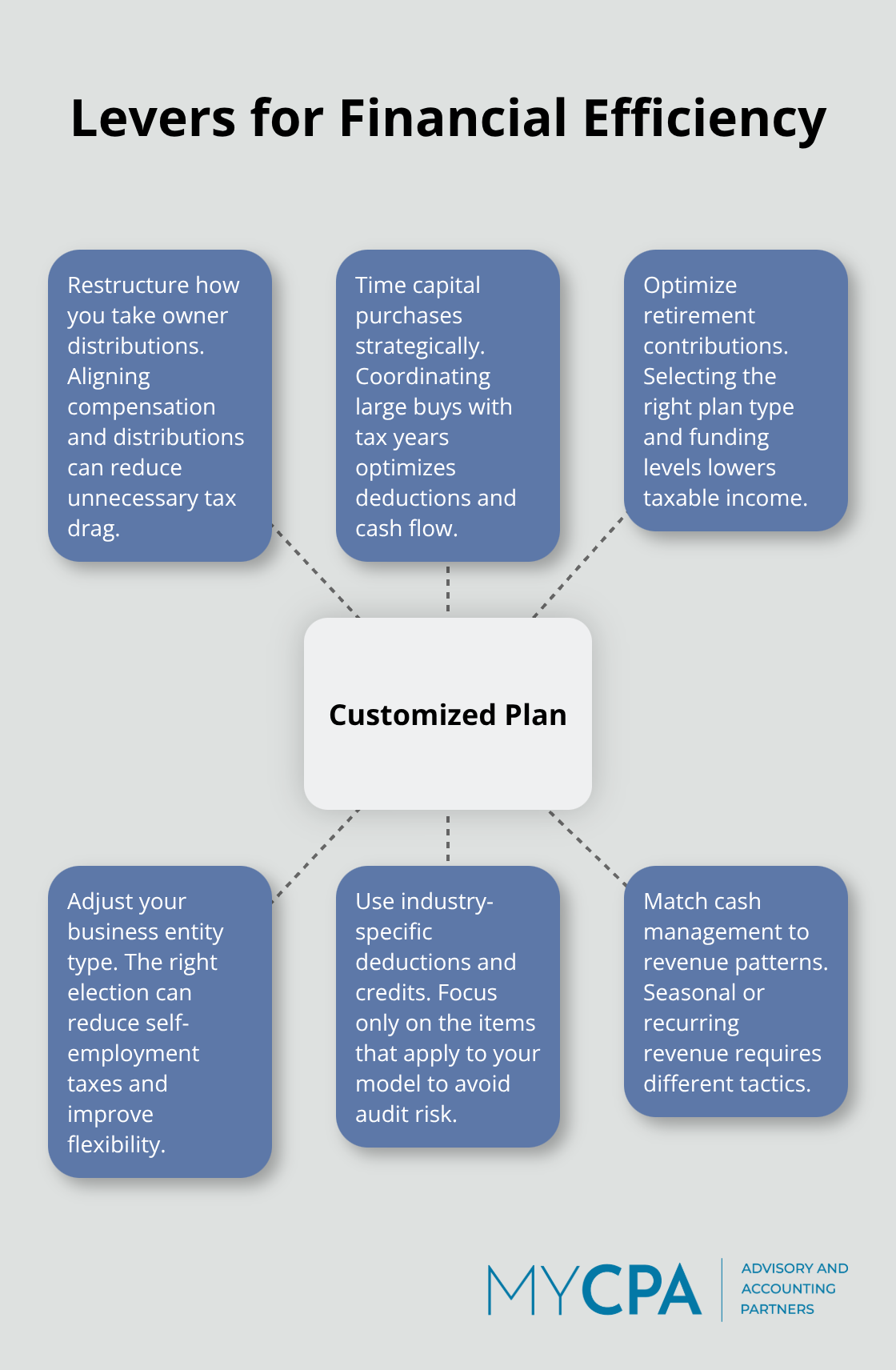
Your competitors aren’t all paying the same effective tax rate or managing cash the same way. Some have optimized their business structure, timing of expenses, and strategic investments to maximize profitability. Others haven’t. The difference between a 25% tax burden and a 35% tax burden on the same revenue represents thousands in annual cash available for reinvestment, payroll, or growth. This gap compounds over years. A customized financial plan identifies inefficiencies in your current setup and implements changes that align with your business model. Whether that means restructuring how you take distributions, timing large purchases strategically, optimizing retirement contributions, or adjusting your business entity type, these decisions flow from understanding your complete financial picture, not applying generic rules.
Most business owners operate without a clear picture of their true financial position relative to their potential. You might know your revenue and basic expenses, but you likely don’t know which specific deductions you’re missing or how your business structure affects your tax liability. A thorough assessment examines your complete financial situation-your income sources, expense patterns, business entity type, and growth goals. This analysis reveals opportunities that generic advice never surfaces. You might discover that a different business structure saves you thousands annually, or that timing your equipment purchases differently creates substantial tax benefits. These insights only emerge when someone understands your actual business, not when they apply a standard template to your situation.
The process of creating a personalized financial strategy starts with understanding where you actually stand, not where you think you stand. A comprehensive assessment goes far beyond last year’s tax return.
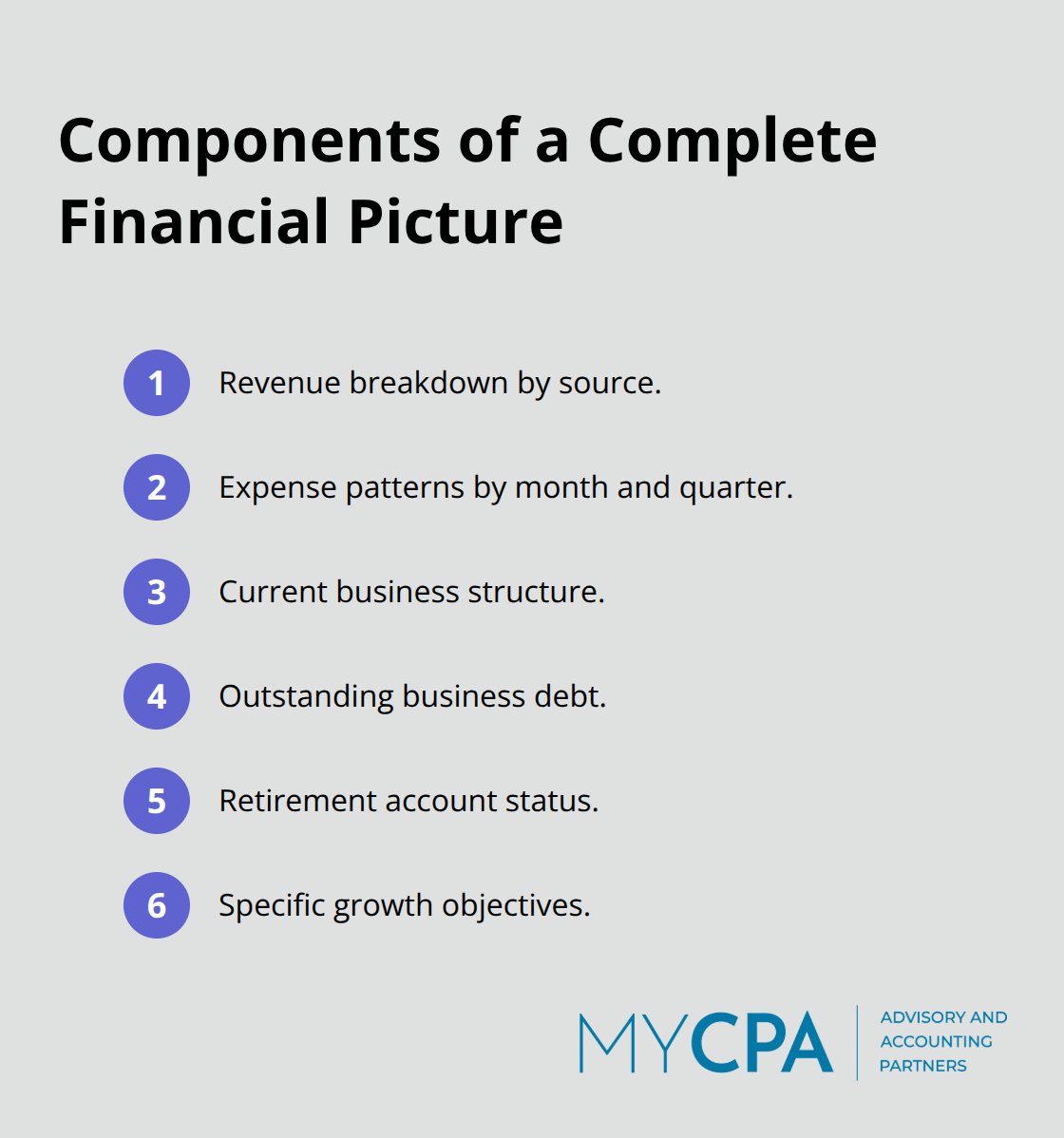
This assessment examines your complete financial picture: revenue breakdown by source, expense patterns across months and quarters, current business structure, outstanding debt, retirement account status, and specific growth objectives.
Many business owners discover during this phase that they’ve categorized expenses incorrectly or missed deductions entirely. A home-based business owner might not realize that legitimate home office expenses, internet costs, and equipment purchases are deductible. A manufacturing business might overlook Section 179 depreciation opportunities that allow immediate deductions for equipment purchases instead of spreading costs over years.
The assessment also identifies structural inefficiencies that drain your profitability. A sole proprietor pays self-employment tax, but an S-corp election can reduce this burden significantly. An LLC owner might be missing tax-saving opportunities available through different classification options. Without this detailed examination, you operate blind to thousands in potential savings.
Your business structure affects everything from tax liability to liability protection to retirement contribution limits. The right structure for your situation isn’t the same as the right structure for your competitor. What works for a service business doesn’t work for a product business. What works for a solo operation doesn’t work for a multi-employee company.
Once we understand your actual situation, we develop strategies specifically built around your business model and goals. A landscaping company with seasonal revenue needs completely different cash management tactics than a consulting firm with predictable monthly income. The strategy for a business owner planning to sell within five years differs dramatically from someone building a multi-generational enterprise.
We identify which deductions apply to your industry, which tax credits you qualify for, and which timing strategies reduce your overall liability. This might mean accelerating certain expenses into the current year, deferring income strategically, optimizing retirement contributions, or restructuring how you take distributions. The IRS allows hundreds of legitimate deductions and credits, but only a fraction apply to your specific situation. A strategy built on generic advice captures maybe 40% of available opportunities. A personalized approach identifies and implements the ones that actually matter for your business.
After implementation, ongoing monitoring keeps your plan working. Tax law changes, your business grows, your personal situation evolves. A financial plan that worked perfectly last year might miss new opportunities this year or fail to account for changed circumstances. Quarterly or semi-annual reviews catch problems before they become expensive mistakes and identify new strategies as your situation shifts.
This continuous adjustment separates a plan that works today from one that works for years. Your financial strategy should evolve with your business, not remain frozen in time. The real value emerges when you have someone actively monitoring your situation and making adjustments rather than simply implementing a one-time plan and hoping it still fits.
A manufacturing company with 12 employees paid an effective tax rate of 34% on $1.8 million in annual revenue. The owner accepted this as normal business cost. When we assessed their complete financial picture, we found three immediate opportunities: their business structure didn’t match their revenue model, they missed over $47,000 in legitimate equipment deductions, and their retirement contribution strategy left tax savings untapped. After restructuring the business entity and implementing strategic timing for capital purchases, their effective tax rate dropped to 19% within the first year.
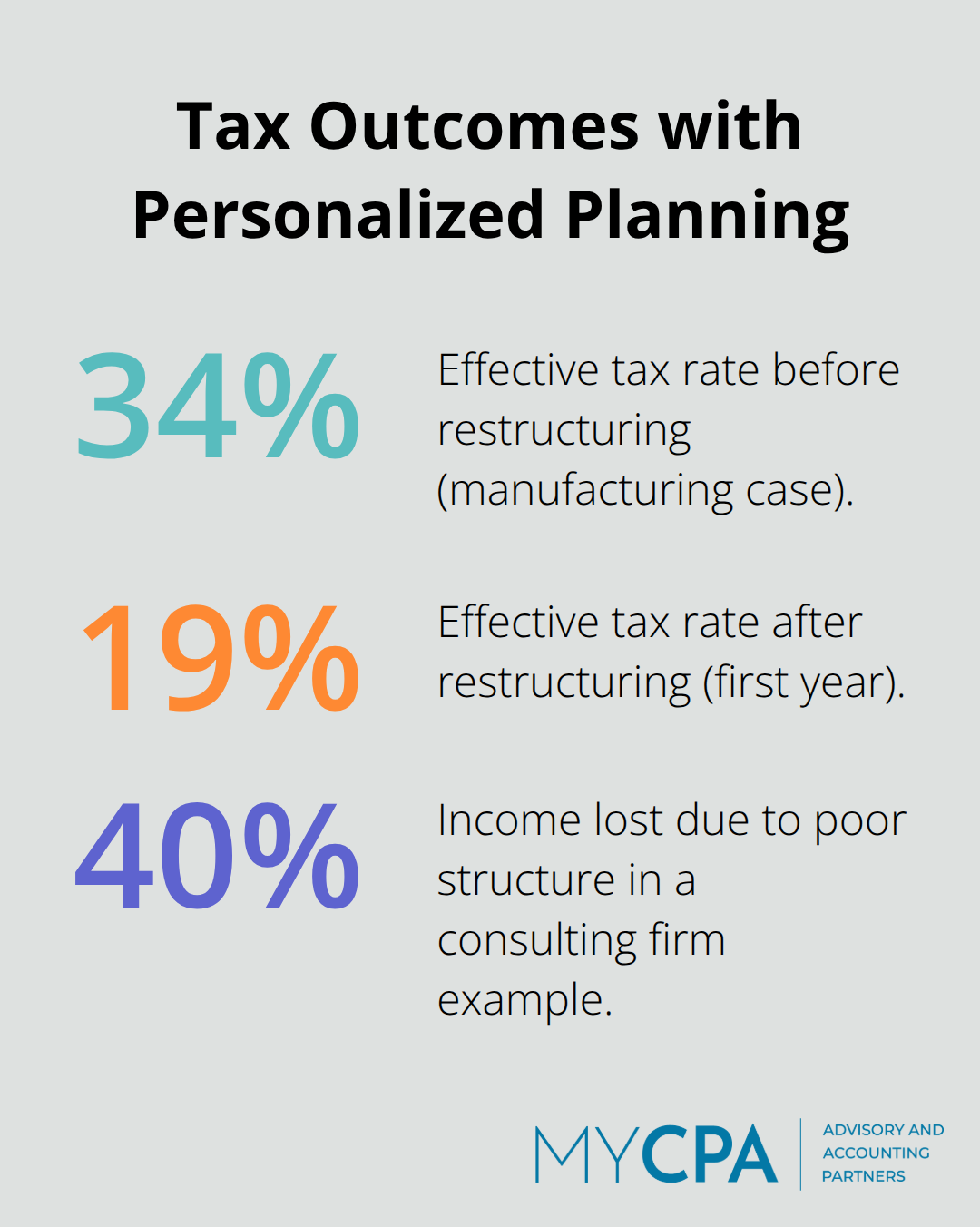
That shift represented nearly $270,000 in cash that stayed in the business instead of going to the IRS. The owner used that money to hire two additional employees and expand service offerings.
Tax savings like this happen repeatedly when someone understands your actual situation instead of applying templates. A service-based consulting firm took home 40% less than they should have because their business structure created unnecessary self-employment tax burden. A retail business owner missed seasonal deductions that could have reduced quarterly tax payments by $8,000 each quarter. An e-commerce seller discovered their inventory accounting method overstated tax liability by thousands annually. A real estate investor hadn’t claimed depreciation benefits on rental properties, missing five years of deductions they could recover through amended returns.
Businesses that operate with customized financial strategies consistently outperform those following standard advice. The difference isn’t luck or industry advantage-it’s the direct result of strategies built around actual business models and goals rather than generic templates. When someone understands your revenue sources, expense patterns, and growth trajectory, they identify which deductions apply to your situation and which tax credits you qualify for. This specificity captures opportunities that standard approaches miss entirely.
The outcomes vary by business type and situation, but the principle remains constant. A consulting firm’s tax strategy differs completely from a manufacturing operation’s approach. A seasonal business needs different cash management than one with predictable monthly income. A solo operation faces different structural decisions than a multi-employee company. Personalized planning recognizes these realities and builds strategies around them.
Proactive planning stops expensive mistakes before they happen. A business owner without financial monitoring throughout the year might discover in April that they owe $80,000 in estimated taxes they didn’t budget for. Someone without a strategic plan might make a major purchase without considering tax implications, missing timing opportunities that could have saved thousands. A company without regular financial reviews might accumulate expense categorization errors that create audit risk or miss new tax credits they qualified for.
The cost of these mistakes-whether emergency borrowing, missed opportunities, or audit complications-far exceeds the investment in proactive guidance. Ongoing monitoring catches problems before they become expensive and identifies new strategies as your situation shifts. Your financial plan should evolve with your business, not remain frozen in time.
Construction companies, e-commerce businesses, professional services, and retail operations each face distinct financial challenges that generic advice overlooks. A construction firm manages project-based income requiring completely different cash flow planning than a SaaS company with recurring monthly revenue. Real estate investors benefit from depreciation strategies that don’t apply to retail owners. The tax code offers hundreds of deductions and credits, but only a fraction apply to your specific business model.
Identifying which strategies actually reduce your tax burden requires understanding your exact revenue sources, expense patterns, and growth trajectory. Without this specificity, you either miss opportunities or claim deductions that don’t fit your situation, creating audit risk. Personalized strategies recognize these industry realities and build plans around them rather than forcing your business into a standard framework.
Most business owners operate without a clear picture of their true financial position relative to their potential. You might know your revenue and basic expenses, but you likely don’t know which specific deductions you’re missing or how your business structure affects your tax liability. A thorough assessment examines your complete financial situation-your income sources, expense patterns, business entity type, and growth goals. This analysis reveals opportunities that generic advice never surfaces.
You might discover that a different business structure saves you thousands annually, or that timing your equipment purchases differently creates substantial tax benefits. These insights only emerge when someone understands your actual business, not when they apply a standard template to your situation. The real value comes from having someone actively monitor your situation and make adjustments rather than simply implementing a one-time plan and hoping it still fits.
Generic financial advice leaves business owners operating in the dark, missing thousands in tax savings and competitive advantages. The businesses that pull ahead operate with personalized business guidance built around their actual situation, not templates that fit nobody perfectly. A manufacturing company restructures their entity and captures $270,000 in annual savings, while a consulting firm eliminates unnecessary self-employment tax burden and a retail business owner discovers seasonal deductions worth thousands each quarter.
The shift from uncertainty to confident financial decisions starts with understanding your complete financial picture. Most business owners know their revenue and basic expenses but miss which deductions apply to their industry, how their business structure affects tax liability, or which timing strategies reduce their overall burden. A thorough assessment reveals these opportunities and identifies structural inefficiencies that drain profitability.
Building long-term financial success requires more than a one-time plan-your business evolves, tax law changes, and your personal situation shifts. We at My CPA Advisory and Accounting Partners specialize in personalized financial services that address your specific situation, combining tax services, accounting, business advisory, and QuickBooks management to build strategies around your complete financial picture.








Privacy Policy | Terms & Conditions | Powered by Cajabra