
Accounting Accuracy Improvements: Techniques That Endure
Boost accounting accuracy improvements with proven techniques that reduce errors, save time, and strengthen financial controls for your business.
The month-end close process is where accuracy either thrives or falls apart. Most finance teams we work with at My CPA Advisory and Accounting Partners struggle with delays, manual errors, and inconsistent data that compound into reporting problems.
This guide covers the real obstacles you face and the practical solutions that actually work.
Data doesn’t arrive when you need it. Finance teams at businesses large and small face a fundamental timing problem: information trickles in throughout the month from sales systems, bank feeds, payroll processors, and accounts payable platforms, but it rarely synchronizes. When you’re closing on the 5th of the month, critical transactions from payment processors, customer invoices, or expense reports may still be in transit. Your team manually chases down missing data instead of having automated feeds pull information continuously. Companies without real-time data integration waste time hunting for missing transactions and reconciling discrepancies that shouldn’t exist in the first place.
Manual reconciliation introduces errors that multiply throughout your close. When your reconciliation process relies on spreadsheets, VLOOKUP formulas, and human comparison between bank statements and your general ledger, mistakes become inevitable. Those errors cascade: a mismatched payment creates an out-of-balance account, triggering additional investigation time and delayed reporting. Many teams only discover these errors during the audit trail review, forcing rework late in the close cycle. AI-enabled reconciliation tools can match transactions and perform continuous reconciliation, resulting in faster reconciliations and fewer surprises at close.
Account coding inconsistencies compound the problem further. When different team members code the same type of transaction differently, your financial statements become unreliable. One person codes office supplies as office expenses while another codes identical purchases as supplies inventory. This classification drift makes budget variance analysis meaningless and obscures your actual spending patterns. Without standardized coding rules enforced at the point of entry, you end up with a general ledger that looks balanced but tells an inaccurate story about where money actually went. These three obstacles-delayed data, manual errors, and inconsistent coding-create the foundation for the best practices that actually fix your close process.
The gap between identifying problems and fixing them is where most teams lose time. You know manual reconciliation causes errors. You know inconsistent coding distorts your reports. But knowing the problem and having a system that prevents it are completely different things. The solution starts with automation that works continuously, not just at month-end. Real-time reconciliation across your bank feeds, payment processors, and general ledger means discrepancies surface immediately instead of piling up for discovery on the 4th of the month.
AI-powered transaction matching handles the scenarios spreadsheets cannot: partial payments, refunds, chargebacks, and complex one-to-many or many-to-many scenarios that would take your team hours to untangle manually. One fintech company shortened their month-end close by five to six days simply by moving from manual reconciliation to continuous automation. The payoff extends beyond speed. Automated journal entry posting with role-based approvals reduces data entry errors and creates an audit trail that satisfies compliance requirements without manual documentation chasing. Your team stops hunting for supporting files and starts closing with confidence.
The second layer is structure: a detailed closing checklist with assigned owners, sequential task ordering, and explicit due dates. This sounds basic, but most teams operate with informal processes that shift based on who’s available. A structured checklist clarifies who reconciles bank accounts, who reviews accounts receivable aging, who posts adjusting entries, and when each task must complete.
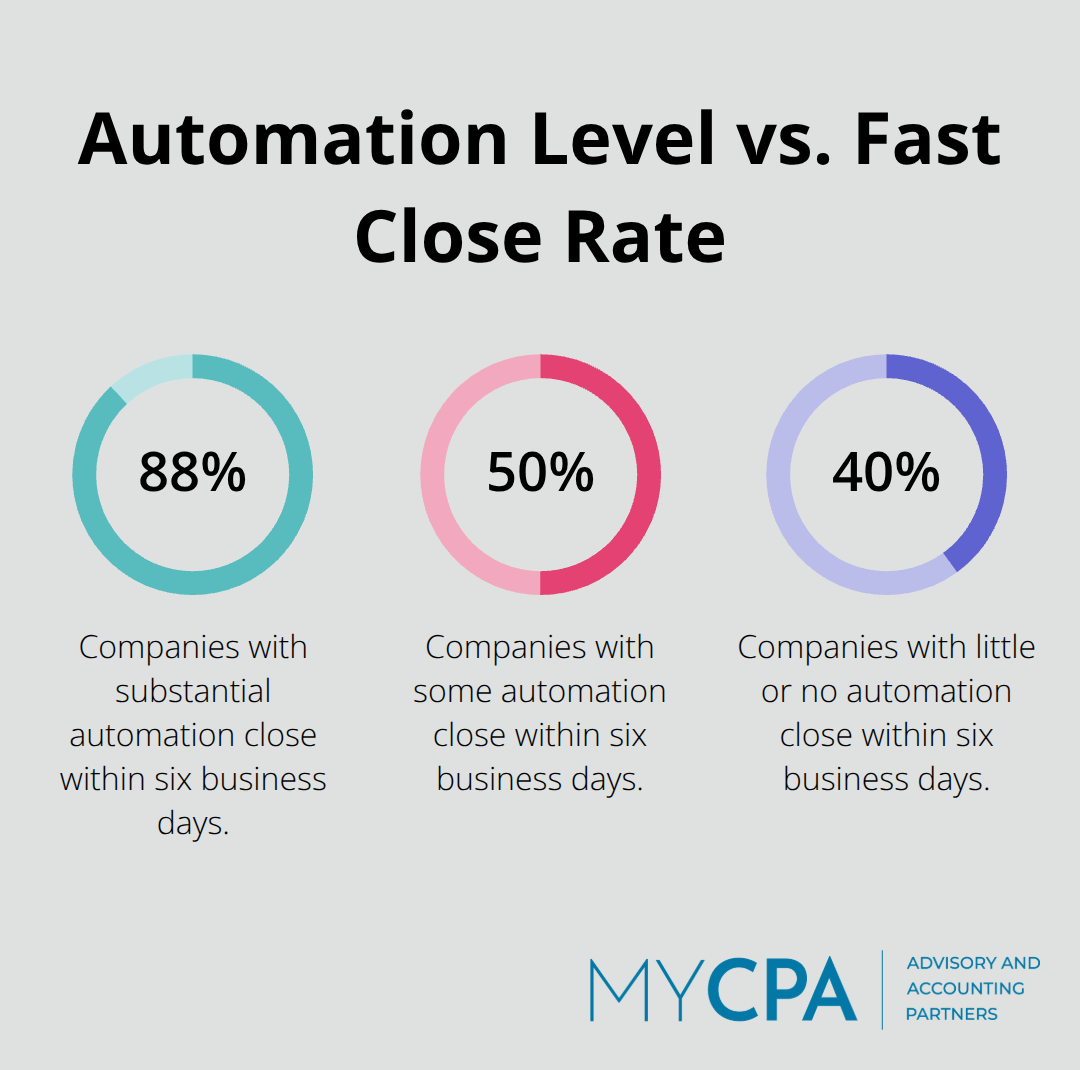
Ventana Research found that 88 percent of companies with substantial automation close within six business days, compared to 50 percent with some automation and 40 percent with little or no automation. That gap widens further when you add clear accountability.
Centralize all supporting documents in a single repository with standardized naming conventions, not scattered across email and shared drives. Real-time progress visibility through project management or financial close software keeps managers informed and prevents bottlenecks from becoming surprises. Finally, implement a hard close that locks final numbers and prevents backdating transactions after the close period ends. This enforcement of discipline prevents the slow erosion of data integrity that happens when transactions continue trickling in days after you thought the close was complete.
With automation handling continuous reconciliation and structure providing clear accountability, your close transforms from a chaotic scramble into a predictable workflow. The next step involves selecting the right tools and systems that support this integrated approach-systems that connect your bank feeds, accounting software, and reporting dashboards so information flows seamlessly rather than requiring manual transfers between platforms.
Your accounting software forms the backbone of an efficient close, but only if it connects to your actual data sources. Cloud-based platforms like QuickBooks Online integrate bank feeds directly, which eliminates manual transaction entry and reduces reconciliation time significantly. The automation happens at the source: transactions import automatically, and your team reviews and reconciles rather than hunting through statements. However, QuickBooks Online alone won’t solve your close if your payment processors, payroll system, and expense management platform operate in isolation. The real efficiency gain comes from integrating these systems so data flows in one direction without manual re-entry.
When your bank feeds sync with your general ledger continuously rather than at month-end, you catch discrepancies immediately instead of discovering them during final review. This integration also captures transaction details automatically: processing fees, refunds, chargebacks, and discounts that teams typically miss or manually adjust later. Your team no longer waits until the close period to identify problems that should have surfaced weeks earlier. Continuous synchronization means your general ledger reflects current reality throughout the month, not just on the day you officially close.
Real-time dashboards built into modern accounting platforms show your close progress against your timeline, flagging accounts that aren’t reconciled and highlighting which tasks are overdue. This visibility prevents the last-minute scramble where managers realize on the 4th that critical reconciliations are incomplete. Dashboards also display key metrics like accounts receivable aging in 0-30, 31-60, 61-90, and over 90-day buckets, giving you immediate insight into collection risk and cash flow impact without generating separate reports. Your team accesses this information instantly rather than waiting for someone to compile it manually.
Workflow automation systems layer on top of your accounting software to manage the sequencing and approvals that structure demands. These platforms assign tasks to specific team members, track completion status, and enforce the order of operations so one person doesn’t start a reconciliation before another has finished posting entries. Automated journal entry posting with role-based approvals means entries post directly to your general ledger with an audit trail intact, which eliminates the manual copy-paste work that introduces errors. Your team also stops searching for supporting documents scattered across email and drives because a centralized repository stores everything with standardized naming conventions.
When an auditor asks for the documentation behind a specific adjustment, you retrieve it in seconds rather than spending hours reconstructing files. This infrastructure transforms your close from a reactive scramble into a proactive, predictable process where technology handles data movement and your team focuses on review and analysis. The companies closing fastest aren’t the ones working harder-they’re the ones whose systems work continuously instead of waiting for month-end to activate.
Your month-end close process either supports confident decision-making or creates friction that delays reporting and obscures your financial reality. Automation that runs continuously throughout the month eliminates the scramble of hunting missing transactions on the 4th, structured checklists with assigned owners prevent bottlenecks and confusion, and real-time dashboards catch discrepancies immediately instead of during final review. Companies implementing these practices close faster and with greater accuracy than those relying on spreadsheets and informal processes.
The financial impact extends beyond speed. Accurate reporting directly influences your cash flow planning, budget variance analysis, and the decisions you make about resource allocation. When your accounts receivable aging is current and your general ledger reflects reality, you make better decisions about collections, spending, and growth investments, and when your close is predictable and auditable, external reviews move faster and internal controls strengthen.
Moving forward means evaluating where your current process breaks down and addressing the highest-impact problems first. If data delays are your bottleneck, integrate your bank feeds and payment processors with your accounting software; if manual errors plague your reconciliation, implement AI-powered transaction matching; if unclear responsibilities cause duplication and omissions, build a detailed closing checklist with assigned owners and due dates. We at My CPA Advisory and Accounting Partners work with business owners who want their financial operations to run smoothly and their reporting to be accurate, and whether you need help designing a month-end close process, selecting the right accounting software, or building the structure and automation that transforms your close from chaotic to predictable, we’re here to guide you.






Privacy Policy | Terms & Conditions | Powered by Cajabra