
Accounting Accuracy Improvements: Techniques That Endure
Boost accounting accuracy improvements with proven techniques that reduce errors, save time, and strengthen financial controls for your business.
A sloppy month-end close costs you time, money, and accuracy. We at My CPA Advisory and Accounting Partners have seen too many businesses waste hours chasing down missing transactions and reconciliation errors that could have been prevented.
A solid monthly close checklist eliminates guesswork and keeps your finances on track. This guide walks you through the exact steps you need to tighten your process and close your books with confidence.
Bank and credit card reconciliations are where your close begins, not where it ends. Too many teams treat these as afterthoughts, but they’re your foundation. When you reconcile first, you catch timing issues, duplicate transactions, and missing entries before they cascade into larger problems. According to Ledge, 50% of month-end closes stretch beyond six days, even though teams target three days. A major reason is that teams skip or rush early reconciliations, forcing them to backtrack later.

Start by exporting your bank and credit card statements the moment the month closes. Match every transaction in your general ledger against the statement line-by-line. Flag anything that doesn’t match immediately-don’t wait. Look for transactions that posted in the wrong month, duplicate charges, or fees you didn’t anticipate.
If your bank integrates directly with your accounting software, use that connection to pull transactions automatically. Automation eliminates manual entry errors and cuts reconciliation time significantly. Once you’ve matched transactions, investigate outstanding items. Outstanding checks and pending deposits are normal, but anything older than a few days warrants attention. If a check from last month still hasn’t cleared, contact the vendor or recipient. If a deposit hasn’t posted, verify it was actually sent. This step prevents surprises during your final close review.
After bank accounts are locked in, move to your general ledger. Pull a trial balance and review every account balance for reasonableness. Does your utilities account look too high or too low compared to last month? Is there an unusual balance in a suspense account? These anomalies often reveal data entry mistakes or misclassified transactions.
Reconcile your accounts payable and accounts receivable subledgers to the general ledger totals. Many teams skip this, but mismatches here corrupt your entire close. If your AP subledger shows $50,000 in payables but your GL shows $48,000, that $2,000 gap must be explained and corrected before you move forward. APQC benchmarking shows median closes take 6.4 days, and much of that delay stems from teams discovering reconciliation gaps late in the process. Catch them now.
Review any intercompany transactions if your business has multiple entities. These often get posted incorrectly or forgotten entirely. Verify that money moving between entities is recorded symmetrically on both sides. If one entity records a payment but the other doesn’t record receipt, your consolidated numbers will be wrong.
When you find a discrepancy, investigate the root cause immediately rather than posting a blanket journal entry to hide it. A missing invoice, a transposed number, or an entry posted to the wrong cost center should be corrected at the source. This takes discipline but prevents the same error from repeating next month. If you can’t resolve a discrepancy within 30 minutes, document it clearly with the date, amount, account, and what you’ve checked so far. Assign it to a specific person with a deadline. Don’t let unresolved items linger-they compound complexity as the close progresses.
Use a centralized checklist to track which reconciliations are complete and which are pending. A shared spreadsheet or close management tool keeps everyone aligned and prevents duplicate work. Assign clear ownership for each reconciliation so no one assumes someone else handled it. When a reconciliation is complete, have a second person review it before marking it done. This separation of duties catches errors and strengthens your audit trail.
If you’re relying heavily on manual processes and spreadsheets, reconciliations will take longer and errors will multiply. Automation tools can match transactions across systems and flag discrepancies in seconds rather than hours. The investment pays for itself through faster closes and fewer post-close adjustments. With your data locked down and reconciliations complete, you’re ready to move into expense verification and accruals-the next critical phase where you capture costs that haven’t yet hit your books.
Your reconciliations are locked down, but your books aren’t complete until you capture every cost incurred during the month, whether or not an invoice has arrived. This is where most teams stumble. Expenses that haven’t been billed yet sit in limbo, and teams either forget them entirely or post them months late, distorting the month they belong to. The result is a profit figure that doesn’t reflect reality. You need to hunt down these costs aggressively and accrue them before you close.
Start by pulling a list of all invoices received and posted during the month, then cross-reference it against your purchase orders and service agreements. Any PO that you fulfilled but lack a matching invoice needs an accrual. If you hired a contractor on the 28th of the month for work completed, but their invoice won’t arrive until next month, you still owe that cost and it belongs in this month’s books. Pull timesheets, delivery confirmations, and project completion documents to support the accrual amount. Don’t guess at the figure-use actual supporting documentation.
Match every invoice posted to your books against a corresponding purchase order, receipt, or service completion record. This isn’t just about accuracy; it’s about preventing fraudulent or duplicate payments. Before you mark an invoice as processed, verify that goods actually arrived or services actually got delivered. If you work with multiple departments, this step requires coordination. Send a reminder to operations, procurement, and project managers asking them to confirm receipt of any outstanding deliverables by a specific cutoff date. Use a centralized tracker so you can see which invoices still wait for confirmation and which are ready to post. Flag unmatched invoices and investigate them before month-end, not after.
Accrued expenses are costs incurred in one accounting period but not paid until a future period. Recurring expenses deserve special attention because they’re easy to overlook when they’re routine. Electric bills, software subscriptions, insurance premiums, and retainer fees should all get verified for accuracy and completeness.

Compare this month’s amounts against the previous three months. If your utilities bill jumped 40% without explanation, investigate before posting. A data entry error or a billing mistake from your vendor could be hiding in that variance. For subscriptions and retainers, confirm the vendor hasn’t increased the rate without your knowledge. Many teams waste thousands annually by paying inflated recurring costs they never questioned.
Set a specific date-typically three to five days after month-end-and stop accepting new transactions for the prior month. This cutoff prevents last-minute entries that scramble your close and create audit headaches. Communicate this date clearly to all departments at least two weeks before month-end. Once the cutoff passes, any legitimate expenses from the prior month must go through a formal adjustment process, not slip into the regular posting queue. This discipline forces teams to plan ahead and reduces the chaos of a prolonged close window. Document your cutoff policy in writing so there’s no ambiguity when someone inevitably asks for an exception on day seven.
With your expenses captured and accruals locked in, you’ve completed the groundwork for accurate financial statements. The next phase-finalizing those statements and supporting documentation-transforms your detailed work into the reports that drive business decisions and satisfy auditors.
Your reconciliations and accruals are complete, but you cannot close the period until you generate a trial balance, review it for errors, post all final adjustments, and produce the financial statements your business depends on. This phase separates teams that close in three days from those that drag on for two weeks. The difference isn’t effort-it’s precision and process discipline.
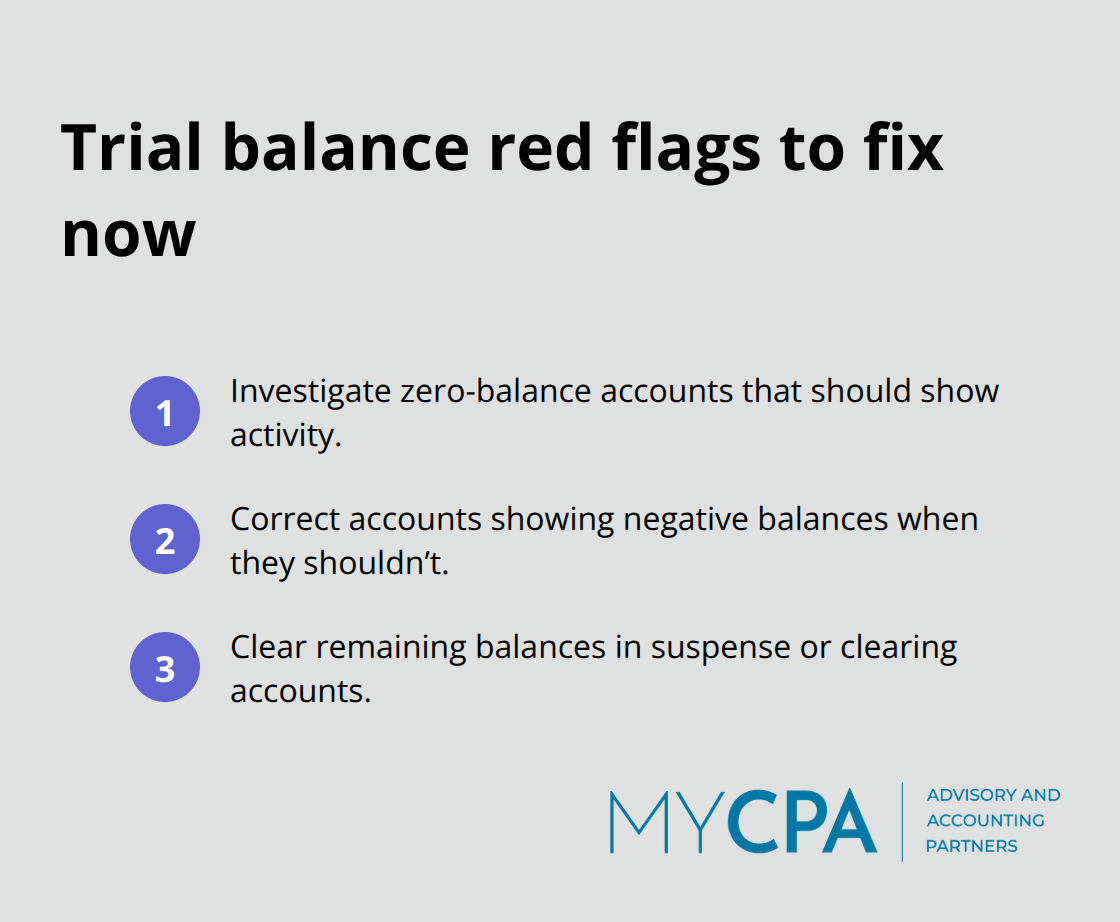
Pull your trial balance the moment your cutoff date passes. Export it into a clean spreadsheet and sort accounts by category: assets, liabilities, equity, revenue, and expenses. Look for accounts with zero balances that should have activity, accounts with negative balances that shouldn’t be negative, and any suspense or clearing accounts that still hold balances. These red flags indicate missing entries or posting errors.
Cross-reference your trial balance reconciliation against your bank account balance, accounts receivable aging report, and accounts payable aging report. If your trial balance shows $500,000 in receivables but your AR aging shows $520,000, that $20,000 gap needs investigation and correction before you generate financial statements. Don’t assume the difference will resolve itself-it won’t. Find them now.
Review all journal entries posted during the close period with ruthless scrutiny. Every adjustment must have supporting documentation attached-timesheets for accrued labor, invoices for accrued expenses, bank statements for reconciling items, depreciation schedules for fixed assets. If a journal entry lacks documentation, question it. Who posted it, when, and why? If you cannot answer those questions immediately, reverse the entry and have the preparer resubmit it with full supporting materials.
Implement a journal entry documentation and approval process for all close-period entries. This separation of duties isn’t bureaucracy-it’s the difference between a close you can defend in an audit and one that raises red flags. Once all entries receive approval and documentation, your trial balance should balance perfectly. If it doesn’t, stop everything and find the error. A trial balance that doesn’t balance means you have a posting error, reversed sign, or missing entry somewhere. Do not proceed to financial statements until this is resolved.
Generate your income statement, balance sheet, and cash flow statement only after your trial balance is locked and approved. Review each statement for reasonableness. Does your gross margin look consistent with prior months? Are operating expenses in line with expectations? Has your cash position changed dramatically without explanation?
Compare current-month balances against the prior three months and year-to-date figures. Unusual variances warrant investigation. If your rent expense doubled suddenly, that’s a posting error or a lease change that needs documenting. If your inventory balance increased 50% without corresponding sales growth, physical counts may be needed to verify the GL balance. Once you’ve reviewed the statements and resolved any concerns, archive all supporting documentation in a centralized location with clear file naming and date stamps. Auditors will ask for these materials, and organized documentation proves you followed a controlled process.
Incomplete or missing documentation signals sloppy work and creates compliance risk. If your business operates multiple entities or locations, produce separate financial statements for each before consolidating. This approach catches entity-specific issues early and gives you visibility into performance by unit. Consolidation becomes a mechanical step at the end, not a scramble to figure out why numbers don’t tie.
A disciplined monthly close checklist transforms what feels like chaos into a predictable, repeatable process. You’ve now walked through the exact steps: reconciling your bank accounts and general ledger, capturing every expense and accrual, and finalizing your financial statements with full documentation and approval. Each step builds on the previous one, and skipping any of them creates downstream problems that multiply as the close progresses.
Teams that follow this process close their books in three to five days instead of six or more. They catch errors before they corrupt the financial statements and build audit trails that satisfy external reviewers without scrambling for missing documentation. Most importantly, they produce financial statements they actually trust, which means better decisions about cash flow, spending, and growth.
Start by documenting your current close process exactly as it happens today, even if it’s messy, then assign clear ownership for each task and set realistic deadlines. Use a centralized tracker so everyone sees what’s complete and what’s pending. If you’re drowning in spreadsheets and manual reconciliations, explore automation tools that integrate with your accounting software-the investment pays for itself through faster closes and fewer errors. We at My CPA Advisory and Accounting Partners help business owners and individuals build financial processes that actually work, and our team brings the expertise to tighten your process and give you confidence in your numbers. Contact us today to learn how we can support your financial management.







Privacy Policy | Terms & Conditions | Powered by Cajabra