
Financial Reporting Accuracy: How Precise Data Powers Confident Decisions
Improve financial reporting accuracy with precise data practices for confident decisions and stronger compliance.
A single accounting error can cost your business thousands in penalties, missed opportunities, and damaged credibility. Yet many business owners operate with financial data they don’t fully trust.
At My CPA Advisory and Accounting Partners, we’ve seen firsthand how financial reporting accuracy transforms decision-making. When your numbers are precise, you gain real visibility into what’s actually happening in your business.
Inaccurate financial reporting doesn’t just create a minor headache-it cascades into costly operational failures that directly impact your bottom line. When your accounting systems contain errors, you make business decisions based on incomplete information. A company that thinks it’s profitable might actually be bleeding cash, while another that appears to be struggling could be performing well. This mismatch between perceived and actual performance leads to terrible strategic choices.
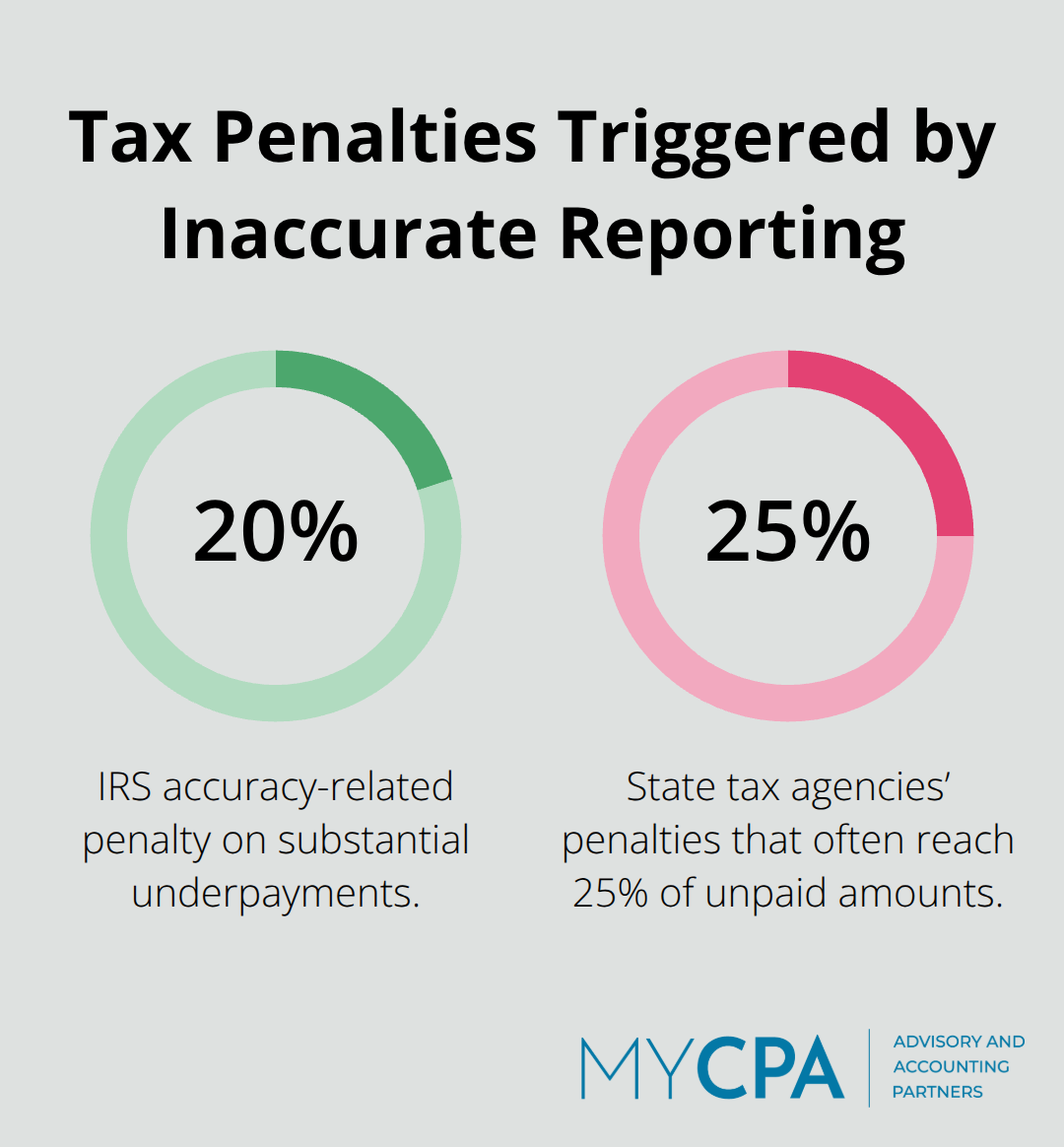
Regulatory bodies don’t tolerate sloppy financial reporting. The IRS imposes accuracy-related penalties of 20% of underpaid taxes when errors are substantial, and these penalties apply regardless of intent. State tax agencies add their own penalties on top, often reaching 25% of unpaid amounts. A manufacturing business with $500,000 in unreported income faces potential penalties exceeding $100,000 before interest accrues.
Beyond tax penalties, companies that misstate financial information to lenders or investors face civil fraud charges and potential criminal liability. Financial institutions conducting audits identify discrepancies, and the cost of remediation spirals quickly. Auditors charge premium rates for investigating and correcting errors, sometimes doubling or tripling audit fees.
When cash flow projections are wrong, you either miss growth opportunities or overextend yourself into insolvency. A retail business that misunderstands its accounts receivable aging might extend credit to customers who never pay, inflating apparent profitability while destroying actual liquidity.
Without accurate and up-to-date financial records, pricing decisions become guesses rather than calculations, eroding margins silently. Strategic decisions about hiring, expansion, or debt financing rest on these numbers. Companies that operate with inaccurate financial data tend to discover problems only when they’re acute-when cash runs dry, when audit findings surface, or when investors demand accountability.
The cost of fixing these situations is exponentially higher than preventing them through accurate systems from the start. Errors compound over time, creating larger gaps between your reported position and your actual financial health. The longer inaccurate data persists, the more difficult the correction becomes (and the more expensive the audit adjustments). This reality makes the next step clear: you need practical systems and processes that catch errors before they damage your business.
Precise financial data removes uncertainty from decision-making. When your accounting systems capture transactions correctly and your reconciliations catch errors before they spread, you gain a clear picture of where your business actually stands. This clarity shifts your approach from reactive firefighting to strategic planning. Cash flow visibility becomes your competitive advantage. A company that knows its exact cash position 30 days forward can negotiate better vendor terms, time hiring decisions, and capitalize on unexpected opportunities. Without this visibility, you operate without direction.
Real-time dashboards showing accounts receivable aging, expense breakdowns by category, and monthly profitability trends transform how leadership operates. Instead of waiting for monthly close processes to understand performance, you see what’s happening daily. This speed matters enormously when market conditions shift or customer payment patterns change unexpectedly. Your team responds to actual conditions rather than outdated reports.
Identifying genuine trends requires accurate data spanning months and quarters. When your historical records contain errors, pattern recognition becomes impossible. A business owner analyzing three years of sales data discovers that seasonal dips occur consistently in Q2, not Q3 as previously assumed, allowing inventory and staffing adjustments that save 12-15% in carrying costs. Another finds that their most profitable customer segment is actually their smallest by revenue, prompting a strategic shift toward that market. These insights only emerge when data integrity is beyond question.
Lenders and investors scrutinize your financial statements before committing capital. Banks review cash flow statements to assess your ability to service debt, while investors examine profitability trends and balance sheet strength. Accounting accuracy strengthens trust, compliance, and growth. A business presenting clean, auditable financials gains immediate credibility and negotiating leverage. When you establish accounting foundations that withstand investor and lender scrutiny, you accelerate capital access when your business needs it most.
The foundation for these advantages rests on systems and processes that prevent errors from taking root in the first place.
Automation serves as your first line of defense against financial reporting errors, and the data proves its value. Companies that implement automated bookkeeping systems reduce data entry errors compared to manual processes. This matters because manual entry remains the primary source of accounting mistakes in most businesses. When your team manually enters transactions into spreadsheets or accounting software, fatigue and distraction create typos that cascade into incorrect account balances. Automated systems eliminate this vulnerability entirely.
Cloud-based accounting platforms like QuickBooks and Xero connect directly to your bank accounts and payment processors, pulling transaction data automatically without human intervention. This direct integration means your general ledger updates in real-time, and reconciliation becomes a verification process rather than a detective hunt through months of transactions. Set up bank feeds immediately if you haven’t already, and ensure every revenue stream and expense account feeds automatically into your accounting system. The setup takes a few hours but prevents thousands in future corrections.
Your chart of accounts functions as the skeleton of your entire financial reporting structure, and sloppiness here corrupts everything downstream. Create an account list that mirrors your business operations with enough detail to answer real questions but not so much granularity that you create duplicate accounts. A service business might separate labor costs from subcontractor costs, while a retail operation needs separate accounts for different product categories to track profitability accurately.
Document exactly how each transaction type gets classified, then enforce these standards relentlessly. When your bookkeeper encounters an unfamiliar transaction, they should have a written procedure to follow, not guesswork. This documentation prevents inconsistency and ensures that multiple team members classify similar transactions identically.
Schedule monthly reconciliations where you compare your accounting records against bank statements and credit card statements line-by-line, investigating any discrepancies immediately rather than letting them accumulate. This monthly discipline catches errors when they’re fresh and fixable. Quarterly financial reviews go deeper, examining trends in key accounts and investigating unusual activity.
A sudden spike in office supplies expense or an unexpected drop in revenue deserves investigation while the details remain accessible. This rhythm of monthly reconciliation and quarterly analysis creates multiple checkpoints where errors surface before they damage your decision-making or trigger audit adjustments. The consistency matters more than the complexity-a simple monthly process executed faithfully outperforms an elaborate quarterly review that never happens.
Financial reporting accuracy separates businesses that grow with confidence from those that operate in uncertainty. When your numbers reflect reality, you make decisions grounded in facts rather than assumptions, you negotiate from strength with lenders and investors, and you spot opportunities before your competitors do. The systems we’ve outlined-automated data entry, standardized chart of accounts, and monthly reconciliations-work because they eliminate the human error that corrupts most financial data.
Many business owners understand that accurate financials matter but struggle to build these systems alone. The technical complexity of modern accounting, combined with the demands of running your business, makes it easy to let financial reporting slide into inconsistency. We at My CPA Advisory and Accounting Partners work with business owners to construct accounting foundations that support growth without creating administrative burden, handling the technical work while you focus on what you do best.
Taking control of your financial data starts with one decision: treat financial reporting accuracy as a competitive advantage rather than a compliance obligation. Contact us to discuss how we can build or strengthen your accounting systems and give you the financial clarity your business deserves.








Privacy Policy | Terms & Conditions | Powered by Cajabra